

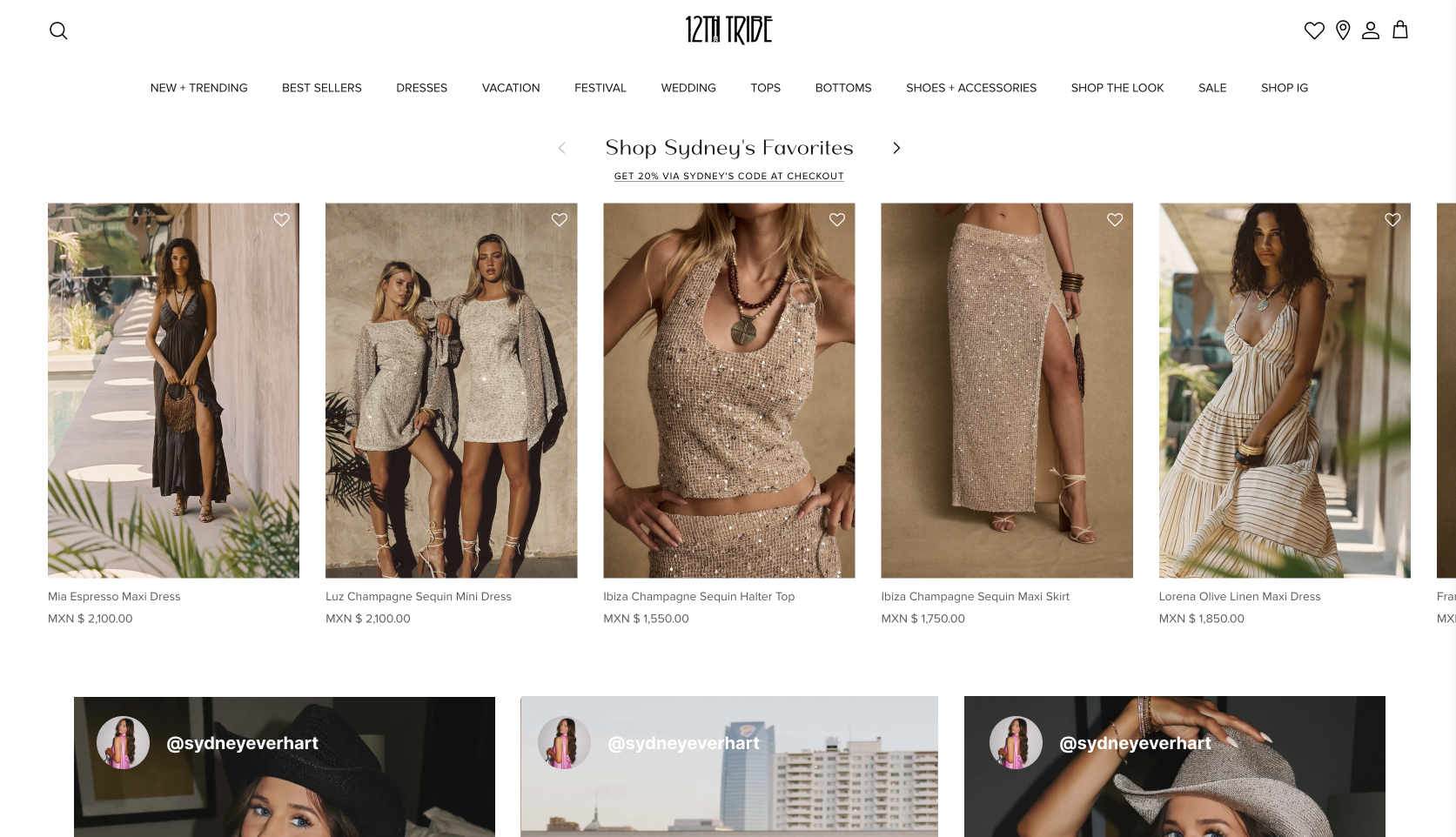


The Playbook for 12th Tribe (GRIN) — co-branded shopping that turns 'GRWM' into revenue
12th Tribe already has the ingredients that make creator commerce work: a strong visual point of view (Cali-boho, festival, vacation), a large catalog (2,000+ products), and an audience that shops based on inspiration, not spreadsheets. The problem most fashion affiliate programs run into is not a lack of traffic. It's that the traffic lands on a generic experience that breaks the story. A creator posts an outfit, but the shopper lands on a standard page, searches around, loses the exact pieces, and bounces.
CreatorCommerce is designed to keep the story intact. Instead of 'link in bio' going to a single product or a bland collection, each partner could send shoppers to a co-branded storefront that looks like 12th Tribe, but feels like the creator. This tends to raise conversion rates by 30%+ and AOV by 67%+ compared to regular affiliate links, because the funnel does more of the work: it shows the full look, clarifies what to buy, applies the discount automatically, and adds trust through the creator's name, image, and content.
Below is a practical plan you could run with your GRIN program. It's written as a sequence you could execute with a small team, then scale to hundreds or thousands of partners.
Step 0: Segment strategy (pick the partner types that match how women shop 12th Tribe)
Because 12th Tribe is a fashion brand with a huge assortment and a $90 average item price, the highest-performing partner strategy is usually a mix of (1) influencer cohorts that create demand spikes around moments and (2) longer-tail creators that compound sales with evergreen outfit edits. The key is to build different co-branded funnels by segment, rather than giving everyone the same link and hoping for the best.
Recommended segments to win:
- Outfit-story influencers (top and mid-tier): TikTok/IG creators who post GRWM, 'what I wore', vacation packing, date night, festival fits, and 'Amazon vs boutique' comparison content. These partners should get a high-touch co-branded page per campaign because they drive spikes and need tight matching between content and products.
- Micro-influencers with high trust: 5k–75k followers; lower reach but higher purchase intent. They often perform best when you remove friction (auto discount, exact look recreation) and give them a page that feels like a mini shop.
- Ambassador/stylist-adjacent partners: Not necessarily professional stylists, but creators who consistently make outfit boards, Pinterest content, or 'capsule wardrobe' edits. These partners should get evergreen storefronts they can keep updating so they stay active longer.
- Event/moment specialists: Partners who own specific occasions: festival, bachelorette, honeymoon, spring break, Miami trip, 'girls night', and 'wedding guest'. Their storefront should be organized by event, because that matches buyer intent.
What you should avoid early on: trying to treat every GRIN partner as identical. If you start with segment-specific templates (GRWM, vacation, festival, denim staples), you can scale without losing relevance.
Step 1: Partner enrollment (increase volume without lowering quality)
Enrollment is where most brands either bottleneck or dilute. For 12th Tribe, the goal should be to recruit partners whose content already matches your aesthetic and price point, then immediately show them a better way to monetize than a basic affiliate link.
Recruitment flows you could run:
- Always-on seeding for micro creators: Offer product seeding with a requirement: they submit one 'look' concept (event/vibe) and basic sizing info. That data becomes the seed for their co-branded storefront.
- Campaign-based enrollment for moments: Example: 'Festival Fits Drop' cohort. You recruit 30–100 creators at once, give them a launch calendar, and provide a co-branded page template that matches the moment.
- Inbound capture that converts: When creators apply, ask 5 questions that let you auto-build a storefront: typical sizes, top 3 events they dress for, preferred silhouettes, audience location (US), and their best performing content format (GRWM, try-on, outfit transitions, haul).
- High-value partner outreach: For a short list of bigger creators, you pitch the storefront as the differentiator: 'We'll build a co-branded shop that matches your content and helps your audience buy the entire look in two clicks.'
CreatorCommerce's partner apps could power these flows so your team isn't building manual pages or chasing content in DMs. The objective is to turn enrollment data into a storefront automatically.
Step 2: Partner activation by segment (get them live fast, with 'shock & awe' co-branding)
Activation is where programs win or lose. Most partners sign up and then do nothing because the first step feels like work. The fix is to make the first step feel like a benefit: they get a store that looks like they belong on 12thtribe.com.
Activation system you could implement:
- Day 0: Auto-create a draft storefront from partial info. Use whatever you have (GRIN profile, handles, top posts, past gifted orders) to generate a first version: creator header, bio, a starter 'Top Picks' row, and one featured outfit collection (e.g., 'Weekend Getaway'). If you don't have enough data, use AI workflows to propose a draft assortment and let the creator approve or swap items.
- Day 1: One form to make it real. A short form inside their dashboard: select 3 vibes (boho, beach, city night), 2 events (festival, vacation), and choose their discount framing (e.g., 'Use SAM10 at checkout' or auto-applied). Also capture sizing guidance and a note like 'I size up in denim'—these micro-details raise conversion.
- Day 3: Content extraction. Ask for 2–3 pieces of content to embed (a GRWM, a try-on, an outfit transition). If they do not submit, you can embed their public posts with permission and simple guidelines.
- Day 7: First push with a clear script. Give them a post + story script that matches 12th Tribe: 'I made a shop with my full vacation looks—everything is linked in one place and the discount applies automatically.'
Whitelisted ads (optional but powerful): For your best partners, offer 1-click ad authorization so 12th Tribe can run Meta whitelisted ads from the creator handle to their co-branded storefront. This works best when the page is tightly aligned to the ad creative: one hero video, the exact products, and a fast add-to-cart flow.
Step 3: Co-branded storefronts & funnels (design templates that match how fashion is discovered)
A 12th Tribe co-branded storefront should not feel like a generic affiliate landing page. It should feel like an outfit editor: fewer choices, better storytelling, and faster purchase paths. Because you have ~2,000 products, curation is your advantage. A curated page reduces decision fatigue and increases AOV by encouraging full-look purchases.
Storefront templates to build first:
- GRWM / 'Wear it with me' template: Hero: embedded video. Below: 'Shop the exact look' (3–8 items), then 'More outfits like this' (2–4 outfit capsules), then 'Under $100 favorites'.
- Festival Fits template: Sections: 'Day 1', 'Day 2', 'Night', 'Accessories that finish the look'. Add a sizing/note module (e.g., 'I’m 5’6, wearing S'). Include a 'Last-minute shipping' callout if relevant.
- Vacation / Packing list template: Sections by destination vibe: 'Beach day', 'Dinner', 'Exploring', 'Airport fit'. Include bundles (dress + jewelry + bag) to lift AOV.
- Denim & staples template: For evergreen creators. Sections: 'Best jeans', 'Tops that go with everything', 'Layering pieces'. This drives repeat traffic over months.
Funnel tests you should run early:
- UGC above the fold vs below: Test a hero video vs a hero product grid.
- Creator note modules: Add a simple 'Fit + sizing' block. Fashion shoppers love guidance and it reduces returns.
- Event-based navigation: Tabs like 'Vacation', 'Festival', 'Date night' vs standard categories.
- Discount framing: Auto-applied discount banner vs code text. Auto-apply reduces mental math and tends to lift conversion.
Step 4: Funnel details (go beyond the landing page: product pages, cart, and micro-moments)
The biggest lift usually comes from carrying co-branding deeper into the shopping experience. If the storefront is co-branded but the cart is generic, the emotional connection drops right before purchase.
On-site elements 12th Tribe could add:
- Co-branded product pages: If a shopper clicks a product from a creator store, show a slim creator module on the PDP: 'Recommended by [Creator]' + thumbnail + 'Shop their full edit'. This keeps the loop tight and increases multi-item carts.
- Co-branded cart: Show the creator name and discount confirmation ('[Creator] discount applied'). Add a 'Complete the look' upsell drawer with 2–4 add-ons selected from the creator's edit (jewelry, jacket, bag).
- Co-branded pop-ups: Exit intent: 'Want the full outfit list from [Creator]? Save this shop.' Capture email/SMS with consent. This is how you turn creator traffic into owned retention.
- Reviews + UGC that match the vibe: For fashion, social proof works best when it looks like the intended occasion. If the page is 'Festival', prioritize reviews/UGC that show festival styling, not generic studio shots.
- Auto-generated bundles: Create 'head-to-toe' bundles behind the scenes (dress + necklace + bag). Even if you do not discount the bundle, presenting it as a set increases AOV.
Step 5: Launch & track (roll out in cohorts, keep measurement simple)
Because you are on GRIN (influencer-driven, cohort-based rollouts), the cleanest launch is a cohort pilot. You don't need to boil the ocean. You need a controlled test that proves lift vs baseline affiliate links.
Suggested pilot design:
- Cohort A (control): 20 creators keep using standard links to a collection or PDP.
- Cohort B (test): 20 creators get a CreatorCommerce storefront based on a shared moment (e.g., 'Spring Break / Vacation').
- Run time: 21–30 days.
- KPIs: Conversion rate, AOV, revenue per click, attach rate (# items/order), and partner activation rate (did they post + link).
Attribution improvement: Cart-based attribution can capture additional orders that typical last-click systems miss (often ~2.5% more). For a high-volume program, that is meaningful incremental revenue and helps you pay creators correctly, which improves retention.
Step 6: Optimize (turn pages into a seasonal engine + retention loops)
Once the pilot works, optimization is mostly a content and merchandising cadence. For fashion, your strongest lever is seasonality and event calendars. Your second strongest lever is retaining the customer after the first creator-driven purchase.
Seasonal campaign calendar (examples you could run):
- February–March: 'Spring break packing lists' + 'Resort dinners' edits.
- April: 'Festival kit' storefronts (fits + accessories + layering).
- May–June: 'Graduation / wedding guest' looks + 'Girls trip' capsules.
- July–August: 'Hot weather staples' + swim-to-dinner styling.
- September–October: 'Transition layers' + denim refresh.
- November: 'Going out tops' + gifting accessories.
- December: 'Holiday party looks' + NYE edits.
Must-have retention flows (co-branded):
- Co-branded cart abandonment: Email/SMS that says 'Your picks from [Creator]' with the exact items and the discount already applied.
- Post-purchase: 'How to style it' from the creator + recommendations to complete the look (jacket, jewelry). This is a direct AOV and repeat-order lever.
- Winback: 'New drops in [Creator]'s shop' so customers return to a familiar curator instead of starting over.
Partner retention: Let creators refresh their storefront monthly with a simple workflow: 'Pick 10 new arrivals, set 1 featured outfit, upload 1 new video.' That keeps them active and makes their shop feel alive. Retention improves when partners feel they are building something, not just posting links.
Step 7: Advanced (for power partners: deeper integrations and white-label experiences)
As your program matures, you will find a handful of partners who behave like publishers: they drive steady traffic, have an audience that trusts their taste, and want a more integrated shopping experience. For these, go beyond a single storefront page.
Advanced options:
- 100% co-branded microsites on your domain: A fully built-out shop with multiple collections, blog-style content (e.g., 'What to wear in Tulum'), and embedded video modules. It still checks out through Shopify and stays on-brand.
- Product embeds for their owned sites: If a partner has a blog, let them embed a 'Shop my 12th Tribe picks' module that pulls from their curated assortment and preserves attribution.
- Creator-led drops: For the top 1–5 partners, run a limited 'Creator Edit' collection page with a pinned hero video, exclusive styling notes, and a time-boxed incentive. This creates a moment and a reason for the audience to act now.
What this could look like for 12th Tribe in practice
If you implement this with a GRIN cohort, you could keep the operational load low while scaling impact: start with 20–40 creators, focus on two moments (vacation + festival), and build 3–4 reusable templates that match those moments. Then expand to 200+ creators by auto-generating storefront drafts and only applying human review to the highest-traffic partners.
The outcome you're aiming for is simple: every time someone sees a 12th Tribe outfit in a GRWM, they should be able to buy the full look in one place, with the discount already applied, while staying in the creator's story. That is how you turn creator attention into consistent Shopify revenue—and how you keep partners loyal because their earnings improve and their audience has a better experience.



%201.png)
%201.png)