

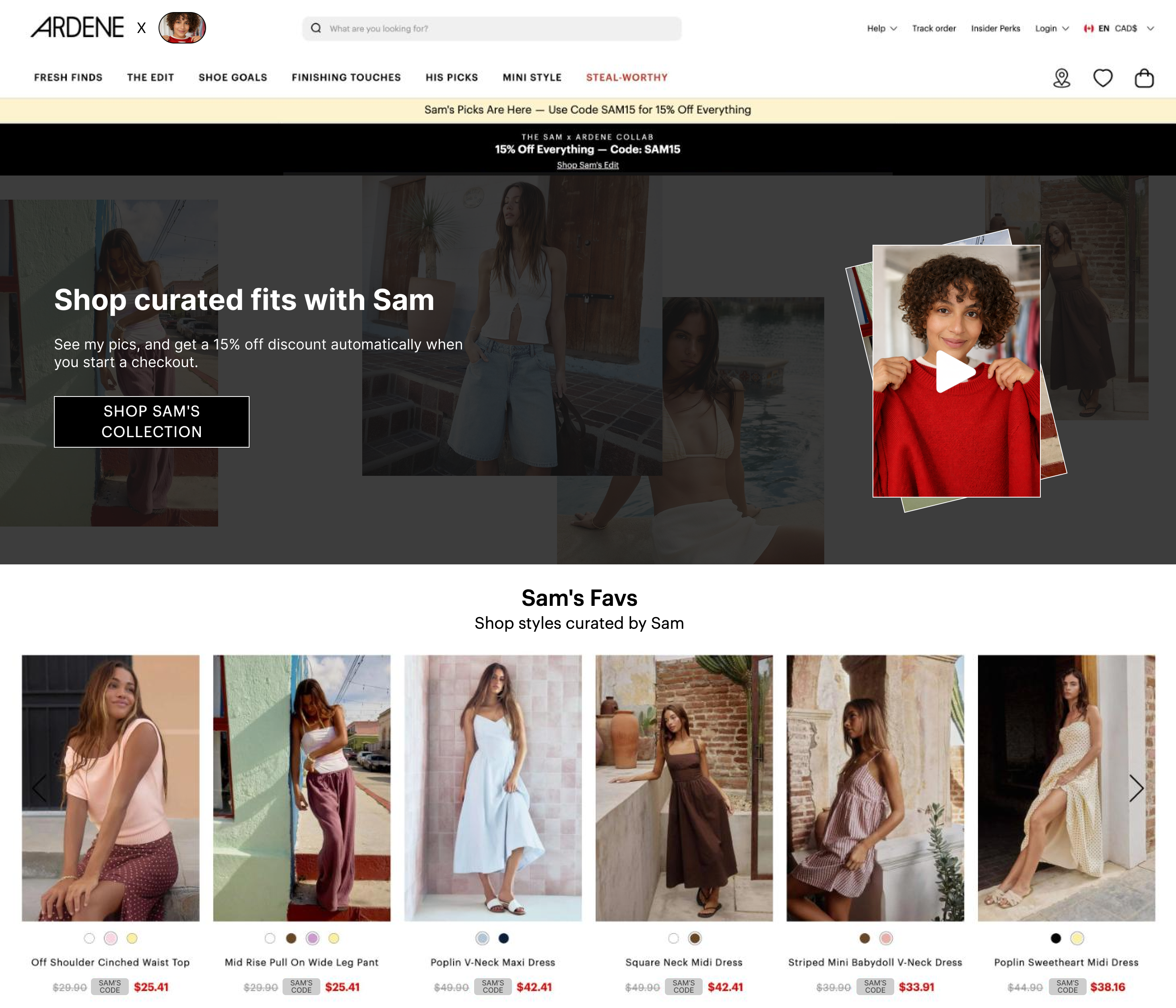


The Playbook for Ardene
Ardene already has what most brands want: strong brand recognition, frequent product drops, and a customer who loves to shop full looks. The gap that usually shows up in influencer programs is that the shopping experience after the click doesn’t match the content quality before the click. A GRIN creator posts a great outfit video, but the audience lands on a generic product page or a collection that doesn’t feel like the creator’s edit. That creates three problems: conversion drops because shoppers have to hunt, AOV stays lower because they don’t see the full outfit in one place, and creator retention suffers because the creator can’t build a long-term ‘home’ on your site.
CreatorCommerce is designed to fix the post-click experience by turning each GRIN partner into a co-branded storefront on Ardene.com. Instead of asking creators to drive traffic to a standard page, you would give them a personalized shop with their name, their curated picks, auto-applied discounts, and on-site content like UGC, Q&A, and quick styling notes. This is the kind of setup that typically drives 30%+ higher CVR and 67% higher AOV vs regular affiliate links, because the shopper immediately understands what to buy and why it fits them.
Step 0: Segment Strategy (who you are building for first)
For Apparel, the highest-leverage approach is a cohort-based rollout with clear partner segments, because each segment needs a slightly different storefront and activation plan. For Ardene, you could prioritize four segments:
1) Top creators (VIP tier, 20–50 partners): People already driving meaningful clicks/sales in GRIN or those you know are strong fit for ‘head-to-toe’ styling. These partners get the most customized storefronts and the earliest access to new drops. This is where you prove the lift in CVR/AOV quickly.
2) Micro-influencers (50–500 partners over time): The goal is volume and authenticity. These creators don’t need heavy 1:1 management, but they do need a page that makes them look bigger than they are. Co-branded shops help them feel official, which improves posting consistency and retention.
3) Ambassadors / campus reps (always-on): If Ardene runs any campus, employee, or community rep programs, co-branded pages become a simple way to track, attribute, and create local ‘uniform’ edits (campus essentials, interview outfits, winter layering, etc.).
4) B2B-style partners (optional later): Stylists, boutique gyms for activewear capsules, or small local orgs doing fundraisers. Even if this is not your current program, CC can support it later with co-branded fundraising shops or curated ‘team’ collections.
Given your focus on novelty and long-term creator retention, the VIP + micro-influencer tracks should launch first. They benefit most from the feeling of ownership and the ability to update their page each month.
Step 1: Partner Enrollment (fill the top of the funnel)
Your enrollment goal should be to make joining feel like joining a brand experience, not filling out a form. You could keep GRIN as the source of truth for recruitment and contracts, and use CreatorCommerce pages as the ‘reward’ for joining.
Enrollment flow you could run:
Offer: ‘Get your own Ardene Shop’ + early access to seasonal drops + higher earning potential because your audience shops your curated outfits, not a single link.
Entry points: Product seeding to targeted creators (especially those already producing outfit-style content), inbound application page, and outbound email/DM to creators who fit Ardene’s trend-forward audience.
What makes this enroll better: Instead of saying ‘join our affiliate program,’ the message becomes: ‘We’ll build you a storefront on Ardene.com with your picks and discount.’ That’s a tangible asset. It also aligns with your internal goal: let top creators shine and make it worth it to stay longer-term.
Data to capture at enrollment (lightweight): preferred style (minimal / bold / street / cozy), top sizes they want featured, favorite categories (intimates, accessories, footwear, activewear), and 3–5 reference links to past content. This is enough for CC to generate a first version of their shop quickly.
Step 2: Partner Activation by Segment (make the first week count)
Activation is where most affiliate programs leak. A creator joins, gets a link, and then nothing happens. The fix is to deliver a ‘shock & awe’ moment: their page is already live, already merchandised, and already feels like them—then you give them a simple posting plan.
VIP creator activation (first 7–14 days):
Day 0–2: Use a form + automation to collect their style notes and discount preferences. Use AI/workflows to generate a starter shop: ‘Complete the Look’ sets, a bestsellers row, and a ‘new drop’ row. If you have any past sales data or seeded product SKUs, CC can use that to pre-populate picks.
Day 3–5: Send them a preview link to approve the shop. Give them 3 easy edits: swap hero image, reorder collections, choose a featured outfit. This builds attachment because they feel ownership.
Day 6–14: Launch with a 3-post sprint: one outfit video, one try-on carousel, one ‘under $X’ or ‘weekend looks’ story sequence that points to their co-branded shop. Your job is to make the shop the center of the campaign, not a footnote.
Micro-influencer activation (template-driven):
Micro creators should get a proven template: a page pre-built around a seasonal theme (Back-to-School essentials, Winter layering, Party season, Valentine’s, Festival fits). They get fewer customization steps, but still get their name, image, discount, and a curated assortment that makes sense for a young women’s fast-fashion basket.
Whitelisted ads (Meta) to amplify what works:
If a VIP creator’s content hits, you could run whitelisted Spark/Meta ads through one-click partner authorization (via our partners) and send paid traffic to that creator’s Ardene shop. This solves two problems: you scale winners without asking the creator for extra posts, and you keep attribution clean by keeping the storefront tied to that creator.
Step 3: Co-branded Storefronts & Funnels (what the pages should actually do)
The storefront should behave like a high-performing outfit funnel, not like a generic affiliate landing page. For Ardene, the highest AOV unlock is ‘set-building’: show the shopper the full look, with easy add-to-cart for multiple items.
Recommended page sections for Apparel:
1) Creator header: Creator name, photo, short ‘what I’m into right now’ line, and an auto-applied discount. This reduces the shopper’s uncertainty immediately.
2) Shop the look (3–6 complete outfits): Each outfit is a bundle-like grouping: top + bottom + outerwear + accessories. Even if you do not use formal bundles, you can present it as a shoppable set with quick add-to-cart.
3) New drop picks: A smaller row that updates weekly. This creates a reason for repeat visits and gives creators a reason to post again.
4) Under $X section: Fast-fashion shoppers respond to clear value anchors. Even if average product price is around $100, you can frame ‘complete the look under $150’ or ‘3 accessories under $50’ depending on Ardene’s pricing strategy and categories.
5) UGC + reviews module: Pull in creator video, customer photos, and simple fit notes. For fashion, fit uncertainty is a conversion killer; quick notes improve confidence.
6) Email/SMS capture with creator context: ‘Get drops picked by [Creator]’—this sets up co-branded retention flows later.
Core funnel tests to run (simple, measurable):
A/B test 1: Auto-applied discount banner vs no banner. Measure CVR lift and discount usage.
A/B test 2: Outfit set-first layout vs product grid-first layout. Measure AOV and items per order.
A/B test 3: Creator video above the fold vs below the fold. Measure bounce rate and add-to-cart.
A/B test 4: ‘Complete the look’ add-to-cart module vs standard PDP routing. Measure attach rate (accessories and footwear are usually the easiest attach wins).
Step 4: Funnel Details (beyond the landing page)
The biggest lift often comes from carrying co-branding through the entire shopping journey: product pages, cart, and checkout experience. This is also where you earn more attribution accuracy.
Co-branded pop-ups (smart, not spammy): If a shopper comes from a creator link, show a small, brand-aligned pop-up: ‘You’re shopping [Creator]’s Ardene edit. Discount applied.’ This builds trust and reduces ‘did my code work?’ friction.
Co-branded product pages: When the shopper clicks a product from a creator shop, keep the creator context on the PDP: show the creator’s styling note, a ‘pair with’ row curated by that creator, and a reminder that the discount is active. This keeps the story cohesive.
Co-branded cart: The cart is where AOV is won. Add a creator-specific ‘complete the look’ module: accessories, hosiery, jewelry, bags, and add-on basics that match the items in cart. Also include a clear line item showing the discount applied. Cart-based attribution can also capture additional orders that would otherwise fall through attribution gaps, often tracking ~2.5% more orders.
Checkout confidence: Ensure the discount stays applied and the creator name remains present in a subtle way. Shoppers should never wonder if they lost the deal.
Step 5: Launch & Track (how you would roll this out with GRIN)
Because you are on GRIN (influencer-driven, cohort-based), the best launch is a structured pilot:
Pilot scope (30 days): 20 creators total: 10 VIP + 10 micro. Build co-branded shops for all 20, but put heavier customization into the VIP tier. Keep the micro tier template-driven so you can learn what scales.
Measurement plan: Compare performance of creator traffic sent to standard affiliate destinations vs the co-branded shops. Track CVR, AOV, items per order, and repeat purchase rate over a longer window. Also track creator retention signals: number of posts per creator, time-to-first-post after receiving the shop, and month-2 posting rate.
Linking strategy: Keep existing GRIN links as the starting point, and route them to the creator shop experiences. This reduces operational friction because you do not need to rebuild your partner tracking system.
Step 6: Optimize (ongoing campaigns + retention)
The programs that win long-term create a content calendar that creators can reliably plug into. For fashion, your advantage is seasonality and drops. The key is to give creators repeatable formats that are easy to execute and map cleanly to their shop sections.
Seasonal campaign calendar (examples you could run):
Back-to-School (Aug–Sep): ‘First week fits’ storefront section + ‘day-to-night’ outfit sets. Add a ‘campus essentials’ bundle row (tanks, denim, sneakers, bag).
Fall Layering (Sep–Oct): ‘3 ways to layer’ hero module. Encourage creators to update only 6 SKUs weekly to stay fresh without heavy work.
Holiday Party (Nov–Dec): Party dress + shoes + accessories sets, plus a ‘giftable add-ons’ row to lift AOV.
New Year / Activewear push (Jan): Activewear edits, ‘gym-to-street’ sets, and a fit-confidence section with quick sizing notes and UGC.
Valentine’s / Spring refresh (Feb–Mar): Date night + girls night storefront themes; add a ‘pink/red edit’ row for novelty.
Festival / Summer (Apr–Jun): Statement accessories and outfit sets; this is a natural attach-rate season.
Always-on monthly format: ‘My 10 picks this month’ + ‘Top 3 bestsellers from my shop’ + ‘New drop I’m wearing.’ This keeps pages active and gives you consistent testing cycles.
Must-have retention flows (co-branded email/SMS):
Cart abandonment: Email/SMS that says ‘[Creator] saved your picks’ with the exact items + a creator note. This is one of the simplest ways to recover revenue because it maintains the creator trust context.
Post-purchase: ‘How to style what you bought’ follow-up with cross-sell recommendations from the same creator. For apparel, this is especially strong when it suggests accessories or matching basics.
Winback: ‘New drop picked by [Creator]’ after 30–45 days. This is how you tie creator content to repeat purchases and CLTV.
Step 7: Advanced (optional): deeper co-branding for power partners
Once you identify 5–10 creators who consistently drive sales, you could offer them deeper experiences:
Whitelabel creator mini-sites on Ardene.com: A more editorial layout with lookbooks, embedded video, and seasonal ‘chapters.’ This works well for creators who want a signature ‘style world’ and will keep improving it over time.
Product embeds for publishers: If you partner with fashion blogs or shopping communities, provide shoppable modules they can embed that still route to their co-branded Ardene experience.
Creator-exclusive capsules (lightweight version): Even without custom manufacturing, you can create creator-exclusive edits with early access to a curated set of SKUs and a unique landing experience. The exclusivity is in the presentation and access window, which is often enough to create a reason to post.
What success would look like for Ardene
In practice, the win is straightforward: creators send traffic that behaves more like branded traffic, because the shopper lands in a page that feels like the creator’s recommendation and Ardene’s store at the same time. You would expect higher conversion because the path to purchase is clearer, higher AOV because outfits are merchandised as sets, better attribution because the creator context persists into cart, and better retention because creators have a durable asset they can keep building on. That matches your stated goal: real novelty and experience in campaigns, while letting top creators shine and making GRIN partnerships stick longer-term.



%201.png)
%201.png)