

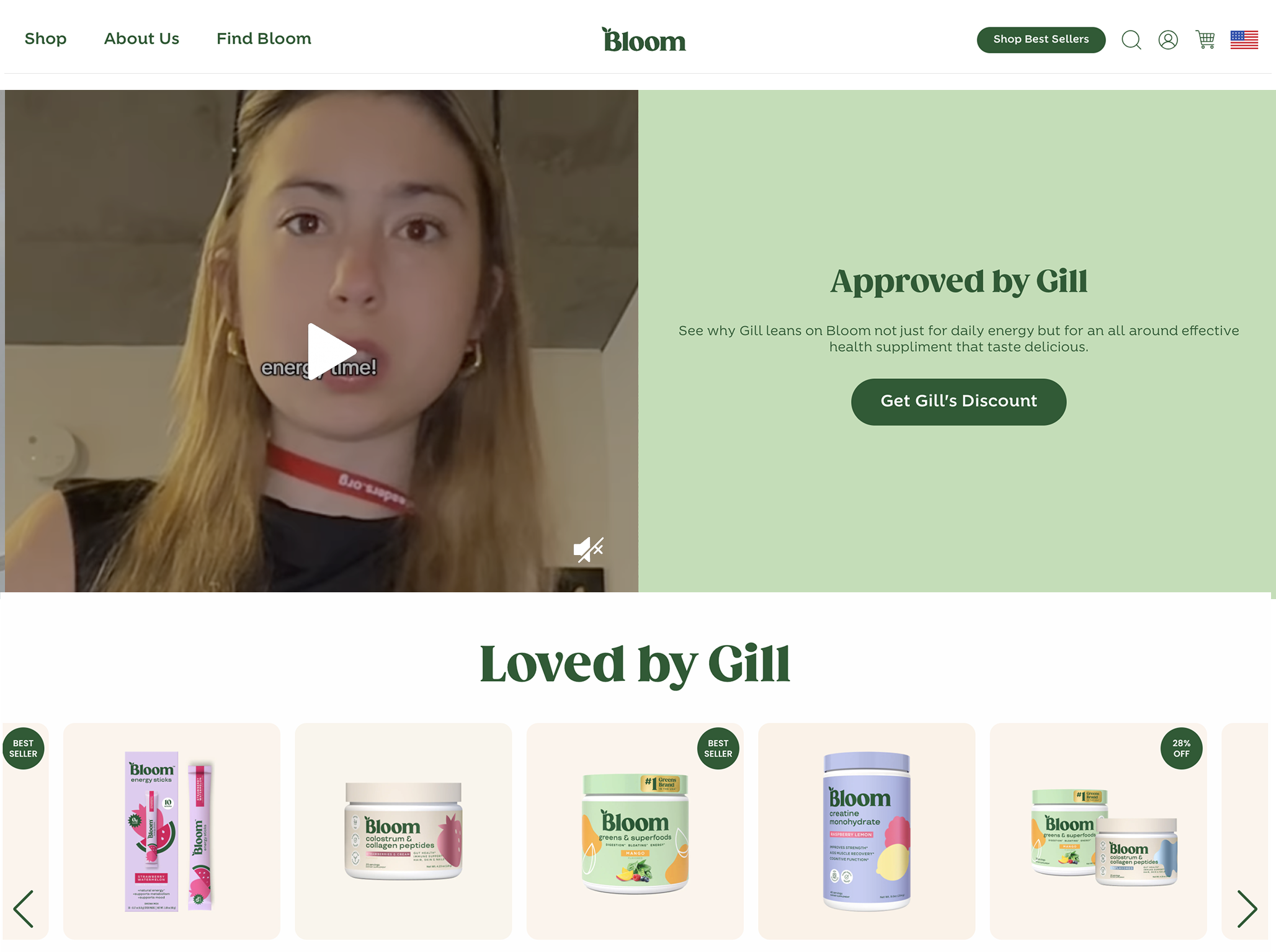


The Playbook for Bloom Nutrition
You already have the hardest part: a product line people talk about, a founder-led story that feels real, and an influencer engine that can scale. The issue for most wellness brands at Bloom’s level isn’t getting clicks—it’s what happens after the click. Standard affiliate links send every audience to the same destination, with the same merchandising, the same proof, and the same next steps. That creates three problems: (1) intent mismatch (a bloat-focused viewer lands on a generic page), (2) trust leakage (the consumer doesn’t see the partner they came for), and (3) low leverage (partners can’t build a repeatable on-site system, so performance depends on constant posting).
CreatorCommerce is designed to turn each GRIN partner into a co-branded shopping experience on bloomnu.com: a storefront + funnels + on-site content, all tracked behind existing affiliate links. Across top Shopify brands, these co-branded experiences typically drive 30%+ higher conversion rate and a 67% higher AOV vs regular affiliate links, because they reduce friction, increase trust, and improve merchandising.
Step 0: Segment Strategy (decide which partner cohorts you want to win)
For supplements, the highest-leverage approach is not a single ‘influencer program.’ It’s a segmented partner strategy where each cohort gets a different on-site template, content requirements, and merchandising logic. Bloom’s catalog (~100 products, ~$35 average price) is ideal for this because it supports ‘stacks’ and routines. Start with 3–4 partner segments that map to real shopping intent and real trust signals:
1) Influencers (UGC + routine-based): lifestyle creators, ‘greens for beginners,’ morning routine creators, weight management audiences, and general wellness. Their storefronts should feel simple, visual, and fast: 3–6 hero products, a starter bundle, and a short ‘how I use it’ section.
2) Athletes / fitness creators (performance-forward): strength, endurance, Hyrox/CrossFit, runners, and gym creators. Their pages should emphasize performance outcomes and clarity: pre-workout + protein + creatine + collagen stack logic, with ‘when to take it’ guidance and a cart that makes bundling easy.
3) Practitioners (practitioner-forward trust): dietitians, nutrition coaches, functional wellness educators, and clinicians (where compliant). Their storefronts should prioritize education and Q&A. The goal is not hype; it’s confidence: ingredient highlights, ‘who it’s for,’ and an intake quiz that routes to a recommended set of Bloom products.
4) Ambassador communities / campus reps (deal + community): if you run ambassador-style cohorts, give them simpler pages that push a single seasonal offer and a clear ‘shop my picks’ module. Make it easy to share, easy to convert, easy to track.
Each segment should have a distinct ‘storefront kit’ (template + product rules + content blocks + offer strategy). This becomes the foundation for scale: you can onboard 50 or 5,000 partners without your team creating bespoke pages from scratch.
Step 1: Partner Enrollment (get more of the right partners into GRIN + into CC)
Enrollment should be built like a funnel, not a one-off outreach motion. The simplest approach is to create 2–3 enrollment paths that all end in the same outcome: partner approved → storefront created → partner receives a link and a page they’re proud to share.
Path A: Product seeding → activation. Seed your hero products (greens, protein, collagen, pre-workout, iced coffee) based on partner segment. The key operational change: don’t wait for content to come back before setting the partner up. As soon as the seeding is confirmed, generate their co-branded page and send it with a ‘soft launch’ message: ‘Your Bloom page is ready whenever you want to share.’ This reduces drop-off because the partner sees the ‘offer’ immediately.
Path B: Inbound creators → instant storefront. For partners applying inbound, redirect them from a generic application to a short intake that powers page creation: name, handles, category (influencer/athlete/practitioner), top 3 products they want to promote, and their audience’s primary goal (bloat, energy, performance, weight management, digestion). CreatorCommerce can use AI and workflows to create a first-pass storefront from this partial data, then your team moderates for brand fit.
Path C: Outbound recruitment → ‘storefront-first’ pitch. For outreach, lead with the differentiated asset: ‘We build you a storefront on bloomnu.com with your picks, your discount, and your content.’ That is a stronger ask than ‘share a link,’ and it tends to improve reply rates because it feels like real collaboration, not a commodity affiliate offer.
CC’s partner apps power these enrollment flows by automating page creation, routing partners into the right template, and making the program feel premium at scale.
Step 2: Partner Activation by Segment (turn approved partners into revenue quickly)
Activation is where most programs leak. Partners are excited, but they don’t know what to post, what to recommend, or how to make it ‘theirs.’ Bloom’s advantage is that your products naturally fit into routines and stacks—so activation should be a ‘build your stack’ process with minimal friction.
Activation core loop (all segments): (1) partner confirms their angle → (2) storefront is pre-filled with best-fit products → (3) partner adds 2–5 content assets → (4) Bloom approves → (5) partner shares one link that stays consistent across posts.
Influencers: Use a lightweight form to collect: (a) 3 audience pain points, (b) 3 favorite Bloom products, (c) one ‘how I take it’ note, (d) 3 pieces of UGC (or permission to pull from their posts). Automate the first version of their page using their handle and any prior order history. Then send an email/SMS sequence: Day 0 ‘Your page is live,’ Day 2 ‘Add one more asset to increase conversions,’ Day 7 ‘Here’s a new bundle to test.’
Athletes: Collect training style (strength/endurance), timing preference (AM/PM), and goals (performance/lean mass/recovery). Build an ‘Athlete Stack’ module that shows timing (e.g., pre-workout before training, protein after, creatine daily, collagen for connective tissue support). The page should make the ‘add stack to cart’ action simple. Athletes often perform well with clear systems.
Practitioners: Collect credentials, disclaimers (as needed), and a ‘recommendation framework’ (e.g., bloat + digestion → greens; hair/skin support → collagen; performance → creatine + protein; energy → pre-workout/coffee where appropriate). Then publish Q&A blocks: ‘Who should avoid this?’ ‘How long until you notice changes?’ ‘How to take it without stomach upset?’ This reduces purchase anxiety and increases conversion quality. Add a short intake quiz to route users to a ‘recommended cart’ that still gives the practitioner credit.
Whitelisted Meta ads (high leverage for top partners): For your top 20–50 partners, set up a simple 1-click ad authorization flow so Bloom can run paid spend through partner handles while sending traffic to their co-branded storefront. This typically improves CPM/CVR because the ad comes from a trusted face, and the landing page matches that face—closing the trust loop from ad to checkout.
Step 3: Co-branded Storefronts & Funnels (build pages that match intent)
Instead of one partner page template, Bloom should run a small set of repeatable funnel types that map to how consumers actually shop supplements. You can reuse these across thousands of partners by swapping the content and product set.
Funnel type 1: ‘Greens Starter’ (influencers + beginners). Above the fold: partner photo/name, 1-sentence reason they use it, auto-applied discount, and a ‘Start here’ bundle (greens + shaker + whatever add-on makes sense). Below: taste notes, ‘how I mix it,’ and a short FAQ.
Funnel type 2: ‘Bloat + digestion’ (results-forward). Focus the storytelling on the problem the viewer came for: what causes bloat, how the routine fits, what consistency looks like, and what to expect. Include testimonials (partner + customer) and make the cart feel guided: ‘Most customers add collagen’ or ‘Add protein for a complete morning stack.’
Funnel type 3: ‘Performance stack’ (athletes). Build a ‘timing’ section and a one-click stack add-to-cart. Emphasize simplicity and compliance-friendly education (avoid overpromising). Add a section for partner’s weekly routine and the products mapped to days.
Funnel type 4: ‘Practitioner picks’ (authority). This should look less like an influencer landing page and more like a curated clinic shelf: clearly labeled recommendations, who it’s for, and a quiz that builds a cart. This is how you become ‘practitioner forward’ without rebuilding your main site.
Each funnel should have consistent Bloom branding while still reflecting the partner identity. The goal is that consumers feel they’re shopping Bloom, guided by someone they trust.
Step 4: Funnel Details (upgrade the shopping experience beyond a landing page)
The biggest lifts often come from what happens after the click, not just the top of the page. Bloom can extend co-branding across the shopping journey:
Co-branded product pages: If a partner sends traffic to a specific product, add a co-branded header and a ‘Recommended by [Partner]’ module. Include partner-specific tips (how they take it) and a mini-bundle module (‘Complete the stack’).
Co-branded cart: Auto-apply the partner’s discount and show the partner identity in-cart so shoppers don’t second-guess if the code worked. Add cart upsells that match supplement behavior: ‘Most add protein’ or ‘Add collagen’ rather than generic cross-sells. This is where AOV lift often comes from.
Pop-ups with purpose: Avoid generic email pop-ups. Use partner-specific ones: ‘Get [Partner]’s routine PDF’ or ‘Take the 30-second quiz to find your best stack.’ This grows email/SMS lists with context (what the customer is trying to solve), which improves retention.
Content blocks that reduce anxiety: Supplements can trigger skepticism. Add ‘What’s inside’ highlights, sourcing/testing statements that are accurate to Bloom’s policies, and a clear ‘what to expect’ section. Keep the language simple and conservative—consumers reward clarity.
Recipes + usage: Bloom has a natural advantage here (greens, protein, iced coffee). Make recipes a conversion asset: partner recipe cards with shoppable ingredients (‘Add all to cart’). This turns UGC into merchandising.
Step 5: Launch & Track (roll out without breaking your existing program)
Bloom can launch CreatorCommerce in parallel with your current GRIN setup. The practical approach is to keep existing affiliate links and simply redirect the destination experience to co-branded pages. Start with a pilot cohort to prove the lift, then expand.
Pilot recommendation (30 days): 30–50 partners across segments: 20 influencers, 5–10 athletes, 5–10 practitioners. Give each a storefront plus one focused funnel. Track performance vs a control group using standard affiliate links.
Primary metrics: conversion rate (CVR), average order value (AOV), revenue per click, and partner-level retention (are they still posting in 60–90 days). Also track quiz completion rate and add-to-cart rate by page type.
Attribution improvement: Cart-based attribution can recover orders that traditional link attribution misses (often from multi-session shoppers), which helps you pay partners fairly and understand true ROI.
Step 6: Optimize (turn partner pages into a compounding growth loop)
Optimization should be a monthly cadence of content prompts + funnel tests. The goal is not endless redesign; it’s systematic iteration: add one new asset type, test one merchandising change, and scale what works.
Must-have: co-branded abandonment + post-purchase flows. For carts started from a partner storefront, your cart abandonment emails/SMS should reflect that: ‘Your Bloom order from [Partner] is waiting’ with the discount still applied. Post-purchase, send a co-branded ‘how to use it’ email featuring the partner’s routine (and a ‘next order’ recommendation). This improves repeat purchase and protects the partner relationship because customers associate their success with both Bloom and the partner.
Monthly content campaigns (examples for Bloom):
January–February: ‘Reset routines’ and ‘Consistency week 1–4’ pages; partners update their routine weekly; add a ‘what I changed’ module.
March–April: ‘Spring energy + digestion’ stacks; recipe-led campaigns (greens mocktails, iced coffee blends).
May–June: ‘Summer travel’ funnel: travel packs, easy-to-mix tips, ‘hotel gym stack’ for athletes.
July–August: ‘Hot weather hydration + routine’ content; emphasize ease and taste; campus/ambassador push.
September–October: ‘Back to schedule’ practitioner-forward education; quiz-driven funnels.
November–December: gifting and ‘year-end favorites’; partner-curated gift guides and bundles.
Testing ideas: auto-applied discount vs ‘reveal code’; 3-product vs 6-product storefront; video-first hero section vs static; bundle-first cart vs single SKU; practitioner Q&A depth (3 vs 8 questions); recipe card placement above vs below fold.
Step 7: Advanced (practitioners + publishers who want deeper collaboration)
For your highest-trust partners—top practitioners, large publishers, or major athletes—consider deeper integrations:
Whitelabel co-branded microsites on bloomnu.com: a fuller experience that looks like a ‘program,’ not a landing page. Include education, protocols (compliance-friendly), and a shoppable ‘recommended cart.’
Embeds for their existing sites: shoppable product modules or ‘stack builders’ that can live on their blog while still checking out on Bloom. This keeps them on-brand and drives cleaner conversion.
Partner dashboards: let them update picks, swap hero products for seasonal pushes, and upload new content without needing Bloom’s team each time. This turns partners into operators and increases velocity.
What this unlocks for Bloom
Bloom’s goal—becoming influencer-forward, athlete-forward, and practitioner-forward at the same time—requires one central mechanism that can adapt the brand experience to the partner and the audience. Co-branded storefronts are that mechanism. They let you scale personalization across your entire GRIN program, increase CVR and AOV, improve attribution, and build partner retention by giving creators something they can own and grow. The result is not just better links. It’s a better shopping system for every partnership you run in the United States and beyond.

.png)

.jpeg)

.jpeg)


%201.png)
%201.png)