



The Playbook for Buoy
Buoy has a product that sells best when trust is high and instructions are clear. Unflavored electrolyte + nutrient drops are simple once someone understands how to use them, what to expect, and why they fit into real life (morning coffee, workouts, chronic illness routines, travel, nights out). The challenge is that a standard affiliate link does not carry that context. It sends shoppers to a generic experience where they have to do the mental work: pick the right products, decide on quantity, calculate discounts, and hunt for social proof that feels relevant to them.
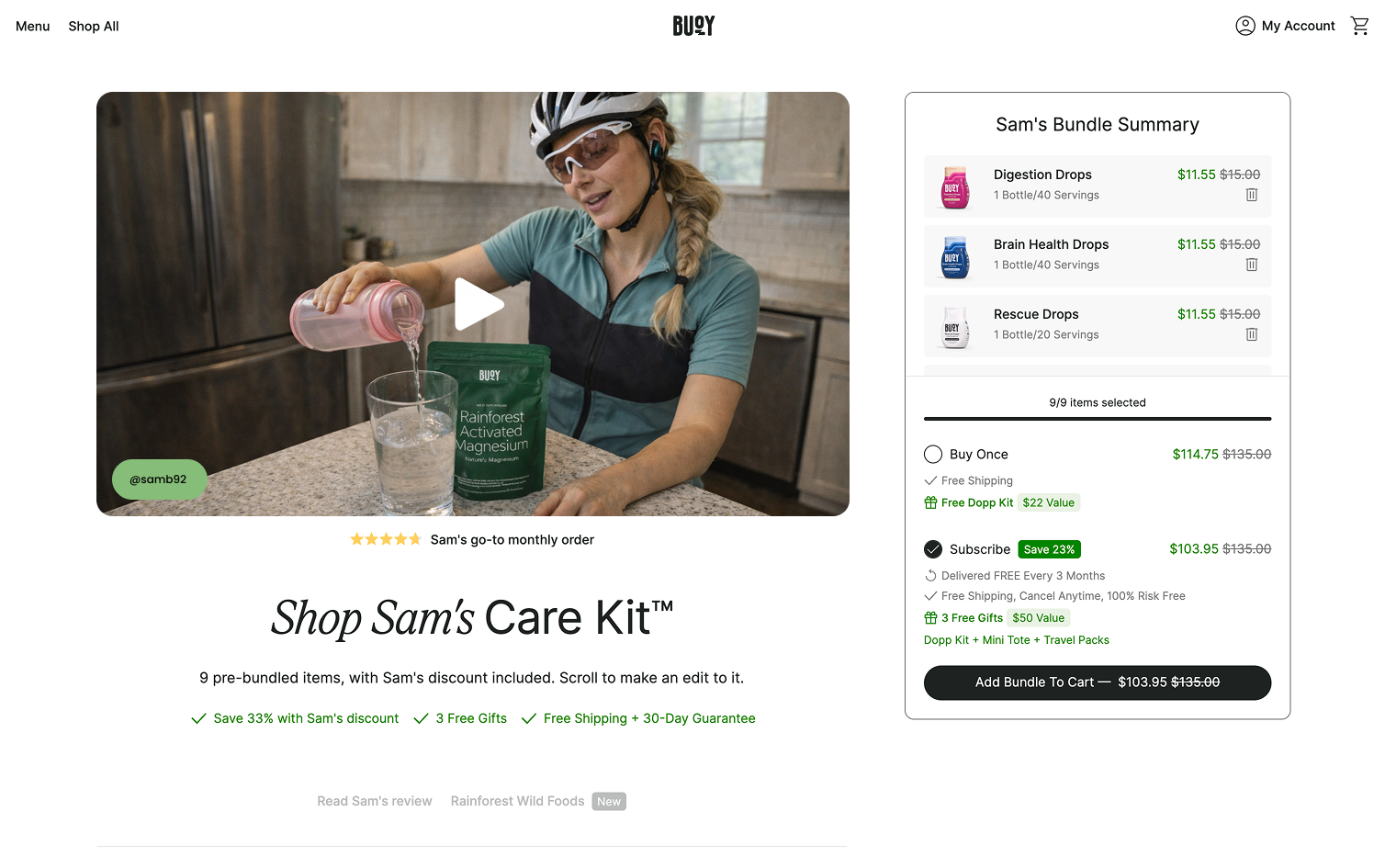
CreatorCommerce is built to turn partner traffic into co-branded shopping funnels on your Shopify theme. Instead of 'Sam sent me a link,' the shopper experiences 'Sam's Buoy routine' (or an athlete's training-day protocol, or a clinician's hydration checklist) with the right products, a simple offer, and proof that matches the audience. Across top Shopify brands, co-branded funnels like this typically drive 30%+ higher conversion rate and 67% higher AOV compared to regular affiliate links—because the experience reduces friction and increases confidence.
Below is a specific plan Buoy could run in the US market using Social Snowball, focused on BYOB (build your own buoy) kits as the viral wedge and on practitioner trust as the moat.
Step 0: Segment Strategy (who Buoy should win first)
Buoy should treat partners as different 'sales motions' and build different storefront templates for each. In health & wellness, a single template rarely converts across audiences because the trust triggers differ. Start with three primary segments, then expand.
Segment A: Health creators (micro + mid influencers)
These are creators whose audience already cares about hydration, energy, digestion, and low-sugar living. They win through relatability and repeatable routines. Their storefronts should be routine-based: 'My daily add-in checklist' with 2–4 hero SKUs, a BYOB kit, and a subscription nudge.
Segment B: Athletes, coaches, and performance communities
These partners win through protocols. Their audience wants 'what to do' and 'how much.' Storefronts should be anchored to training moments: 'before training,' 'during travel,' 'after sauna,' 'tournament weekend.' Use bundles and multipacks to raise AOV and reduce repurchase friction.
Segment C: Practitioners (doctors, nurses, dietitians, chronic illness educators)
This segment is the long-term moat. They do not want to feel like influencers, and they are sensitive to claims. Their storefronts should be education-first: a hydration basics page, a 'who this is for' checklist (POTS community, migraine support, GI sensitivity, sugar-free needs), and a 'what I recommend' product set. Add optional disclaimers and a 'talk to your clinician' framing. Practitioners can also drive B2B leads: clinic sampling, patient handouts, or resource kits.
Each segment will get its own conversion path, content requirements, and offer rules. This keeps Buoy compliant and consistent while still letting partners personalize.
Step 1: Partner Enrollment (how Buoy could recruit more of the right partners)
Buoy already has an affiliate foundation via Social Snowball. The next step is building enrollment flows that promise partners something tangible: 'You will get your own storefront on Buoy's site, with your kit, your discount, and your content.' That is a stronger hook than 'get a link and a code.'
Recruitment channels Buoy could run in parallel
1) Product seeding with an activation goal
Ship a 'partner starter box' that is designed to create a storefront, not just a post. Include: a quick-start routine card, 3 usage ideas (water/coffee/mocktail), and a QR that opens their personalization form. The objective is: complete storefront + one piece of proof (short video or written routine), not just 'post when you can.'
2) Inbound capture from your existing customers
Many Buoy customers are already evangelists, especially in chronic illness communities. Add an on-site 'Become a Buoy Partner' flow that asks two questions: 'Do you create content?' and 'Do you work with clients/patients?' Route them into Segment A or C. CC can host the form and pre-build the first draft storefront from minimal data.
3) Targeted outreach to practitioners and clinics
Build a small list of dietitians, hydration-focused clinicians, and POTS educators. The pitch is not 'affiliate.' It is 'co-branded patient resource page + optional discount for your community.' If they want compensation, great—Social Snowball handles payouts. If not, the value is the resource and credibility.
4) Athlete/coaching networks
Recruit through gyms, run clubs, CrossFit boxes, cycling communities, and collegiate athlete micro-influencers. Offer them a 'team hydration kit' storefront and a simple performance-oriented bundle.
CreatorCommerce supports these flows by letting Buoy create a consistent co-branded experience for every partner without building custom pages manually.
Step 2: Partner Activation by Segment (turn sign-ups into storefronts that sell)
Activation is where most affiliate programs lose money: partners join, get a link, and never convert meaningful revenue. Buoy could make activation a checklist that ends with a live storefront and a simple launch plan.
Activation mechanics that Buoy could standardize
Partner personalization form (5–7 minutes)
Collect only the data needed to build a high-trust funnel: preferred audience (athletes, chronic illness, general wellness), top 3 objections they hear, favorite 2–4 SKUs, whether they want BYOB kit featured, their discount preference, and 1–2 pieces of proof (quote, before/after style story without medical claims, routine). If they do not provide proof, CC can generate a draft 'routine' from a few prompts and Buoy can moderate it.
Auto-creation + moderation
Use automation + AI to generate the first version of their storefront: headline, routine bullets, recommended products, and FAQs. Then Buoy reviews quickly (especially for practitioner pages) and publishes. This turns what used to be weeks into same-day activation.
Segment-specific storefront 'shock & awe'
The moment the partner sees 'their' page on Buoy's domain, the program feels different. This is the core activation lever: ownership. Send them their unique URL, 3 launch assets, and a 7-day plan.
Whitelisted Meta ads for top performers
For partners who already convert, Buoy could offer one-click ad authorization and run whitelisted ads driving to that partner's storefront. The difference versus sending paid traffic to a generic PDP is that the ad-to-landing message match is perfect: the creator in the ad is the creator on the page, with their kit and their offer.
What to extract per segment
Influencers: routine + taste reassurance (unflavored), 'what I add it to,' sustainability angle (PCR packaging), and 1 short UGC video.
Athletes/coaches: protocol timing, 'tournament weekend' checklist, travel hydration bundle, and a 'team code.'
Practitioners: educational framing, patient-friendly language, disclaimers, and a 'recommended starting plan' bundle with conservative claims.
Step 3: Co-branded Storefronts & Funnels (what Buoy should actually build)
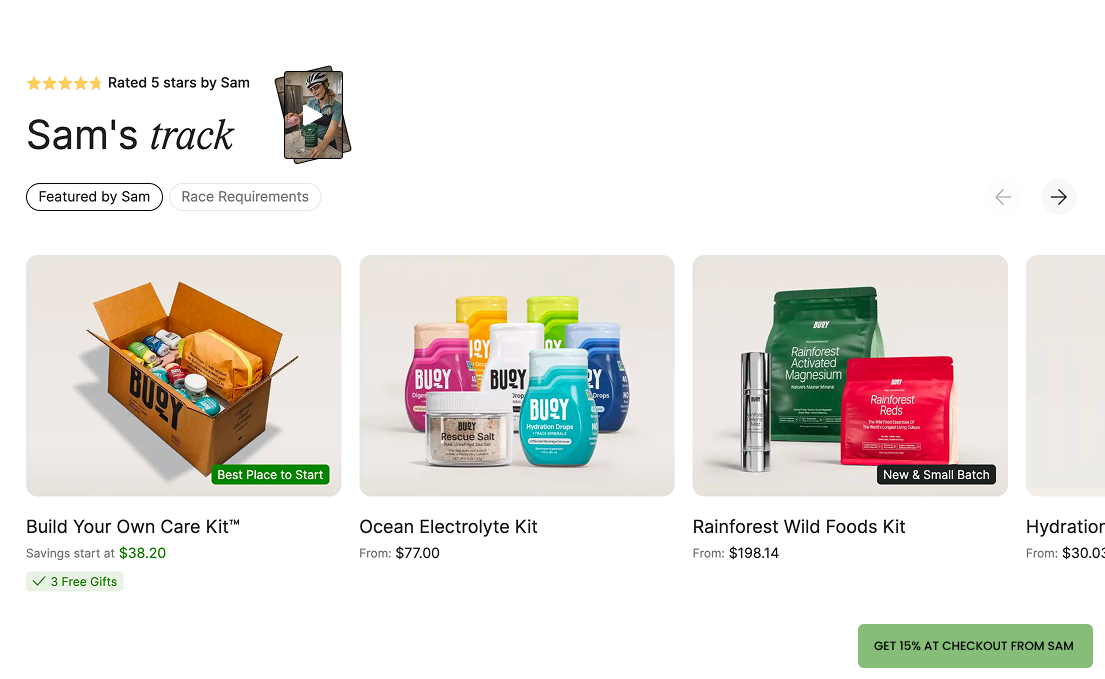
Buoy has ~20 products with a ~$40 average price. That is perfect for curated bundles, kits, and subscriptions. The goal is to make the partner page feel like a guided decision, not a catalog.
Core storefront modules Buoy could standardize
1) The hero section: 'Why this partner uses Buoy'
A simple headline, partner photo/name, and 3 bullets: when they use it, what they notice, who it is for. Keep it practical and avoid medical claims.
2) BYOB kit builder as the centerpiece
Buoy already has a BYOB kit concept—this can become the viral wedge. Each partner's storefront could feature a 'My BYOB kit' with 3–6 included items and an explanation for each. The shopper can buy the kit as-is or customize it (upgrade path = higher AOV). Add a 'Start here' default that is easy to purchase.
3) Two curated alternatives: 'Budget' and 'All-in'
Not everyone wants to customize. Offer two quick-buy bundles: a starter pack and a higher-AOV replenishment pack. This reduces choice paralysis and raises conversion.
4) Proof block: testimonials that match the segment
For chronic illness audiences, show careful, compliant testimonials about routine support and ease of use. For athletes, show training and travel use-cases. For general wellness, show energy and hydration habits.
5) FAQ block that removes friction
Answer: 'Does it change taste?', 'How much do I use?', 'Can I add it to coffee/tea/alcohol?', 'Is there sugar/sweeteners?', 'What are trace minerals?', 'What is eco-friendly packaging?'
6) Subscription nudge
If Buoy offers subscription, partners should be able to present it as 'set it and forget it.' If not, offer a 'reorder in 30 days' reminder flow with co-branded email.
Funnel tests Buoy could run in month 1
A/B test 1: BYOB kit vs curated bundle first
Some audiences convert faster with a simple bundle; others love customization. Test which module appears first per segment.
A/B test 2: Auto-apply discount vs code reveal
Auto-apply reduces mental math. For some partners, showing the code can increase perceived value. Test both.
A/B test 3: Practitioner template vs creator template
Practitioner pages should feel more like a resource than a sales page. Test tone and layout to protect trust while keeping conversion strong.
Step 4: Funnel Details (beyond the landing page)
Conversion gains often come from the small details after the click: product pages, cart, pop-ups, and post-purchase. CreatorCommerce is strongest when the co-branding follows the shopper through the funnel.
On-site elements Buoy could implement
Co-branded product pages
If a shopper clicks into a product from a partner storefront, keep the partner context visible: 'Recommended by [Partner]' plus their one-line reason and their discount status. This maintains trust and reduces drop-off.
Co-branded cart
Show 'You are shopping with [Partner]' and ensure the discount is applied automatically. Add a cart upsell tied to their routine: 'Add a travel-size' or 'Add a second bottle for the gym bag.'
Exit-intent / scroll pop-up
Offer a low-friction capture: 'Want [Partner]'s exact hydration checklist? Send it to me.' This builds email/SMS while keeping the message partner-specific.
Content tiles inside the funnel
Add small content blocks that answer objections at the moment they appear: taste, sugar-free, trace minerals, and sustainability. Keep them as short tiles, not long paragraphs.
Cart-based attribution
If a shopper clicks a partner link but buys later (or navigates to another page), cart-based attribution can capture more orders than link-only models. This is especially important for considered purchases or subscription decisions and typically tracks ~2.5% more orders.
Step 5: Launch & Track (what Buoy should measure)
Buoy could launch with a focused pilot: 25–50 partners across segments (for example: 20 creators, 20 athletes/coaches, 10 practitioners). The objective is to prove lift and establish repeatable templates before scaling to hundreds.
Launch approach
First: integrate Shopify theme + Social Snowball, publish 3 templates (creator, athlete, practitioner).
Next: activate pilot partners with a storefront, BYOB kit module, and auto-applied discount.
Then: run a 14-day 'storefront launch sprint' with weekly office hours and a simple content checklist.
KPIs to track weekly
Conversion rate by partner segment and by template.
AOV overall and by BYOB kit vs bundle purchases.
Take rate of subscription (if applicable) and repurchase rate within 30/60 days.
Partner activation rate: % of partners with a live storefront + at least one content asset.
Affiliate retention: partners who post again in 60 days, and revenue concentration (top partners vs long tail).
Incremental revenue: compare performance versus standard affiliate link flows.
Step 6: Optimize (how Buoy could keep the program compounding)
Once storefronts are live, the best growth comes from content cadence and iterative merchandising, not constant recruiting. Buoy could run monthly partner campaigns that produce new on-site modules and new reasons to buy.
Must-have retention flows
Co-branded cart abandonment
Email/SMS that says, 'Your Buoy kit from [Partner] is waiting' and reminds them the discount is still applied. Include the partner's one-line routine tip and 1–2 testimonials.
Co-branded post-purchase
Teach usage to reduce refunds and increase repeat purchases: day-1 'how to use,' day-7 'how to build the habit,' day-21 'how to restock.' Keep the partner present so the customer stays attached to the same funnel.
Partner-driven replenishment
At ~21–30 days, send 'Recreate [Partner]'s routine' with a 1-click reorder bundle. This turns partner acquisition into retention, not just first-order revenue.
Seasonal campaign calendar Buoy could run
January (habits): '30-day hydration routine' storefront refresh for creators + a 'starter kit' default.
March (travel + training): spring break/travel hydration bundles for athletes and general wellness.
May–August (heat + outdoors): 'hot weather protocol' modules and multipack offers.
September (back-to-routine): office + school routines, coffee/tea add-in content, subscription push.
November (gratitude + sustainability): PCR packaging story + referral-style gifting bundles (without heavy discounting).
December (gifting): 'Build a kit for someone you love' BYOB gift modules and creator gift guides.
Each campaign should produce: a storefront tile, a bundle, 2–3 UGC assets per segment, and a co-branded email/SMS sequence. This keeps partner storefronts fresh and gives partners a reason to talk about Buoy repeatedly.
Step 7: Advanced (practitioners, publishers, and embedded commerce)
For practitioner and publisher partners, Buoy could go beyond a single storefront and provide either a 100% co-branded micro-site experience on Buoy's domain or embeddable product modules that can live inside their existing sites.
Two advanced options
1) Whitelabel practitioner resource hubs
A clinician-branded page that includes: hydration basics, a 'recommended starting plan' kit, printable guidance, and a patient-friendly FAQ. This can also capture leads for clinic sampling or patient education. It is a scalable way to earn trust in the US market without relying on short-form content cycles.
2) Embedded kits for publishers and communities
If a chronic illness educator runs a blog or resource site, embed 'My Buoy kit' as a shoppable module. The shopper never loses context, and Buoy still hosts checkout and attribution. This is especially valuable where audiences want to research before buying.
The point of these advanced motions is to turn Buoy's partner program into a defensible channel: partners are not just sending traffic, they are building durable, co-branded assets that live on Buoy's storefront and in their communities.
What Buoy could pilot first (a simple 30-day plan)
Week 1: Build 3 templates (creator/athlete/practitioner), define BYOB kit defaults, set discount rules, and integrate Social Snowball.
Week 2: Activate 25–50 partners, collect minimal content via form, auto-generate pages, moderate and publish.
Week 3: Launch sprint: partners post 1x, Buoy runs whitelisted ads for the top 5, and email/SMS capture is turned on for storefront visitors.
Week 4: Review CVR, AOV, kit adoption, and reorder signals. Ship improvements: better bundles, clearer FAQs, stronger proof blocks, and co-branded abandonment/post-purchase flows.
At the end of 30 days, Buoy should know which segment and storefront style is the best lever for revenue now, and which is the best lever for long-term moat. From there, scaling to hundreds of partners becomes a repeatable operational play, not a custom project.


%201.png)
%201.png)