

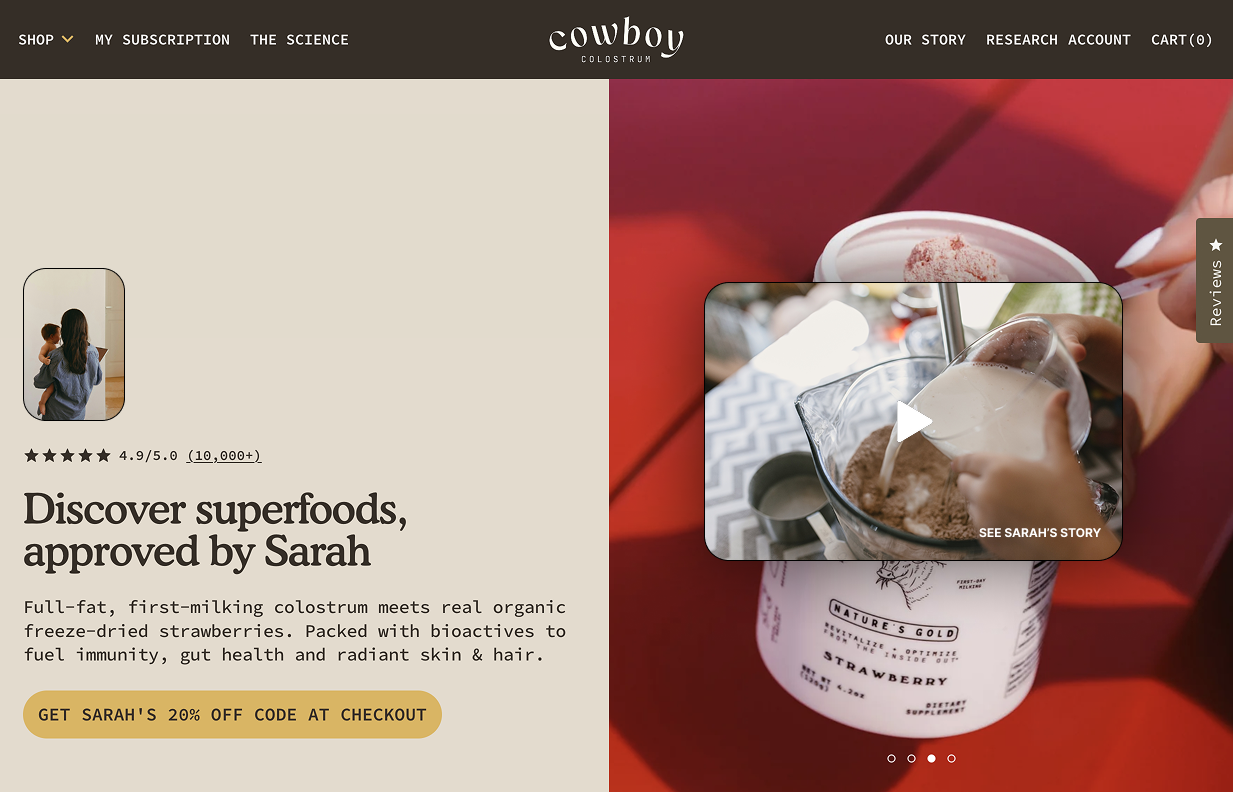


The Playbook for Cowboy Colostrum
Cowboy Colostrum already has the hardest part working: a product with clear reasons to believe (U.S.-sourced, first-day colostrum, ethical calf-first practices, full-fat/unstripped, and a higher 3g serving). The gap is not product. The gap is translation—turning partner content (stories, routines, recipes, education) into an on-site buying experience that converts more reliably than a standard affiliate link.
Most wellness affiliate programs plateau when they rely on the same pattern: creator posts, bio link, customer lands on a generic PDP, then bounces because they still have unanswered questions (What does it taste like? How do I mix it without clumps? Which flavor should I choose? How long until I notice changes? Is this ethical? Will it work for my specific goal?). The fix is not more posts. The fix is a better destination.
CreatorCommerce could sit on top of your existing Social Snowball program and turn each affiliate link into a co-branded storefront and funnel that answers those questions, carries the creator's voice into the purchase, and merchandises the best offer for that specific audience. Across top Shopify brands, these co-branded experiences typically drive 30%+ higher conversion rate and 67% higher average order value compared to standard affiliate flows.
Step 0: Segment Strategy (who to win, and why)
For a premium health product with a $100 average order value and ~20 SKUs/flavors, Cowboy Colostrum could win by running a blended partner strategy: creators for reach and cultural credibility, and practitioners for trust and repeatable education. The segments below map to the main jobs-to-be-done (immune, gut, beauty) and to the content formats that perform best.
Segment A: Micro and mid-tier wellness creators (primary growth engine)
These are TikTok/IG creators who can credibly talk about routine, digestion, immunity, and skin/hair. They do not need to sound clinical; they need to sound consistent and honest. Their storefronts should be built around a personal routine, a flavor preference, and an auto-applied discount. Their conversion lift comes from clarity and trust, not from pushing.
Segment B: Beauty-forward creators (hair/skin angle)
Colostrum fits a 'glow' narrative, but it needs guardrails: simple expectations, a routine, and a time horizon. These pages should show before/after style education carefully (no aggressive claims), plus a 'how I take it' recipe (vanilla/cacao) and a bundle that increases AOV (for example: 2-tub routine or flavor duo).
Segment C: Fitness and performance coaches (habit + compliance)
This segment can drive higher AOV because they sell routines. Their pages should feature a '30-day consistency' framing, a checklist, and a subscribe-and-save prompt if you offer it. Their funnel should reduce friction: which flavor to start with, how to mix (frother tip), and what to pair it with (coffee/smoothie).
Segment D: Practitioners (nutritionists, health coaches, functional med, chiropractors, boutique gyms)
This segment is about trust and long-term LTV. They can be smaller in audience but high in conversion and repeat purchase. Their storefronts should be more educational: sourcing and ethics, what 'first-day' means, serving size (3g), and a simple 'who is this for' section. They also benefit from advanced options: whitelabeled pages, product embeds on their own sites, and downloadable handouts.
Segment E: Existing customers turned ambassadors (high intent, scalable)
These are buyers who already love the product and can tell authentic stories. Their content is often less polished but more believable. Their storefront should be lightweight: a short testimonial, the exact SKU they buy, and an auto-applied code.
The key operational decision: Cowboy Colostrum could treat each segment as its own funnel template rather than trying to make one universal page work for everyone. CreatorCommerce makes that scalable because templates can be reused, and content fields can be filled via forms, AI enrichment, and moderation workflows.
Step 1: Partner Enrollment (increase volume without lowering quality)
If the goal is to ramp Social Snowball sales, enrollment needs to be predictable and role-based: who recruits, what they offer, and what the partner sees immediately after approval. The fastest path is to combine three inputs: (1) product seeding for story creation, (2) a simple application/approval path for inbound interest, and (3) proactive outreach to partner lists that match your angles (gut, immune, beauty, coffee/smoothie recipes).
Offer design (what partners get)
Beyond commission, the 'yes' moment could be: a co-branded storefront on cowboycolostrum.com with their name, photo, routine, discount auto-applied, and their best content embedded—plus a curated starter kit they can actually film (including a frother recommendation or mixing instructions to prevent clumps). The storefront is the asset. The product is the content fuel.
Recruitment flows (how they join)
Cowboy Colostrum could keep Social Snowball as the tracking and payout system, and use CreatorCommerce partner apps to power the co-branded experience. Enrollment could happen via: a landing page for applications, a 'customer-to-ambassador' post-purchase invitation, and outbound DM/email outreach. Each channel should push one clear action: apply, get approved, and publish your storefront link.
Quality control (who gets in)
Use lightweight gates instead of heavy admin: ask for (a) primary platform, (b) audience type (women's wellness, fitness, beauty, moms, etc.), (c) preferred angle (gut/immune/beauty), and (d) a past piece of content. This is enough to route them to the right funnel template without slowing down approvals.
Step 2: Partner Activation by Segment (make partners go live fast)
Activation is where programs win or lose. Most partners do not fail because they are lazy; they fail because they do not know what to say, what to link to, or how to make their audience buy without sounding salesy. CreatorCommerce could solve this by giving them a page that already looks finished, then asking them for small inputs to personalize it.
Activation goal
Within 48 hours of approval, each partner could have: (1) a co-branded storefront link, (2) a default product recommendation (flavor), (3) a starter offer (discount + bundle), and (4) at least one piece of on-site content (testimonial, recipe, routine, or FAQ).
Segment-specific activation kits
Micro creators: a 'my daily mix' script, 3 hook ideas, and a recipe card (vanilla latte, cacao smoothie, unflavored in coffee).
Beauty creators: a '30-day routine' outline and a gentle expectations section (consistency, routine, nourishment).
Fitness coaches: a habit tracker and a 'stack' section (what they pair it with).
Practitioners: an educational mini FAQ plus sourcing/ethics highlights and serving size clarity.
Customer ambassadors: a short prompt to capture their story (why they tried it, what changed, how they take it).
Data collection via forms (minimal, high impact)
To personalize at scale, you only need a few fields: preferred flavor (vanilla/cacao/unflavored), preferred mix method (frother/blender/shaker), their top audience goal (gut/immune/beauty), and one short quote. CreatorCommerce could then generate the rest: draft page copy, suggested product tiles, and a starter bundle based on that segment.
Automation + AI for page creation
For partners where you have partial data (name, handle, content links), workflows could prefill the page with their profile image, a short bio, and draft sections. Your team can moderate before it goes live. This preserves brand voice while keeping speed high.
Whitelisted Meta ads (for your best performers)
Once you identify 10–20 partners with proven creative, you could run whitelisted ads from their handle (with authorization) and send that traffic to their co-branded storefront. This often outperforms sending paid traffic to a generic PDP because the ad and landing page match: same person, same routine, same offer. The storefront also makes attribution and optimization cleaner because the message is consistent end-to-end.
Step 3: Co-branded Storefronts & Funnels (what the destination should look like)
The storefront should feel like a guided recommendation. For Cowboy Colostrum, the best co-branded pages are likely not just 'shop all.' They should be a short story plus a guided path: choose your flavor, learn how to mix it, see what to expect, and buy with a code already applied.
Core modules Cowboy Colostrum could standardize
1) Partner header (name, photo, why they use it).
2) 'Start here' product pick (one SKU per partner as the default).
3) Routine section (when they take it, what they mix it with, frother tip).
4) Proof and trust (ethical calf-first summary, first-24-hours explanation, 3g serving highlight).
5) FAQs (taste, clumps, dairy sensitivity guidance, storage, timing).
6) Offer block (auto-applied discount, free shipping threshold messaging if relevant).
7) Bundles to lift AOV (flavor duo, 2-pack for 30 days, 'starter + travel' if you have it).
Template ideas by persona
Gut-first template: focuses on daily consistency, meal pairing, and gentle education.
Immune-first template: focuses on routine, seasonality, travel, and 'what I do when my schedule is hectic'.
Beauty-first template: focuses on daily nourishment and a longer time horizon; keep it grounded and simple.
Recipe-first template: for food/coffee creators, with 2–3 recipes and the SKU embedded below each recipe.
Funnel tests (what to A/B)
Test A: creator video at top vs midway down the page.
Test B: 'choose your flavor' quiz vs default recommended flavor.
Test C: discount-only vs discount + bundle anchor (for example, 2-pack starter).
Test D: ethics/sourcing section above the fold vs below (for audiences that care deeply about calf-first practices).
Test E: recipe cards first vs benefits first (some audiences buy on utility; others buy on outcomes).
Step 4: Funnel Details (beyond the landing page)
Most conversion gains come from fixing the last 20%: PDP clarity, cart confidence, and reducing mental math. CreatorCommerce could extend co-branding across product pages and carts so that the shopper never 'loses' the creator.
Co-branded product pages
When a shopper clicks into Vanilla, Cacao, or Unflavored, the PDP could retain the partner header and show a short 'how I use it' module. This matters for colostrum because the mixing experience (frother/blender) is part of the success. A quick 'no clumps' tip reduces returns and increases satisfaction.
Auto-applied discounts (remove mental math)
Instead of requiring the user to remember and type a code, the storefront could apply it automatically. This reduces drop-off, especially on mobile, and makes the offer feel clean and trustworthy.
Cart-level co-branding
The cart could show: 'You are shopping with [Partner Name]' plus the savings, plus a one-line reassurance about shipping/returns and a small upsell that matches the routine (for example: add a second flavor for variety). Cart-based attribution can also capture more orders that might otherwise be missed when users navigate around.
Educational micro-content at checkout
For premium wellness, shoppers often hesitate at the last step. A small 'How to take it' note, a 'What it tastes like' note, and the ethics summary can reduce hesitation without cluttering the page.
Step 5: Launch & Track (go live without breaking the program)
Cowboy Colostrum could launch in a way that does not disrupt your existing Social Snowball workflows. The simplest rollout: keep your current affiliate links, but redirect the destination to co-branded storefronts (or to a CC experience that dynamically loads the correct partner context). Partners keep their habits; you upgrade the destination.
Launch phases
Phase 1 (2–4 weeks): 25–50 partners across segments A–D. Build templates, prove conversion lift, refine data collection.
Phase 2 (next 4–8 weeks): scale to 200–500 partners, emphasize customer ambassadors and micro creators, and roll out practitioner pages with deeper education.
Phase 3 (ongoing): seasonal moments, whitelisted ads for winners, and co-branded lifecycle flows for retention.
Metrics to monitor weekly
Conversion rate (storefront vs baseline), AOV (bundle adoption), revenue per partner, repeat purchase rate, refund/CS tickets related to mixing/taste, and partner retention (partners who post again in 30/60 days). Also track content coverage: which partners have on-site UGC, recipes, and FAQs filled in.
Step 6: Optimize (content campaigns + retention that feels personal)
This is where you get compounding returns. Once partner storefronts exist, you can run campaigns that produce both content and sales, not just sales.
Must-have: co-branded cart abandonment and post-purchase flows
If someone abandons cart from a partner storefront, the email/SMS could reference the partner by name, repeat the auto-applied offer, and link back to the same storefront. After purchase, the education should also be co-branded: 'Here is how [Partner] mixes it' + 'here are 2 recipes' + 'what to expect in week 1–4'. This increases satisfaction and repeat purchase while reinforcing partner attribution.
Monthly content sprints (simple and repeatable)
Sprint 1: 'My morning mix' recipe month (vanilla latte, cacao smoothie, unflavored coffee).
Sprint 2: 'Travel + routine' month (immune angle, busy schedule).
Sprint 3: '30-day consistency' month (fitness coaches + beauty creators).
Sprint 4: 'Calf-first + sourcing' education month (practitioners + values-driven creators).
Each sprint should have: a content brief, a storefront module update, and a bundle/offer recommendation so AOV stays strong.
Merchandising to lift AOV without forcing it
Because your average product price is about $100, AOV lift will likely come from: flavor duos, multi-month routine packs, and creator-curated bundles (for example: 'Vanilla for coffee + Unflavored for smoothies'). Partners should be able to choose from pre-approved bundles so the brand stays consistent while still feeling personalized.
Reduce support and increase confidence with 'mixing success'
Make 'how to mix without clumps' a standard module on every storefront and PDP. Include a short frother note and 2–3 mixing methods. This small change can improve reviews, reduce refunds, and increase referral confidence for partners.
Step 7: Advanced (for practitioners and publishers)
For practitioners, gyms, and wellness publishers, the opportunity is to go beyond a simple affiliate page and give them a near-whitelabeled experience. This works especially well when they already have an email list and want a trusted store link that feels like part of their practice.
Whitelabel pages on your domain
Practitioners could have a page that reads like a clinic recommendation: who it is for, how to take it, and the brand ethics. They can embed it in their resources page and share it in follow-up emails to clients. Because it lives on cowboycolostrum.com, you keep the checkout, brand control, and data.
Embeds for their existing websites
For partners who do not want to send people away, product embeds (top pick + bundle) can be placed on their site and still route to a co-branded cart on your domain for attribution and conversion.
Practitioner-specific bundles and education
Keep compliance and trust high: give them pre-approved language, a deeper FAQ, and a 'how to explain it to clients' one-pager. Their storefront should be more structured and less personality-driven than a creator page, but still co-branded.
What Cowboy Colostrum could do first (a practical 30-day plan)
Week 1: Build the templates
Create 3–4 storefront templates (gut, immune, beauty, practitioner). Define the required fields (flavor, quote, mix method, audience goal). Decide the default bundles and discount structure for each template.
Week 2: Activate the first cohort
Launch with 25–50 partners pulled from your best current Social Snowball performers plus a handful of practitioners. Use a short activation form. Generate storefronts automatically, then approve and publish quickly. Push a 'go-live in 48 hours' activation sequence.
Week 3: Add co-branded cart + lifecycle
Turn on co-branded cart abandonment and post-purchase flows that reference the partner, include mixing tips, and link back to the partner storefront. This is where retention and satisfaction improve, not just first purchase.
Week 4: Run the first content sprint
Choose one theme: 'My morning mix.' Ask every partner for one recipe video and one short quote. Add that content to their storefront. Run whitelisted ads for 5–10 winners. Compare storefront CVR and AOV to baseline affiliate traffic.
If Cowboy Colostrum wants more authenticity, advice, health stories, and recipes that create genuine feel-good funnels, the co-branded storefront is the missing infrastructure. It turns partner storytelling into a conversion and retention asset on your site, and it gives your Social Snowball program a differentiated destination that scales with your ambitions.
.png)


%201.png)
%201.png)