



The Playbook for Eternal Skincare (UK-first, Refersion-powered, built for Europe + US expansion)
Eternal Skincare already has the right ingredients for a strong partnership engine: a clear product philosophy (botanical, cruelty-free, accessible luxury), a hero product (Aloe Super Hydrating Moisturiser), and an 80-product catalog that supports routines. The main risk is that a traditional affiliate program turns all that into a single thing: a discount link that drops shoppers onto a generic page. That usually underperforms because skincare needs context (skin type, concerns, routine order, trust) and because partners need a reason to stay active beyond commission.
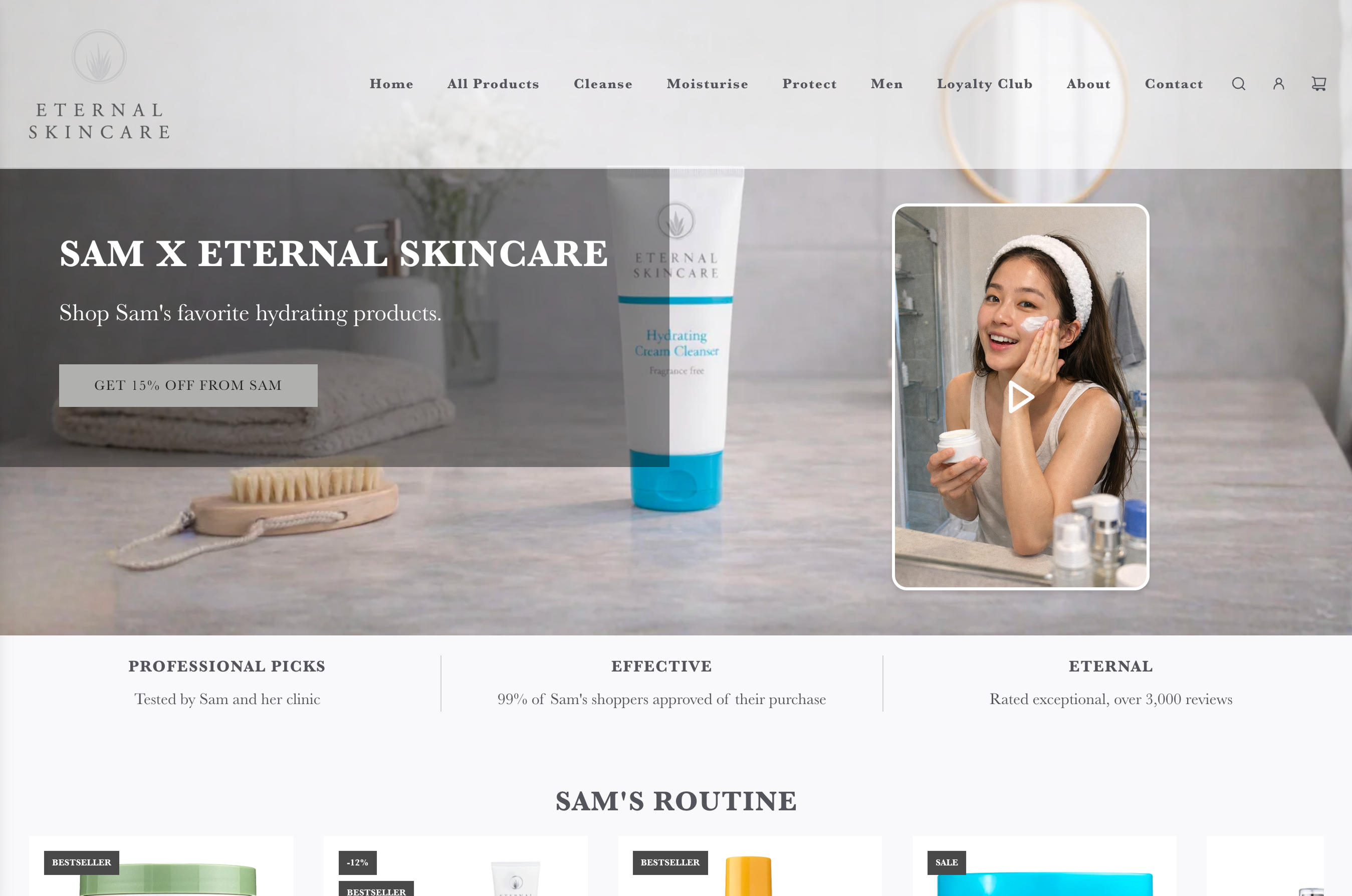
A co-branded storefront strategy fixes both sides: shoppers get a guided routine from someone they trust, and partners get a persistent asset on your domain that improves their earnings per click. In practice, co-branded experiences tend to drive 30%+ higher conversion rate and 67% higher AOV compared to regular affiliate links, because the merchandising and story are built around the partner instead of around your default navigation.
This playbook lays out how Eternal could launch a UK program now, create world-class engagement, and build a moat that makes recruitment easier as you expand into Europe and the US later.
Step 0: Segment Strategy (who you are building for)
Skincare partnerships work best when you separate partners by the role they play in the buyer decision. Eternal could run one unified program in Refersion but design different storefront templates, incentives, and activation tasks by segment.
Segment A: Micro-creators (UK) focused on routines and relatability
These are TikTok/Instagram creators who can consistently produce GRWM, sensitive-skin updates, and seasonal routine changes. They may not have massive reach, but they can generate high trust and repeat conversions if you give them a branded place to send traffic. For Eternal, this segment should drive volume and new customer acquisition, especially for hydration, sensitivity, and glow positioning.
Segment B: Skin educators (estheticians, facialists, salons, dermatology-adjacent educators)
Even if Eternal is not a clinical brand, education partners win because they explain routines, ingredient logic, and who a product is for. These partners also unlock higher AOV by recommending multi-step sets (cleanse + treat + moisturise + SPF) and by steering shoppers into regimen thinking rather than single-item purchases.
Segment C: Ambassador/community partners (customers, brand fans, referral-first)
This is your long-tail base. They do not need heavy content support. They need simple setup, a credible storefront that looks professional, and an easy way to share a routine and discount without doing mental math. This segment is how you scale coverage fast across the UK and then translate the model into other markets.
Segment D (later): European and US market builders
As you expand, you will want partners who can localize the story: climate differences, routine changes, shipping expectations, and skin concerns by region. The system you build now should make it easy to clone UK storefronts into localized versions later (language, currency, shipping notes, and product availability).
The key decision: Eternal could treat co-branded storefronts as the default destination for all partnership traffic (not a special thing for top creators only). That is how you win both metrics and retention.
Step 1: Partner Enrollment (get the right partners in, with the right promise)
The enrollment offer needs to be simple: partners get a co-branded storefront on EternalSkincare.com that they can customize, share, and grow over time. That is more compelling than 'join our affiliate program' because it promises a tangible asset.
Enrollment channels Eternal could run in parallel
1) Product seeding with a routine brief: Instead of seeding random products, ship 'routine kits' aligned to your main use cases: Hydration Reset, Sensitive Skin Calm, Radiance + Barrier Support. Each kit can include 3–5 products plus a one-page routine order and a request for specific assets (morning routine video, texture shots, before/after check-ins at day 7 and day 21). The goal is not just UGC; it is storefront-ready content.
2) Inbound recruitment on-site: Add a partnership page that offers 'Get your own Eternal storefront' and routes applicants into a short form. Ask only what you will actually use to build the storefront: socials, skin focus (dryness, sensitivity, glow, acne-prone), and top 3 product picks. Everything else can be generated later.
3) Outbound email/DM to known-fit creators: For the influencers you already know, the message should lead with the storefront concept and a clear metric promise: 'We will send your audience to a page that looks like your routine, not a generic shop page.' Include the exact deliverable: a live link in 48 hours, preloaded with their picks, discount auto-applied, and space for their videos and Q&A.
4) Partner business recruitment (salons/estheticians): Offer a 'client routine page' they can use in consultations. This is a different value prop than commission alone: it saves them time and makes them look professional. Later, you can extend into co-branded whitelabel pages for businesses who want deeper branding.
Enrollment flow design (keep it frictionless)
Eternal could keep the initial form short and use automation to fill the gaps: pull their name/handle, profile image, and likely skin focus from their content; generate a first-draft storefront; then let them approve and tweak. The priority is speed to first link shared.
Step 2: Partner Activation by Segment (turn signup into first sales)
Activation is where most affiliate programs fail. The fix is to give partners an immediate win: a co-branded storefront that already looks good, already has products, already has an offer, and already has content modules ready to be filled.
Activation principles Eternal could use
Auto-apply discounts: remove mental math and make the offer obvious. The storefront should show the discount applied in the cart and carry the partner name throughout (trust and continuity).
Start with a 'signature routine': for skincare, the routine is the story. Each partner storefront should launch with one routine and one bundle, not 20 products.
Ask for 3 assets max in week 1: (1) a routine video, (2) a texture shot carousel, (3) a short 'who this is for' paragraph. You can request more later, but week 1 is about shipping the first version.
Segment-specific activation tasks
Micro-creators: Provide 2–3 hook templates for TikTok/Reels (winter dryness, post-gym redness, makeup sitting poorly due to dehydration). Ask them to drive to their storefront, not to a product page. Reward speed: a small bonus or increased commission for the first 14 days to create momentum.
Skin educators: Give them a 'consultation flow' storefront: a quick skin-quiz or 'choose your concern' module at the top, then recommended routine. Ask them to answer 5 common questions that appear on the page (e.g., 'Is this good for sensitive skin?', 'How do I layer these?', 'How long until I notice hydration improvements?').
Ambassadors: Provide a prebuilt 'my favourites' storefront that they can share in stories and post-purchase referrals. The primary job is to make them look credible with minimal work.
Paid amplification: whitelisted Meta ads
Eternal could use whitelisted ads for top partners so their best creative becomes scalable. The process should be one-click authorization, then Eternal runs ads through the partner handle to their co-branded storefront. This improves performance because the ad is native to the creator identity, and the landing page continues that identity instead of breaking the trust chain.
Step 3: Co-branded Storefronts & Funnels (what each page should do)
A co-branded storefront is not a static landing page. It is a set of modules that can be tested and improved. Eternal could treat each storefront as a mini funnel that answers: (1) why trust this partner, (2) what routine to buy, (3) what to add to increase results, and (4) why buy now.
Core modules for Eternal storefronts (skincare-specific)
1) Above-the-fold routine: 'My Hydration Reset' with 3–5 products in order, plus a 1-line reason for each step.
2) Shop by concern: dryness, sensitivity, barrier support, glow. This keeps the page useful even if the shopper is not exactly like the creator.
3) Proof and reassurance: UGC tiles, short testimonials, and 'gentle + effective' positioning. If you have cruelty-free or botanical badges, show them near the CTA.
4) The partner's 'how I use it': a short routine note and a video embed. For skincare, this is often the difference between browsing and buying.
5) Bundle builder: a curated set that lifts AOV. With ~£30 average price, a 3-item routine becomes ~£90, which is a meaningful AOV lift. Make the bundle the default purchase path.
Initial funnel tests Eternal could run (first 30 days)
Test A: One hero vs. full routine first: For some partners, leading with the Aloe Super Hydrating Moisturiser first may convert better; for others, leading with a 3-step routine may increase AOV with similar CVR. Run this per segment.
Test B: Educational Q&A vs. minimalist design: Educators may benefit from a Q&A block; micro-creators may benefit from a fast, visual layout. Keep the template flexible by segment.
Test C: 'Sensitive-safe' reassurance: Since you mention sensitivity and gentleness, test a trust panel (what it is free from, cruelty-free, botanical focus) near the add-to-cart area.
Step 4: Funnel Details (beyond the landing page)
The biggest gains often come from continuing co-branding deeper into the journey: product pages, cart, and post-purchase. If the co-branding stops at the landing page, you lose the trust you just created.
Co-branded product pages
Add a 'Recommended by [Partner]' module on product pages when a shopper arrives from that partner. Show the partner's short note (1–2 sentences) and their video snippet if available. This is especially important for products that need explanation, like targeted serums or barrier support items.
Co-branded cart (must-have)
Auto-applied discount and a cart banner: 'You are shopping with [Partner].' Include a 'Complete the routine' upsell that respects the partner's curation (not generic cross-sells). For Eternal, cart upsells could be: add a gentle cleanser to support moisturiser results, add a nighttime treatment, add travel size for consistency.
Co-branded pop-ups (used carefully)
Use an exit-intent pop-up that offers a routine guide download or a small incentive, but keep it aligned with the partner. Example: 'Get [Partner]'s Hydration Routine PDF + tips.' This captures email with a reason that matches the content.
Data capture that improves merchandising
Add a short 'skin concern' selector (dryness, sensitivity, dullness) that personalizes product ordering on the page. This is valuable for Eternal because it lets you learn which concerns each partner actually converts on and it lets you adapt their storefront without them doing extra work.
Step 5: Launch & Track (UK rollout that does not disrupt Refersion)
Eternal could launch without changing how partners share links today. The plan: keep Refersion as the source of truth for partner attribution and payouts, but route every partner link to a co-branded experience.
Launch sequence
First (week 1): Build 10–20 flagship storefronts in the UK across segments (micro-creators + educators + ambassadors). Choose partners with different skin focuses so you can learn what converts: hydration, sensitivity, glow.
Next (week 2): Invite 50–100 additional partners with a 'we built your storefront' message. Preload each with a default routine based on what they say they focus on (or what their content implies). The key is that the page is ready on day 1.
Then (week 3–4): Turn on paid amplification for the top performers via whitelisted ads and expand seeding to recruit the next cohort.
What to track (minimum set)
Track conversion rate (storefront vs. site average), AOV, attach rate (items per order), repeat purchase rate for customers acquired via partners, and partner retention (partners who drive clicks/sales in month 2). For operational clarity, also track time-to-first-share and time-to-first-sale by segment.
Cart-based attribution can also help reduce missed credit in edge cases where cookies fail or shoppers return later; this tends to capture incremental orders that otherwise go unattributed.
Step 6: Optimize (campaigns, testing, and retention loops)
Once the storefront system is live, the growth engine becomes a content + merchandising calendar that gives partners reasons to post and gives customers reasons to return.
Always-on improvements
Storefront refresh cadence: Ask each active partner to refresh one module per month (swap the hero routine, add a new video, update their favourites). The page stays current without asking for constant content.
Bundle optimization: Use the data to identify the best 3-item and 5-item bundles for each concern. Because your catalog is broad (80 products), bundling is where AOV lift comes from, especially at ~£30 average price.
Creator-led FAQs: Identify the top objections in customer support and bake them into the storefront in the partner voice. In skincare, objection handling matters as much as discounts.
Co-branded email/SMS (must-have retention lever)
Eternal could run co-branded flows where the partner identity is present in key emails: abandoned cart, post-purchase education, replenishment reminders, and review requests. Example: 'Your routine from [Partner] — how to use it this week.' This keeps continuity and increases the chance of a second order.
For post-purchase, send a day 3 'routine order' email, a day 10 'what to expect' email, and a day 21 'check-in' email with an easy cross-sell aligned to results (e.g., add a gentle treatment or upgrade to a full routine). This is practical skincare retention, not generic marketing.
Seasonal campaign calendar (UK-first, then exportable)
January–February: Barrier + hydration season: 'Winter skin reset' storefront takeovers. Partners publish a 7-day hydration routine and a 'makeup sits better' angle. Bundle: cleanser + hydrating moisturiser + overnight support.
March–April: Spring glow + routine simplification: '3-step morning routine' campaign. Emphasize consistency and gentle glow. Bundle: cleanse + moisturise + protective step (as applicable).
May–August: Travel + heat + sensitivity: 'Holiday skin survival' and 'post-sun comfort' angles. Create travel-friendly routines and 'sensitive-safe' reassurance modules.
September–October: Back-to-routine: 'Reset after summer' messaging. Partners update storefronts with their fall routine and new favourites.
November–December: Giftable sets + self-care: Creator-curated gift guides and 'spa at home' bundles. Each partner can have a 'Gifts under £X' section to simplify shopping and lift AOV.
These campaigns work because they give partners prompts and give shoppers a reason to buy now, while keeping the storefront feeling updated.
Step 7: Advanced (professional and publisher partners)
If Eternal leans into estheticians, salons, and wellness studios, there is a deeper play than affiliate links: give them a more complete co-branded presence.
Option A: 100% co-branded whitelabel pages
A salon could have a fully co-branded page that matches their visual identity while still living on Eternal's Shopify theme. This works well for client routines and aftercare recommendations. It also gives the business a stronger reason to switch from recommending generic retail products to recommending Eternal consistently.
Option B: Product embeds on partner sites
For publishers or high-intent educators with their own sites, embed Eternal products and bundles directly into their content. The shopper stays in the partner's context and still checks out through Eternal. This is especially useful in the US later, where larger creators may prefer deeper integrations.
What Eternal could do next (a practical starting plan)
1) Choose 3 storefront templates: Creator routine page, educator consultation page, ambassador favourites page. Keep modules consistent but rearranged by segment.
2) Launch with 10–20 UK flagship partners: Include at least 5 hydration-focused, 5 sensitivity-focused, and a mix of content styles (tutorials, talking-to-camera, aesthetic routines).
3) Build 3 bundles: Hydration Reset, Sensitive Calm, Glow Routine. Make each bundle editable per partner, but start with defaults.
4) Turn on co-branded cart + email: Auto-apply discounts, show the partner name, and run co-branded abandoned cart and post-purchase flows to lock in the CLTV gains.
5) Recruit the next cohort with the storefront offer: 'We built your Eternal storefront' is a stronger recruitment message than 'join our affiliate program,' and it scales across the UK now and Europe/US later.
If Eternal executes this as the default partner experience, you do not just get more affiliate sales. You build an on-site content and merchandising system where every partner click lands in a tailored routine, every routine lifts AOV through bundles, and every customer journey keeps the partner identity intact from first click to post-purchase education.
.png)


%201.png)
%201.png)