



Evry Jewels x CreatorCommerce: a retention-first playbook for repeat partner revenue
You already have what most brands spend years building: scale. With 100,000+ affiliates and a TikTok-first growth engine, Evry Jewels has distribution, culture fit, and a product that works for impulse and repeat purchase (stacking, gifting, replacing, trend cycles).
The risk with a program this large is that it becomes replaceable for partners. If the experience is mostly 'here is a link + code,' creators can rotate to whichever brand offers the easiest conversion and the highest payout that week. The outcome is predictable: lots of one-and-done collabs, a long tail that never activates, and top partners who drift unless you keep feeding them new angles.
The goal of this playbook is to make your best partners want to build with Evry repeatedly—every seasonal drop, every trend wave, every new collection—because their Evry storefront gets stronger over time and converts better than any generic link. CreatorCommerce is the system that makes that scalable inside Shopify, while staying compatible with GRIN.
Before → After (what changes for Evry)
Before: partner sends traffic to a generic page
A TikTok drives to a home page or collection page. The shopper has to find the exact product from the video, remember the code, and decide what else to add. It can work, but it is fragile: any extra step is lost intent.
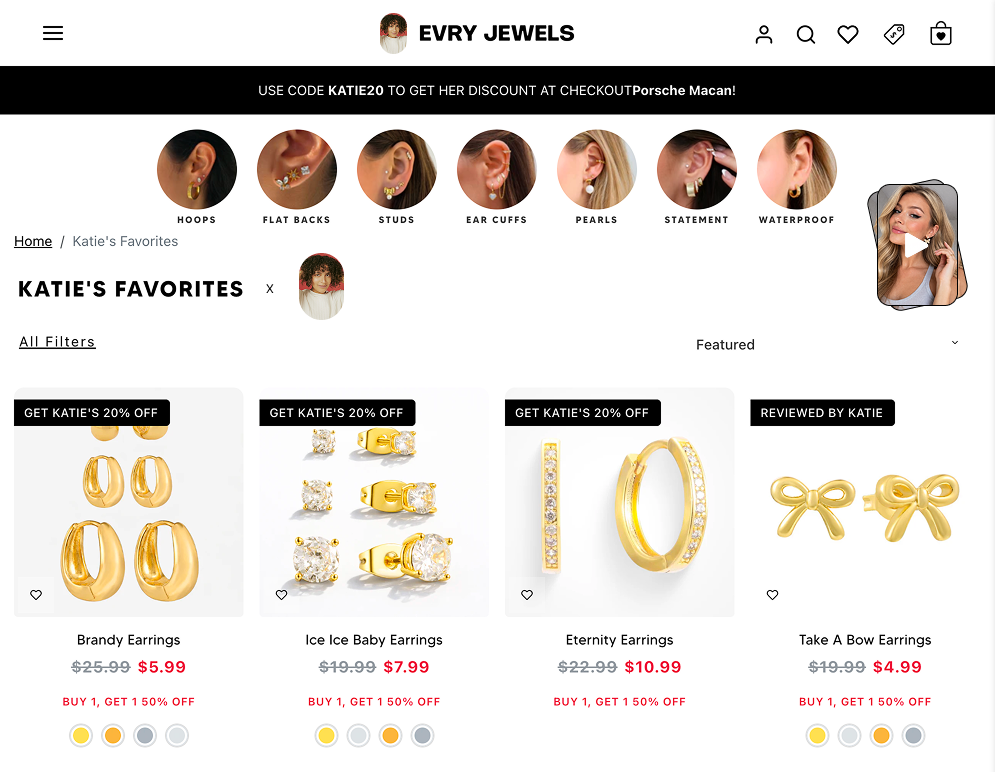
After: partner sends traffic to their own co-branded Evry shop
The same TikTok drives to a co-branded shop on evryjewels.com with: the partner name and styling angle, their curated set of products, an auto-applied discount, on-page UGC, and drop-specific sections. This usually increases conversion and average order value because the page is more relevant and the cart is more guided (sets, add-ons, 'complete the stack'). CreatorCommerce customers typically see 30%+ higher CVR and 67% higher AOV compared to standard affiliate links.
Most importantly for your stated objective, the partner has something worth maintaining. That shifts the psychology from 'post once' to 'I have an Evry storefront—let me update it for the next drop.'
Step 0: Segment strategy (who you should win and why)
Evry’s program is big enough that you should treat it like a portfolio. Not every partner needs deep customization. The segmentation job is deciding who gets what level of experience and what the success metric is per tier.
Recommended segments for a Gen-Z fashion jewelry brand
1) Drop Drivers (top creators): Partners who can move meaningful revenue in 24–72 hours around a drop. They need fast page updates, a clear hero offer, and on-site UGC modules. The goal is conversion rate and revenue per post.
2) Stack Stylists (mid-tier creators): Partners whose content is consistent and style-led, even if their audience is smaller. They are perfect for evergreen 'how to stack' pages and seasonal refreshes. The goal is higher AOV (multi-item carts) and steady monthly revenue.
3) Ambassador Long Tail (scale): Your large affiliate base that may be sporadic. The goal is activation and retention: get them to their first sale quickly, then keep them participating in each seasonal moment with minimal effort.
4) Gifting / Occasion Specialists: Partners who do 'gift guides,' 'under $25,' 'Valentine’s,' 'graduation.' Jewelry performs well here. The goal is new customer acquisition and bundles/sets.
This segmentation drives the storefront templates you should build in CreatorCommerce: Drop template, Stack template, Gift template, and a Simple template for long-tail activation.
Step 1: Partner enrollment (increase quality and readiness, not just volume)
You likely do not need more affiliates; you need more ready partners—people who can publish and drive traffic with a clear merchandising angle. The enrollment motion should move partners from 'accepted' to 'activated with a storefront' in the shortest time possible.
Enrollment flow you could run
First, define the 'creator shop offer' as the perk: When recruiting, the hook becomes: 'You get a co-branded Evry shop on our site with your picks and your discount auto-applied.' That is meaningfully different from most programs and is a strong reason for creators to prioritize Evry.
Next, seed with a purpose: When sending product, attach a simple brief: 'Pick 6 pieces for your storefront: 2 everyday basics, 2 trend pieces, 1 gifting pick, 1 statement.' This makes the content and the shop work together.
Then, tighten inbound and outbound: For inbound applications, route them into a short form that captures their niche (daily wear, bold, minimal, gifting), platforms, and a few style references. For outbound recruitment (email/DM), offer a ready-made shop URL and a 7-day 'welcome push' plan.
CreatorCommerce’s partner apps can power the data collection, page provisioning, and workflows so your team is not manually building pages for thousands of partners.
Step 2: Partner activation by segment (make the first 7 days count)
Activation is where most large programs leak. Partners join, get a link, and never post. Your advantage is that co-branding creates a 'shock & awe' moment: a partner sees themselves on your site with a real shop. That motivates action.
Activation for Drop Drivers
First: Give them a drop-ready storefront with three sections: 'New Drop Picks,' 'My Everyday Stack,' and 'Gifts Under $25.' Add a drop countdown module (or 'live now') and lock the hero to the newest products so it stays current.
Next: Collect two pieces of content that live on their shop: 1) a 10–20 second styling video, 2) a 1–2 sentence 'why these pieces' note. This reduces friction for shoppers and makes the page feel personal.
Then: Offer whitelisted Meta ads as an accelerator. The pitch is simple: 'Let us put spend behind your best-performing post. One-click authorization, you keep creative control, we handle targeting and budgets.' This can stabilize drop performance even when organic spikes are inconsistent.
Activation for Stack Stylists
First: Build a 'Stack Builder' storefront template: curated bundles (earrings set, necklace set), plus add-on suggestions (charms, extra huggies, layers). The job is to engineer a multi-item cart.
Next: Use a form to capture their style tags (minimal, colorful, evil eye, gold vs silver, everyday vs going out). Then auto-generate the first pass of their product selection using AI and your product metadata (top sellers + style tag match). Your team moderates and approves at scale.
Then: Trigger a simple sequence: 'Your shop is live' → 'Add a short video' → 'Update for the next drop.' Keep it email/SMS-light and action-oriented.
Activation for the Ambassador Long Tail
First: Make it easy. Auto-create a simple storefront for every new affiliate with: their name, a best-sellers grid, and their auto-applied discount. Do not wait for them to curate products.
Next: Give them two pre-built share angles: 'Everyday essentials under $20' and 'Gifts under $25.' Each angle maps to a section on their shop, so their content and the landing page stay aligned.
Then: Gamify updates, not just posts. Example: 'Update your storefront for the Spring Drop to unlock a higher commission tier for 14 days.' The behavior you want is ongoing maintenance and seasonal participation.
Step 3: Co-branded storefronts & funnels (what you should build in Shopify)
The winning model for fashion jewelry is not a single landing page; it is a flexible storefront that can change with trends and drops, while staying consistent enough that partners keep reusing the same link.
Core storefront modules for Evry
1) Partner hero + trust: Partner name, photo, and a simple positioning line ('Jane’s Everyday Stack'). This reduces buyer uncertainty: the shopper knows they are in the right place.
2) Auto-applied discount: Show the discount clearly and apply it automatically. Removing 'mental math' increases conversion and reduces cart abandonment.
3) Curated sets to drive AOV: Pre-built 'complete the look' sets (ear stack, necklace layers). Even if the average item is ~$15, the cart should aim for 3–5 items. Present sets as an easy yes: 'Buy the stack' plus the ability to swap a piece.
4) UGC + social proof: Embed 1–3 short videos and a few reviews that match the products on the page. Jewelry is tactile; UGC helps shoppers imagine scale and shine.
5) Drop-specific shelf: A section that can be updated centrally per campaign so 1,000+ storefronts can 'roll forward' to the latest drop without requiring each partner to redo everything.
Funnel tests that map to your goals
Test A: Best-sellers vs partner picks: For long-tail affiliates, start with best-sellers. For stylists, start with partner picks. Measure CVR and AOV by segment.
Test B: 'Shop the stack' bundles: Offer a set price or small bundle incentive. Measure AOV and attachment rate (multi-item carts).
Test C: Content-first layout for TikTok traffic: For TikTok-heavy partners, lead with a video + 3 products shown in the clip. Then show the rest of the catalog. This matches scroll behavior and reduces searching.
Step 4: Funnel details (beyond the landing page)
Most programs stop at the click. The revenue is often decided later: product page, cart, and post-purchase. CreatorCommerce experiences live in Liquid on your Shopify theme, so you can co-brand the entire journey without breaking your existing site architecture.
Product page enhancements
Partner badge + 'selected by': On product pages reached through a creator shop, show 'Selected by [Creator]' and link back to their shop. This keeps the co-branded loop intact.
Upsells that match jewelry buying behavior: Offer add-ons like matching huggies, second piercing picks, or charm add-ons. Keep it simple: 2–3 suggestions, not a carousel overload.
Cart enhancements (must-have for CVR, AOV, and attribution)
Auto-applied discount confirmation: Show 'Discount applied' with the partner name so shoppers feel they are getting the intended deal.
Co-branded cart drawer: Include a small module: 'Complete [Creator]’s stack' with 1–2 add-ons. This is a clean AOV lever that does not rely on bigger ticket items.
Cart-based attribution: Cart-based attribution can catch orders that standard last-click affiliate tracking misses (often due to cross-device, coupon leakage, or payment flows). This typically recovers additional tracked orders, which matters when you are managing a huge partner base and want trust in payouts.
On-site capture for retention
Drop alerts: Let shoppers opt into 'Text me when the next drop goes live' from within creator shops. This turns partner traffic into owned audience, improving CLTV.
Back-in-stock and restock nudges: Jewelry styles go out of stock. Partner-branded restock alerts keep the relationship alive and re-route customers back through the creator experience.
Step 5: Launch & track (rollout without disrupting GRIN)
You do not need to rebuild your program. The clean launch is to keep GRIN as the system of record for partners, links, and payouts, then route existing traffic into co-branded experiences.
Launch sequence
First: Pilot with 25–50 partners across the segments above (a few Drop Drivers, more Stack Stylists, and a meaningful sample of long-tail ambassadors). Use identical commission terms so the test isolates the funnel impact.
Next: Map existing affiliate links/codes to storefront URLs. Partners keep sharing the same link behavior; the destination improves.
Then: Track baseline vs co-branded outcomes: conversion rate, AOV, revenue per session, and repeat purchase rate. Also track partner retention: how many partners post again in the next drop window.
Success metrics that match your 'moat' objective
Partner repeat rate per season: Percentage of activated partners who promote again within 90 days.
Storefront update rate: How many partners edit/refresh their page for a drop. This is a leading indicator of long-term attachment.
CLTV uplift by acquisition source: Compare cohorts acquired via creator shops vs generic affiliate links. Co-branding tends to create higher trust and repeat behavior, especially in fashion.
Step 6: Optimize (turn each drop into a system, not a scramble)
Once the pilot proves lift, the optimization job is to create a repeatable seasonal operating system. The key is to centralize what should be centralized (drop banners, featured products, offer rules) and decentralize what should be personal (creator picks, content, styling notes).
Must-have retention flows: co-branded email/SMS
Cart abandonment, co-branded: If a shopper abandons from a creator shop, the recovery message should reference the creator and keep the discount consistent. This reduces the 'who was I shopping with?' confusion and improves recovery.
Post-purchase, co-branded: After purchase, send a simple note: 'Here’s how [Creator] styles your pieces' with a link back to their shop and 2 recommended add-ons for next time. Jewelry is naturally repeatable; this can drive second purchases.
Content campaigns that keep partners participating
Monthly 'Favorites' refresh: Ask partners to update 3 products each month. Reward with a small commission bump or early drop access.
Seasonal drop kits: Provide a set of 3 creative prompts per drop (e.g., 'ear stack close-up,' 'GRWM with huggies,' 'gift under $25') and make each prompt map to a section on their shop.
Leaderboard by AOV, not just sales: Highlight partners who drive multi-item carts. This encourages merchandising behavior, not just posting volume.
Step 7: Advanced (optional, for your highest-leverage partners)
For your top partners and any partners who operate more like publishers (high-intent audiences, strong SEO, or email lists), you can go deeper than a storefront.
Whitelabel experiences and embeds
Whitelabel creator microsites: A 100% co-branded experience that still checks out through Shopify, useful for your top 5–20 partners who want a stronger brand presence.
Product embeds for external sites: If a partner has a blog or Link-in-bio site, give them an embed that shows their curated products and pricing, linking back into their Evry shop. This keeps merchandising consistent and reduces broken link issues during drops.
Seasonal campaign calendar (built for fashion jewelry + Gen-Z behavior)
Below is a practical calendar structure you could run quarterly. The point is not more campaigns; it is a predictable rhythm that trains partners to update their storefronts and gives shoppers new reasons to return.
Always-on (weekly)
Trend shelf: Update a centralized 'Trending Now' section that can appear on every creator shop (gold vs silver, evil eye wave, heart motifs, etc.).
Under-$25 gifts: Keep this evergreen. It converts and raises AOV with add-ons.
Spring (Mar–May)
Spring stack refresh: Partners update 3 picks. Template: 'everyday,' 'going out,' 'gift.'
Graduation gifting: Build gift bundles and a gifting storefront template for relevant partners.
Summer (Jun–Aug)
Vacation edits: 'Beach trip essentials' and 'festival stack' creator sections. Encourage bright, playful sets to increase multi-item carts.
Back-to-school: Dorm/gifting angles for Gen-Z audiences.
Fall (Sep–Nov)
Layering season: Necklace layers and mixed textures. Push set merchandising hard to grow AOV.
Holiday preview: Early access for top partners, with storefront updates scheduled and centrally supported.
Holiday (Nov–Dec)
Gift guides: Creator shops become mini gift guide pages: 'for her,' 'under $20,' 'stocking stuffers.'
Last-minute shipping: Central banner updates across all shops to reduce support load and cart abandonment.
What a strong pilot could look like for Evry
Pilot scope: 50 partners total. 10 Drop Drivers, 20 Stack Stylists, 20 long-tail ambassadors. Each partner gets a co-branded shop with auto-applied discount and a basic UGC slot.
Primary KPI: Lift in CVR and AOV vs current affiliate destinations, plus partner repeat rate in the next drop window.
Secondary KPI: Increase in tracked orders and reduction in 'my code didn’t work' support noise via cleaner cart and attribution behavior.
If the pilot shows the typical pattern (higher CVR and AOV), the rollout becomes straightforward: auto-provision shops for the long tail, and invest human customization time only where it multiplies (your top creators and stylists). That is how you turn a huge GRIN program into a retention moat: partners keep coming back because their Evry storefront is an asset that compounds.


%201.png)
%201.png)