

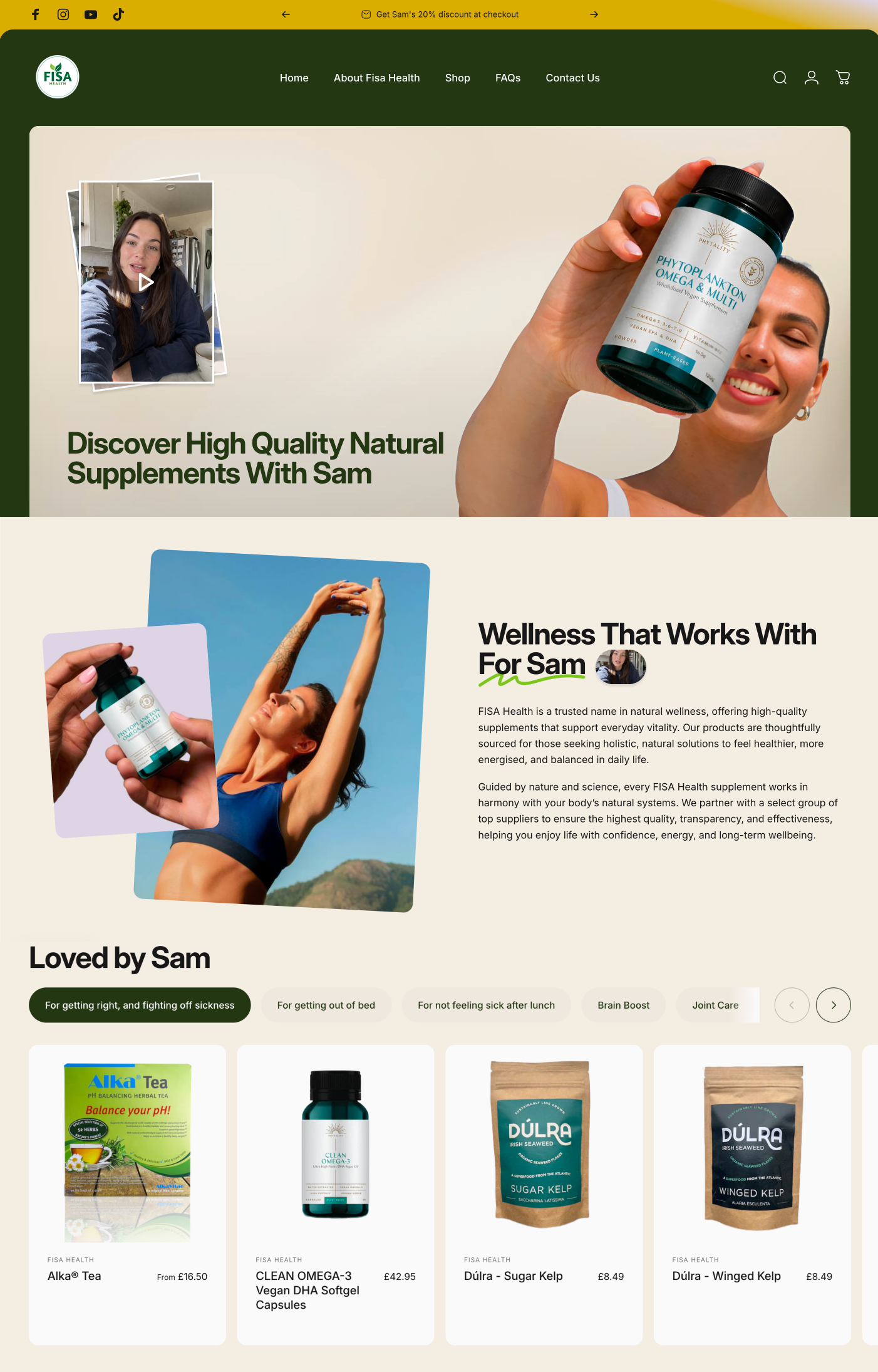


The Playbook for Fise Health
Fise Health sells trust as much as it sells supplements. With ~100 products and an average item price around £15, growth tends to come from three levers: converting more of the traffic you already earn, increasing order size through routines and bundles, and improving repeat purchase through better post-purchase guidance. Traditional affiliate links struggle on all three. They send shoppers to a generic page, they do not help the partner explain why a product matters, and they do not create a reason for the customer to come back through the same partner.
CreatorCommerce is built to solve that by turning each partner into a co-branded shopping experience on your Shopify store. Instead of 'one link, one product,' a partner shares a storefront and funnel that contains their story, their recommendations, and an auto-applied offer. Brands commonly see 30%+ higher conversion rate and 67% higher AOV versus regular affiliate links because the experience is clearer, more trusted, and better merchandised.
Below is a practical plan tailored to a UK-based health and supplements brand like Fise Health, designed for a partner community that includes practitioners, creators, and small businesses building their own storefronts of favourite products.
Step 0: Segment Strategy (choose the partners you can win)
Start by defining 3 partner segments and designing the storefront experience for each. In supplements, 'one size fits all' usually underperforms because an NHS-style practitioner and a lifestyle creator earn trust in different ways.
Segment A: Practitioners (nutritionists, PTs, wellness clinics, functional health coaches)
What they need: credible language, predictable results, clear routines, the ability to recommend a stack per goal, and fewer promotional gimmicks. Their audience wants a plan and reassurance. These partners are often willing to do deeper content (Q&A, 'who should avoid,' routine timing) if it lives on a professional-looking page on your site.
Segment B: Health + lifestyle creators (micro-influencers, community leaders, mums, biohacking hobbyists)
What they need: simple talking points, social-friendly bundles, easy sharing, and proof points (reviews, before/after style journeys where appropriate, 'what I take daily'). Their audience buys when the recommendation feels personal and the next step is frictionless.
Segment C: Small businesses and community storefronts (gyms, yoga studios, wellness subscription boxes, local communities)
What they need: a 'shop our favourites' page that feels like a mini store, plus seasonal kits. These partners can drive higher frequency because they have an ongoing relationship with customers.
For each segment, decide up front: (1) which products they are allowed to promote, (2) which claims are safe, (3) the default discount structure, and (4) the content you want to collect. This segment strategy drives enrollment, activation, funnel layouts, and measurement.
Step 1: Partner Enrollment (make it easy to say yes)
Enrollment should feel like joining a program that helps partners earn more, not like filling out a form to get a link. Your recruitment motion could run in parallel across all three segments:
1) Practitioner pipeline
Build a short list of UK practitioners who already publish routines or product recommendations. Outreach should offer: a co-branded storefront on Fise Health, a practitioner-only routine template, and a simple onboarding call or Loom walkthrough. Provide a 'practitioner starter kit' that includes a recommended baseline stack, an immunity stack, and a vitality/energy stack they can tailor.
2) Creator seeding pipeline
Seed product to micro-influencers who already talk about routines, sleep, energy, immunity, or stress. Instead of asking for a post, ask them to build a 'My daily wellness shelf' storefront. That changes the ask from 'create content for us' to 'build your shop on our site,' which tends to drive higher follow-through.
3) Small business pipeline
Offer gyms and studios a store page they can link from their website, class emails, and QR codes in-store. Position it as 'your members' supplement shelf' with member pricing.
Keep the enrollment flow short: name, email, social/website, partner type, and a single question about the goal they focus on (immunity, energy, gut, stress/sleep, everyday baseline). CreatorCommerce partner apps can power the intake and then generate the first version of their storefront automatically.
Step 2: Partner Activation by Segment (get them live in 48 hours)
Activation is where most affiliate programs lose momentum. The goal is: partner receives access, sees a storefront with their name and products already curated, and has a clear reason to share within 48 hours.
Activation for practitioners
Give them a storefront template that looks clinical and confident: 'Recommended by [Name, Credential]' at the top, a short 'My approach' paragraph, then three goal-based routines with 3–5 products each. Collect (or generate) content that matters: who it is for, when to take, and what to pair with. Use a form to ask 5 questions max (specialty, top goals, favourite 5 products, preferred tone, disclaimers). Where you are missing inputs, use automation/AI to draft routine descriptions from product ingredients and existing site copy, then let the practitioner approve quickly in a dashboard.
Activation for creators
Start with a simple 'Top 10 favourites' shop. Add a 'Start here' product and 2 bundles. Encourage one hero piece of content (30–60 second routine video or a simple 'what I take' post) that you can embed on the storefront. The storefront should include an auto-applied discount so viewers do not have to remember codes and do not second-guess the offer.
Activation for small businesses
Default to a 'member shelf' page with 3 collections: Everyday Essentials, Immunity & Recovery, Energy & Vitality. Provide them with a printable QR code that links directly to their co-branded page and a short email template they can send to members.
Whitelisted Meta ads (partner-authorized)
For partners who have strong content, you could run whitelisted ads where the creative and voice stays in the partner identity but the destination is their co-branded Fise Health shop. The key is reducing approval friction: 1-click partner ad authorization through our partners, then Fise Health controls spend and iteration while keeping the trust signal of the creator/practitioner.
Step 3: Co-branded Storefronts & Funnels (design for how people actually buy supplements)
In wellness, people rarely buy a single item in isolation once trust is established. They buy routines. Your storefront strategy should reflect that and aim to lift AOV above a single £15 item by packaging complementary products and offering clear 'start here' paths.
Storefront layout recommendations
1) Header: partner name + who it is for (e.g., 'For busy professionals' or 'For gut health clients').
2) A single 'Start here' routine (3 products max).
3) Two secondary routines (immunity, vitality, sleep/stress, gut).
4) A short FAQ section in the partner voice ('What I notice first,' 'How long to try it,' 'What to avoid combining').
5) Social proof: reviews and a simple 'why I trust Fise Health' module (pure ingredients, UK-based, quality sourcing).
Funnel tests to run
A/B test 1: Routine-first landing page vs. product grid. For supplements, routine-first often wins because it reduces decision fatigue.
A/B test 2: Auto-applied discount vs. code entry. Auto-apply reduces mental math and removes a common drop-off in cart.
A/B test 3: Partner video at top vs. mid-page. Video can increase trust but can also delay shopping; test placement.
A/B test 4: 'Take this quiz' (lightweight) vs. 'Shop my routine.' For some creators, a simple 3-question quiz increases relevance.
Because you have ~100 products, avoid giving partners a blank canvas. Give them guardrails: recommended lists per goal and an easy way to swap products in and out. That protects brand positioning and keeps storefronts high quality.
Step 4: Funnel Details (beyond the landing page)
Most programs stop at a landing page. The lift comes when co-branding continues through product pages, cart, and post-purchase.
Co-branded product detail pages (PDPs)
When a shopper clicks a product from a partner store, keep partner context visible: 'Recommended by [Name]' and a short 'why' snippet. Add a 'Frequently paired with' module that reflects that partner's routine, not a generic recommendation. This is how you increase multi-item baskets.
Co-branded cart and checkout cues
Add a cart note like 'You are shopping [Partner]'s Fise Health picks' plus the auto-applied offer. If the partner is a practitioner, include a subtle compliance-safe reminder: 'Supplements are not a substitute for a varied diet' (or your preferred UK-compliant wording). Trust and clarity reduce checkout hesitation.
On-site pop-ups that help, not annoy
Use pop-ups for context, not spam: 'Want [Partner]'s 30-day routine?' with a one-click add-to-cart bundle. Another effective option: 'Not sure where to start?' that reveals the partner's top 3 picks based on a single question (goal selection).
Content modules that build trust
For practitioners: credential badge, short bio, and 'how I evaluate supplements' checklist. For creators: a 'My routine' module with simple timing (morning/evening). This content can be collected once and reused across many pages.
Step 5: Launch & Track (measure what matters)
Implementation should sit natively in Shopify (Liquid) so pages load fast and match your theme. The launch plan could look like this:
Week 1: Foundation
Connect Shopify and your affiliate platform (TBD). Define default templates for each segment, default discount rules, and a starter set of 30–50 partners to launch with (a mix of practitioners, creators, and small businesses).
Week 2: Go live behind existing links
Spin up co-branded experiences behind partners' existing affiliate links so they do not have to change behavior. This reduces adoption friction and lets you compare performance apples-to-apples.
Week 3–4: Dashboard reporting and partner coaching
Track conversion rate, AOV, revenue per click, and repeat rate by segment and by partner. Pay special attention to: (1) attach rate of 2nd and 3rd items, (2) bundle take rate, and (3) reorder behavior on core SKUs.
Attribution quality
Cart-based attribution can capture additional orders that would otherwise be missed when shoppers browse and come back later. This is particularly valuable in supplements where consideration cycles can be longer than a single session.
Step 6: Optimize (turn the program into a content engine)
Optimization should be a mix of content campaigns and funnel iteration. The goal is to give partners reasons to talk about Fise Health repeatedly, without repeating the same message.
Must-have retention flows
1) Co-branded cart abandonment: email/SMS that keeps the partner name, their recommended routine, and the auto-applied offer. This maintains trust continuity.
2) Co-branded post-purchase: 'How to take your routine' from the partner, with timing tips and suggested add-ons for next order.
3) Replenishment reminders: for key supplements, send reorder prompts that reference the original partner routine ('Time to restock your immunity stack from [Partner]').
Seasonal campaign calendar (UK health/wellness)
January–February: Routine reset — '30-day baseline' storefront refresh, simple habit trackers, partner-led routines.
March–April: Spring energy — vitality/energy focus; creators share morning routines; practitioners share client-friendly plans.
May–August: Travel + active months — 'travel essentials' shelf, 'gym recovery' shelf for PTs and studios, hydration and immunity bundles (as appropriate to your product line).
September–October: Back-to-routine — stress/sleep and daily baseline stacks; partner Q&A modules perform well here.
November–December: Winter immunity + gifting — immunity routines, family-friendly guides, and curated giftable bundles.
Ongoing monthly beats
'Partner favourites of the month' (easy creator content), 'Ask a practitioner' Q&A drop (trust building), and 'Customer story' features that are compliance-safe and focus on experience rather than medical claims.
Merchandising optimizations that lift AOV
Build bundles that feel like routines, not discounts. Example patterns: Starter (2 items), Core (3 items), Complete (4–5 items). Keep the decision simple and explain who each tier is for. This is often the fastest path to a higher AOV when your base price point is ~£15 per product.
Step 7: Advanced (for practitioners and publishers)
Once you see which partners consistently convert, expand what you offer them.
Co-branded whitelabel experiences
For top practitioners, you could offer a deeper co-branded experience that looks like a micro-site on your domain (their logo, their navigation, their program). This is especially compelling for clinics that want to send clients to a 'recommended products' portal that feels like part of their practice.
Embeds for partner sites
Some professionals will not link out to a generic shop. Product embeds (e.g., 'Recommended stack' widget) on their website that maintains your attribution and pricing can unlock partners you would otherwise miss.
Business-to-business referrals
If you decide to pursue corporate wellness, you can adapt the storefront model into 'company wellness shelves' with limited SKU sets and a simple re-order path. Even a small number of these can become meaningful volume because of repeat purchasing patterns.
What Fise Health could do first (a simple 30-day pilot)
1) Pick 3 goals and build routine templates: Everyday baseline, immunity, vitality/energy (or your top sellers).
2) Recruit 30–50 partners across the three segments: 10 practitioners, 25 creators, 10 small businesses/community leads.
3) Launch co-branded shops behind existing affiliate links so partners do not need to relearn anything.
4) Run two tests: routine-first vs product-first landing pages, and auto-applied discount vs code.
5) Add co-branded abandonment + post-purchase flows to improve conversion and repeat rate quickly.
That pilot will tell you, with real numbers, which partner segment produces the best conversion rate, which produces the highest AOV, and which produces the best repeat purchase. From there, scaling is straightforward: generate more storefronts, deepen content, and keep giving partners new reasons to share.

.png)

.jpeg)

.jpeg)





%201.png)
%201.png)