


The Playbook for G FUEL
You already have what most brands try to manufacture: a real community and a lot of creator-driven demand. G FUEL’s audience follows gamers, streamers, esports teams, athletes, and pop-culture collaborators because they trust them. The problem is that most affiliate programs still send that demand through a generic link path: the fan lands on a standard page, has to remember a code, and then has to search through a large catalog to find what the creator actually meant. That creates drop-off, lower AOV, and lost attribution.
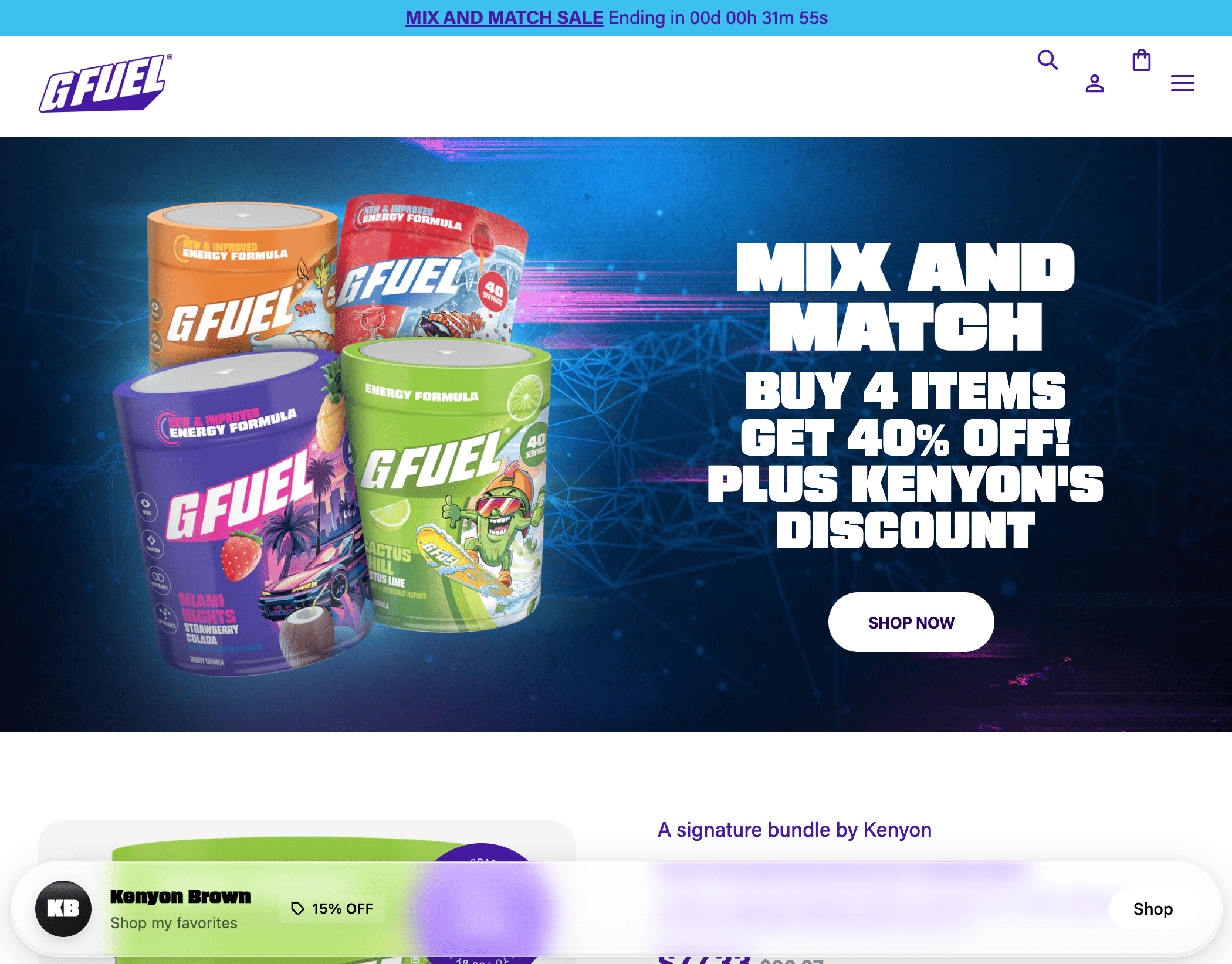
CreatorCommerce is built to change that path. Instead of treating a creator click as a referral to your store, you treat it as the start of a co-branded shopping session. The session should immediately answer: 'What does this creator recommend for me?' and 'What is the best way to buy right now?' When the creator’s identity, curated products, and an auto-applied offer show up on-page, brands typically see 30%+ higher conversion rate and 67% higher AOV compared to regular affiliate links.
Step 0: Segment Strategy (who to win, and what each segment needs)
Start by defining 4–6 partner segments that reflect how people buy in supplements and in gaming culture. The goal is not just better partner management. It is to build storefront templates that match the buyer’s intent, the creator’s content style, and the products that fit that context.
Segment A: Core gaming creators (Twitch/YouTube). These are the partners driving daily sessions and repeat exposure. Their audience buys for performance during long sessions and wants fast decision-making. Their storefront should be optimized for 'best sellers + creator favorites', a simple starter bundle, and one-click trust signals (ratings, what the creator drinks on stream, caffeine clarity).
Segment B: Esports orgs and teams. Team fans buy for identity and collection. Their storefront should lean into drops, limited flavors, team-branded bundles, and a 'fan kit' structure that pushes AOV: tubs + shaker + cans, with an auto-applied team discount.
Segment C: Fitness and athlete partners. These buyers care about ingredients, routine, and outcomes. Their storefront should lead with 'when to use' flows: pre-workout focus, hydration during training, recovery support. Add a 'my stack' section and FAQ content that preempts objections.
Segment D: Pop-culture collaborators. These campaigns spike interest quickly and then decay. Their storefront should be built for moment marketing: launch timer, email/SMS capture, short-form UGC clips, and a clear merchandised path to the collaboration product plus 2–3 related add-ons to lift AOV.
Segment E: Community affiliates and micro-influencers. This includes Discord community leaders, small creators, and niche genre accounts. They convert when the setup is simple. Give them a clean storefront with a pre-curated collection (no heavy customization needed), auto-applied discounts, and a basic UGC request form so you can keep the page fresh without extra work from them.
Because you are in supplements, do not treat this as 'influencers only.' The most sustainable growth comes from matching segment to funnel type: performance segments need clarity and trust; fandom segments need identity and collections; micro segments need ease and consistency.
Step 1: Partner Enrollment (increase partner volume and quality without adding manual ops)
You already run a strong Snowball program with a few dozen programs and a focus on gamers and athletes. The next enrollment step is to remove friction and make the offer more compelling: not just 'here is a link and a code,' but 'here is your shop on gfuel.com.'
First, tighten the enrollment pitch by segment. For gaming creators, the hook is a co-branded shop with their top flavors and an auto-applied discount, plus the ability to add clips and their 'on-stream routine.' For teams, it is a branded fan storefront. For athletes, it is a 'my stack' page. When the promise is specific, response rates go up and the content you request feels natural.
Next, make seeding and recruiting feed directly into storefront creation. Every time you seed product, include a short data capture flow (3–6 questions) that will later populate their storefront: preferred flavors, caffeine tolerance messaging, goal (energy/hydration/focus), and any existing content links. CreatorCommerce pages can be generated from partial data, so you do not need perfection at enrollment. The goal is to start the flywheel: seed → capture minimal data → auto-generate storefront → notify partner → partner shares → you improve storefront over time.
Then, build a simple inbound path for long-tail creators: an 'Apply for your G FUEL Shop' page that leads to Snowball signup plus the CC storefront request form. The key is to position it as a benefit (a storefront) rather than an obligation (an application). This shifts your program from a typical affiliate program to a creator commerce program.
Step 2: Partner Activation by Segment (turn signups into sales quickly)
Activation is where most programs stall. Partners sign up, get a link, and never post. To change that, the first 72 hours after approval should feel like a launch, not an onboarding task.
First: deliver the 'shock & awe' asset. Within one day of approval, the partner should receive their live co-branded storefront URL on gfuel.com, already populated with a strong default layout. Include an auto-applied discount, the partner’s name and image, and a pre-built product set based on segment. For example, gaming creators get 'Creator’s Top 5', 'Starter Kit', and 'Stream Stack'. Athlete partners get 'Training Day', 'Hydration', and 'Recovery add-ons'.
Next: use forms to collect the content that matters. Do not ask for everything. Ask for the pieces that directly improve conversion: 1) their top 3 products, 2) one short 'why I use it' statement, 3) 1–3 content links (clips, posts), 4) any must-avoid claims. CreatorCommerce can use workflows and AI to draft product copy snippets, FAQs, and 'how to use' guidance from these inputs, then your team can approve and moderate at scale.
Then: automate the 'go live' notification sequence. Send a short email/SMS flow: Day 1 'Your shop is live', Day 3 'Add your top flavors (2 minutes)', Day 7 'New content request + featured bundle suggestion', Day 14 'Performance recap + next action.' The point is to make posting and updating feel light, while continuously improving the storefront’s conversion rate.
Whitelisted paid amplification. For top partners, offer a one-click authorization flow for whitelisted Meta ads. You provide pre-approved creative templates (UGC clip + product card + creator shop URL). This is especially effective for new drops and seasonal pushes where creators have content but do not want to manage spend. Your team gets better control over messaging and can scale winners quickly.
Step 3: Co-branded Storefronts & Funnels (what the fan should see, and why it wins)
The storefront should be designed to reduce decision fatigue across ~200 products. A creator’s audience should not land on a huge catalog page. They should land on a curated set that feels like the creator’s personal recommendation.
Template 1: 'What I drink on stream' (gaming). Hero: creator image + short line on when they use it. Modules: Top 5 flavors, Starter Kit bundle, 'Caffeine & timing' FAQ, and UGC clips. Add a 'Try it risk-free' reassurance module if you have it (shipping, returns, subscribe options). Include auto-applied discount so buyers do not do mental math.
Template 2: 'Fan kit' (teams/collabs). Hero: collab branding and drop focus. Modules: featured drop item, limited-time bundle, add-on section (shaker, cans, variety packs), social proof from community photos, email/SMS capture for restocks. This template is built to lift AOV and capture demand when items sell out.
Template 3: 'My stack' (athletes). Hero: routine and outcome framing (without claims that create compliance risk). Modules: recommended stack by time of day, ingredient clarity, how-to-use, 'beginner option' vs 'advanced option', and a simple comparison table to reduce confusion.
Across all templates, build in tests that matter: UGC vs product-first hero; starter bundle placement; FAQ density; and the presence of creator content above the fold. The point is to treat each storefront as a conversion asset you can iterate, not a static landing page.
Step 4: Funnel Details (beyond the landing page: product page, cart, and on-site moments)
Most of the incremental revenue will come from what happens after the first click: product pages, cart, and checkout. This is where co-branding needs to persist.
Co-branded product pages. When a shopper enters from a creator storefront, carry the creator context onto PDPs: 'Recommended by [Creator]', a short creator quote, and a creator-specific 'how I use it' module. This keeps trust high and reduces second thoughts. Also show the discount as already applied to avoid code errors.
Co-branded cart and bundles. Use cart-level modules to increase AOV: 'Complete the stack' suggestions based on what is in cart (e.g., hydration add-on, shaker, variety pack). The cart should show the creator’s name and discount clearly. Cart-based attribution can also capture orders that might be missed when shoppers open new tabs or return later, helping recover ~2.5% more orders.
Pop-ups and moments. Instead of generic pop-ups, use context-aware ones: 'Want [Creator]’s top 3 flavors?' (one-click add bundle), or 'Get restock alerts for the collab drop.' These should be tied to the creator storefront so the shopper feels the page is personalized, not promotional.
On-site content modules. For supplements, trust content matters. Add lightweight modules: caffeine amount clarity, usage timing, and taste notes. For G FUEL specifically, taste is a huge driver. A simple 'Flavor profile' and 'Community rating' module within creator storefronts can reduce returns and increase confidence.


Step 5: Launch & Track (how to roll out without disrupting what already works)
You do not need to replace Social Snowball. The clean rollout is to keep existing links/codes and place CreatorCommerce storefronts behind them. That means partners keep what they already share, but the click experience improves immediately.
First: pilot with a representative cohort. Choose 15–30 partners across segments: a few top gaming creators, a team partner, a couple athletes, and some micro affiliates. Build the storefront templates and launch within 2–3 weeks.
Next: define the scorecard. Track conversion rate, AOV, revenue per session, add-to-cart rate, and repeat purchase rate by cohort. Also track partner retention signals: share frequency, content submissions, and whether partners update their storefront. Compare these against baseline performance from standard affiliate links.
Then: operationalize moderation. Because you have many products and many partners, implement a simple review queue for storefront changes and AI-generated content so brand voice and compliance stay tight. The goal is scale with control: lots of pages, but consistent quality.
Step 6: Optimize (campaigns, tests, and retention flows that compound)
Once storefronts are live, the biggest compounding effect comes from running a recurring content and merchandising calendar. This creates viral moments and keeps creators engaged because there is always something new to promote.
Must-have: co-branded cart abandonment and post-purchase flows. If a shopper abandons cart, the email/SMS should reference the creator: 'Your [Creator] discount is still applied' with the creator shop link. After purchase, send a co-branded follow-up: how to use, flavor suggestions for next order, and a subscription or reorder prompt. This improves conversion recovery and repeat purchase while reinforcing the creator association.
Monthly campaign concepts (gaming + supplements). 1) 'Creator Flavor Draft' (creators pick top flavors, fans vote, page updates). 2) 'Stream Stack Week' (energy + hydration bundles with creator routines). 3) 'New Flavor First' (early access bundles per creator segment). 4) 'Clip-to-cart' UGC collection drive (submit clips, top clips featured on storefronts). These campaigns produce new content and reasons to return.
Seasonal calendar (US market). Spring: hydration push and variety packs. Summer: cold-mix recipes, on-the-go cans, travel bundles. Back-to-school: focus stacks for studying and work. Fall: limited flavors and fandom collabs. Holiday: giftable bundles and 'starter kits' with creator picks. Each season should have pre-built storefront modules you can turn on for the relevant cohort in a day.
Ongoing testing priorities. Test auto-applied discount messaging placement, bundle construction (starter kit vs pick-your-3), UGC placement, and 'recommended by creator' modules on PDPs. Because your baseline AOV is around $40, the fastest AOV lift typically comes from: 1) starter bundles, 2) shaker add-ons, 3) variety packs, and 4) subscribe-and-save prompts in a creator context.
Step 7: Advanced (publisher and professional partners)
If you have partners with larger owned audiences (gaming news sites, esports community hubs, larger Discord communities with web properties, or fitness publishers), offer deeper integrations. This can be either a fully co-branded whitelabel mini-site experience on your domain, or embeddable product modules that live on their site but check out on Shopify.
For example, a publisher could embed a 'Top 10 G FUEL flavors for ranked grind' module that is dynamically powered by your catalog and routes into their co-branded storefront. These partners care about user experience and monetization clarity; giving them a clean, high-converting embed can make you their default commerce partner.
What this could unlock for G FUEL
The goal is to squeeze more metrics and more viral moments out of the program you already have, without adding heavy manual work. Co-branded storefronts turn partner links into fully merchandised shopping sessions, which is why brands typically see 30%+ higher conversion rate and 67% higher AOV compared to regular affiliate links. Just as important, giving creators real on-site ownership changes partner behavior: they share more often, they submit better content, and they stay longer—because they are building something that looks like theirs, on your domain.

.png)

.jpeg)

.jpeg)





%201.png)
%201.png)