

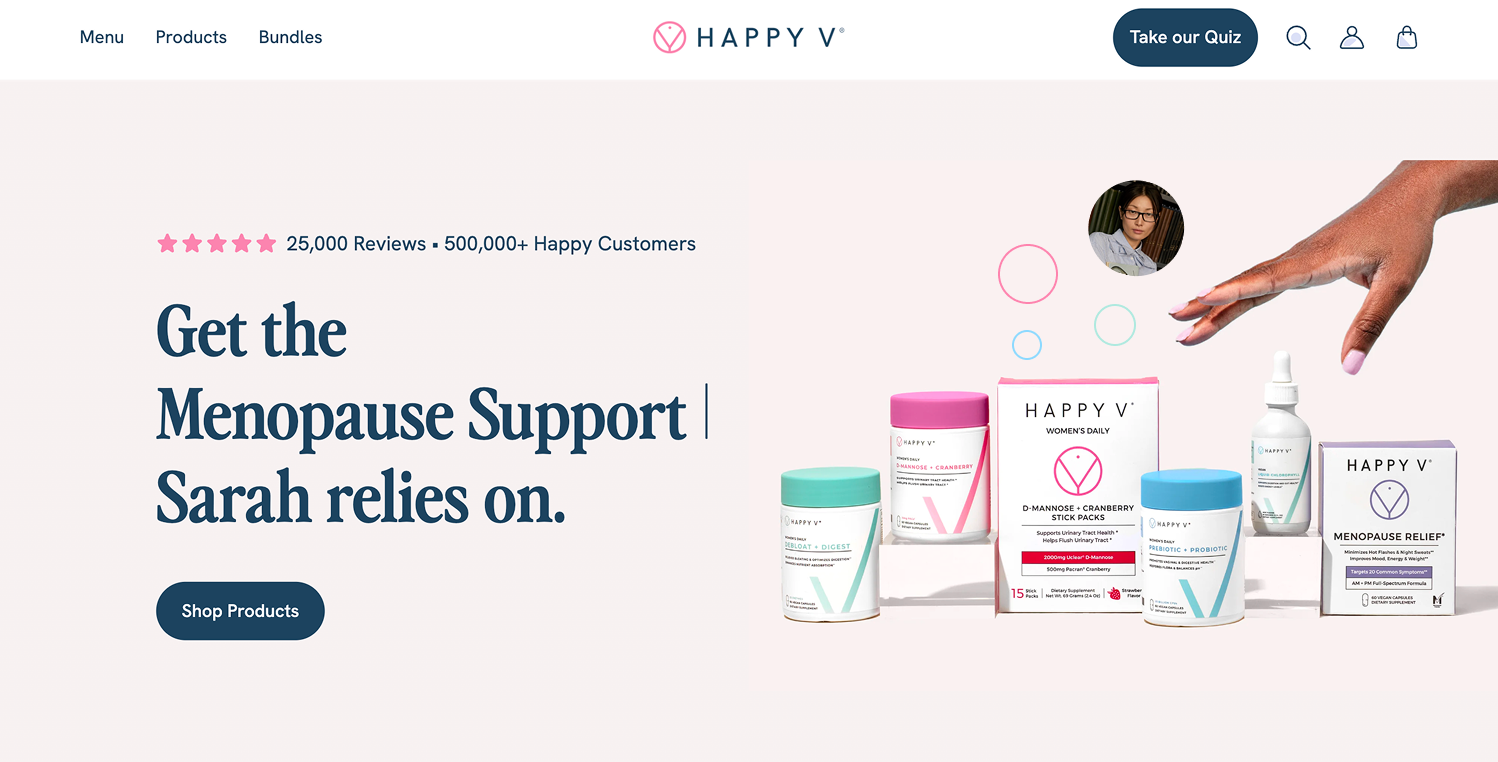


TLDR: This strategy covers something to build upon throughout 2026. It doesn't need to be implemented in full to see quick & snappy results from basic co-branded landing pages -- that can happen in a few days.
The Playbook for Happy V (Female Health, US Market) — Turning Social Snowball traffic into higher CVR, higher AOV storefronts
Happy V already has what most wellness brands are missing: clear product purpose, a tight catalog (9 SKUs), and a science-backed position that can earn trust. The gap is rarely product. The gap is the shopping journey after a partner shares a link. A standard affiliate link sends every person to the same destination, forces them to self-navigate sensitive health needs, and loses context from the person they trusted enough to click.
CreatorCommerce is built to keep that context. Instead of 'traffic to homepage,' each partner could send their audience to a co-branded shopping experience on Happy V's Shopify theme with their name, their routine, their discount auto-applied, and content that answers the first 5 questions a shopper has. Brands using CreatorCommerce typically see 30%+ higher CVR and 67% higher AOV vs regular affiliate links because the experience reduces doubt and increases basket size through curation and bundles.
Below is a specific plan for Happy V with Social Snowball, designed for two growth motions at once: (1) creator-led social momentum and (2) practitioner-led trust and authority. The common thread is that both groups need an easy way to recommend a routine, not a single product, and they need that recommendation to look and feel like Happy V.
Step 0: Segment Strategy (who you will win, and what each segment needs)
For female health, the highest-performing partner program usually blends influencers (reach + relatability) and professionals (authority + conversion). Happy V could run three primary segments, each with a different storefront template and activation flow:
Segment A: Micro-influencers (5k–75k followers) focused on women's wellness. These partners drive volume and consistent content. Their audience needs simple language, routines, and social proof. Their storefront should feel personal: 'My Happy V routine,' FAQs, before/after expectations phrased carefully, and a discount that auto-applies so shoppers do not do mental math.
Segment B: Mid/Top influencers (75k–500k+). These partners drive spikes. Their storefront should be campaign-ready: hero section with their video, a seasonal offer, and a curated bundle to lift AOV. Their audience tends to browse on mobile, so the flow should be short: problem → routine → proof → checkout.
Segment C: Clinical leaders and practitioners (OBGYN-adjacent educators, pelvic floor PTs, dietitians, nurse practitioners, health coaches). These partners drive trust and high intent. Their storefront should be education-first and conservative in claims: what the routine is for, who it may help, who should avoid it, and what to expect over time. It should include a 'recommended starter routine' plus optional add-ons, which is ideal for your ~$40 price point and a 9-product catalog.
This segmentation matters because it determines what you collect from partners, what modules show up on their pages, and what bundles you build. It also helps you avoid trying to make one page do everything.
Step 1: Partner Enrollment (more partners, with the right positioning)
Enrollment should be designed as two lanes: creators and practitioners. Both lanes can run through Social Snowball for tracking, but the pitch and intake form should differ.
Creator lane (influencers/ambassadors): offer a simple promise: 'You will get a co-branded shop on Happy V that converts better than a link.' The enrollment page could show examples of what their shop will look like, explain that discounts auto-apply, and that they can curate a routine (not just one product). The call to action is clear: apply, get approved, receive your shop within a day, start sharing.
Practitioner lane (clinical leaders): position it as 'a compliant, education-led recommendation page on Happy V.' The intake should ask for credentials (if applicable), preferred disclaimers, and the patient personas they work with (menopause, recurrent odor/itch discomfort, gut + vaginal balance, hormonal support). This lane should emphasize that they can recommend routines and share educational notes, and that their audience gets a clean, branded checkout experience.
On recruitment sources: creators can come from product seeding, inbound applications, and short DM/email outreach campaigns. Practitioners can come from targeted lists, conference attendee lists, podcast guests, continuing education communities, and existing customers who self-identify as professionals. CreatorCommerce's partner app experiences could power the intake, content collection, and page setup so enrollment and activation are connected (not separate systems).
Step 2: Partner Activation by Segment (get them sharing fast, with 'shock & awe' co-branding)
Activation is where most affiliate programs leak. Partners join, get a link, and then nothing happens. Happy V could activate partners by giving them something that feels like an asset: a co-branded storefront that already looks finished, plus a quick path to customize.
Activation for creators: within 24–48 hours of approval, they receive (1) their co-branded storefront link, (2) 2–3 pre-written captions that match sensitive wellness language, (3) one 'starter routine' bundle that is ready to share, and (4) a short form where they can pick: top concerns their audience has, content angle (journey/testimonial, education, routine), and preferred discount framing. AI + workflows can pre-fill the storefront using whatever partial info you have: their handle, niche keywords, past seeding order, and any notes from outreach.
Activation for practitioners: they receive a slightly different kit: (1) a co-branded storefront with an education-first template, (2) an editable 'recommended routine' section, (3) a Q&A module with default answers drafted by Happy V (reviewed by your team), and (4) a patient handout-style PDF or 'how to use' summary that links back to their storefront. This makes it easy for them to share in newsletters, resource pages, and follow-up emails. The goal is not viral; the goal is steady high-intent conversion.
Whitelisted Meta ads as an amplifier: for a subset of top creators, Happy V could run whitelisted Meta ads using partner content. The operational ideal is 1-click ad authorization through your partner tooling, then route paid clicks to that creator's co-branded storefront. This often outperforms ads to a generic PDP because the page carries identity, context, and a pre-set routine.
What you should collect during activation varies by segment, but keep it light: 3 audience concerns, 1 preferred product focus, 1 content asset (video or quote), and permission to use name/image/likeness for on-site modules.
Step 3: Co-branded Storefronts & Funnels (templates that match the partner and the shopper)
With a 9-product catalog, Happy V is well positioned for curation. The job of the storefront is not to show everything; it is to reduce choice and increase confidence. Each partner page should have a default structure that makes shopping feel guided.
Creator storefront template (social-first):
1) Hero: creator name + 'My Happy V routine' + one sentence about who it is for (picked from the form).
2) Routine builder: a 2–4 item recommended set (bundle) with clear 'why' bullets in simple language.
3) Proof: UGC video, short quote, or 'what I noticed' timeline with careful wording (no medical promises).
4) FAQ: 5–7 questions tailored to sensitive buying friction (taste, how to take, when to expect changes, who should ask a doctor, shipping/returns).
5) Trust modules: vegan/non-GMO, science-backed, ingredient callouts, and links to brand-level education pages.
6) CTA: 'Add routine to cart' with auto-applied discount.
Practitioner storefront template (education-first):
1) Hero: practitioner name, credential line (if applicable), and 'My recommended Happy V routine.'
2) Patient personas: select 2–3 personas (menopause support, pH balance, gut + vaginal balance, hormonal support) that jump to the right routine.
3) Guidance section: 'Who this is for,' 'Who should not use without guidance,' and 'What to expect' (reviewed by Happy V).
4) Routine + add-ons: start with a conservative starter routine, then optional add-ons for those who want more comprehensive support.
5) Q&A: a practitioner voice Q&A that reduces anxiety and increases confidence.
6) CTA: routine to cart with discount.
Key funnel tests to run early: (a) bundle vs no bundle, (b) auto-applied discount placement (banner vs in-cart), (c) short UGC above the fold vs below, (d) a 'Start here' quiz module vs static routine, and (e) featuring 1 hero SKU vs a routine set. These tests typically drive both CVR and AOV improvements when executed on partner-specific pages.
Step 4: Funnel Details (beyond the landing page: product pages, cart, pop-ups)
The biggest lift often comes from carrying the co-branding all the way through the shopping experience. Happy V could extend the partner identity and routine logic into PDPs and the cart.
Co-branded PDP layer: If a shopper lands on a partner storefront and clicks into a product, the PDP should retain the partner context: 'Recommended by [Partner]' plus their note ('I suggest this if your main goal is...'). This reduces drop-off because the shopper feels guided. It also increases trust for sensitive purchases.
Auto-applied discounts: Ensure the partner discount is applied automatically in the cart and reflected clearly. This removes friction and reduces 'I'll come back later' behavior.
Cart upgrades to lift AOV (aligned to $40 average product price): Add a cart module that says 'Complete the routine' with one-click add-ons. Because your catalog is small, you can curate these add-ons carefully and keep it on-brand. For creators, the upsell is framed as 'my full routine.' For practitioners, it is framed as 'optional support depending on goals.'
Co-branded pop-ups: Use a light-touch capture: 'Want [Partner]'s routine guide + reminders?' Collect email/SMS and tag it to that partner. This supports post-purchase and winback flows while strengthening attribution and retention.
Content modules that matter for female health: ingredient transparency blocks, 'how to take' clarity, shipping/returns reassurance, and a respectful tone that avoids shame. The more the page answers quietly, the less customer support and hesitation you will see.
Step 5: Launch & Track (spin up funnels behind existing links, monitor the right metrics)
Launch should not require partners to change behavior. Keep their Social Snowball links (or codes), and route that traffic into their co-branded experience. This reduces retraining and lets you compare performance apples-to-apples.
Metrics to watch weekly:
1) Conversion rate (CVR) by partner segment and by template.
2) Average order value (AOV) vs non-partner traffic and vs standard affiliate link traffic.
3) Attach rate of 'routine bundles' (how often multi-item carts happen).
4) New customer rate and second-purchase rate (proxy for CLTV).
5) Partner activation rate: % approved partners who share within 7 days.
6) Partner retention: % partners who drive at least one order each month.
Attribution improvements: cart-based attribution can capture additional orders that would otherwise be missed when shoppers browse, leave, and return. This tends to increase credited orders and improves partner trust in the program.
Step 6: Optimize (content campaigns, funnel tests, and co-branded retention)
Once the first wave is live, optimization should be a steady cadence: monthly content themes, quarterly funnel upgrades, and always-on retention flows.
Must-have retention: co-branded cart abandonment. If someone abandons, the email/SMS should reference the partner and the routine: 'Your cart from [Partner]' with the same discount. This single change often increases recovered revenue because it reintroduces the original context.
Must-have retention: co-branded post-purchase education. For supplements, confusion after purchase can increase refunds and reduce repeat. Send a partner-branded 'how to use' and 'what to expect' flow, with gentle prompts to reorder or add complementary items later. For practitioners, this can be more structured; for creators, it can be more conversational.
Seasonal campaign calendar ideas (US):
January–February: 'Routine reset' and 'confidence routine' storefront refreshes; focus on consistency and habit-building. Partners share 'my 30-day routine.'
March–April: 'Spring refresh' content: gut + vaginal balance angle; add a lightweight quiz module to match needs.
May–June: 'Travel-ready routines' and 'summer sweat + pH support' education (careful language). Bundles optimized for convenience to lift AOV.
July–August: Practitioner series: 'Ask me anything' Q&A modules embedded in practitioner storefronts; collect questions via forms.
September–October: 'Back to routine' + menopause education focus; highlight clinical partners and routines for hormonal support.
November: 'Gratitude + stocking stuffer' framing; creator gift guides with curated bundles.
December: 'New year prep' waitlist or early access bundles; recap content from top partners.
The key is that each campaign updates the storefront templates and gives partners a reason to share again. This prevents the common plateau where affiliates post once and then move on.
Step 7: Advanced (for practitioners and publishers: deeper co-branding options)
For select practitioner partners, Happy V could go beyond a storefront page and offer deeper integrations:
Whitelabel resource pages: a practitioner-branded mini site on Happy V's domain with their routines, FAQs, and links they can use across patient emails, Link-in-bio, and websites. This is valuable for practitioners who do not want to send patients to a generic ecommerce page.
Embeddable product/routine modules: if a practitioner has an existing site, provide an embed that displays their recommended routine (with live pricing and auto-applied discounts) while checkout still happens on Happy V. This keeps the experience simple and preserves tracking.
Clinic bundle strategy: because you have 9 products, you can create a small set of 'ready to go' bundles that practitioners can adopt with minimal editing: a starter routine, a menopause-focused routine, and a gut + vaginal balance routine. They can rename them in their storefront to match their voice, but the underlying merchandising stays consistent and operationally manageable.
What this could look like in the first 30 days
Week 1: finalize segment templates (creator vs practitioner), decide the initial bundle structures, and set your activation intake forms.
Week 2: recruit and onboard 20–30 creators and 5–10 practitioner partners; generate storefronts using automation + AI; collect 1 content asset each.
Week 3: launch, run whitelisted ads for 3–5 top creators, and start A/B tests on bundles and UGC placement.
Week 4: add co-branded cart abandonment + post-purchase flows, refine routines based on conversion data, and prepare the next month's content theme.
Happy V's advantage is that shoppers are already looking for guidance and reassurance. Co-branded storefronts turn that need into a structure: the right routine, the right content, and a checkout that feels confident. This is how partner traffic becomes repeatable revenue instead of one-off posts.

.png)

.jpeg)

.jpeg)





%201.png)
%201.png)