

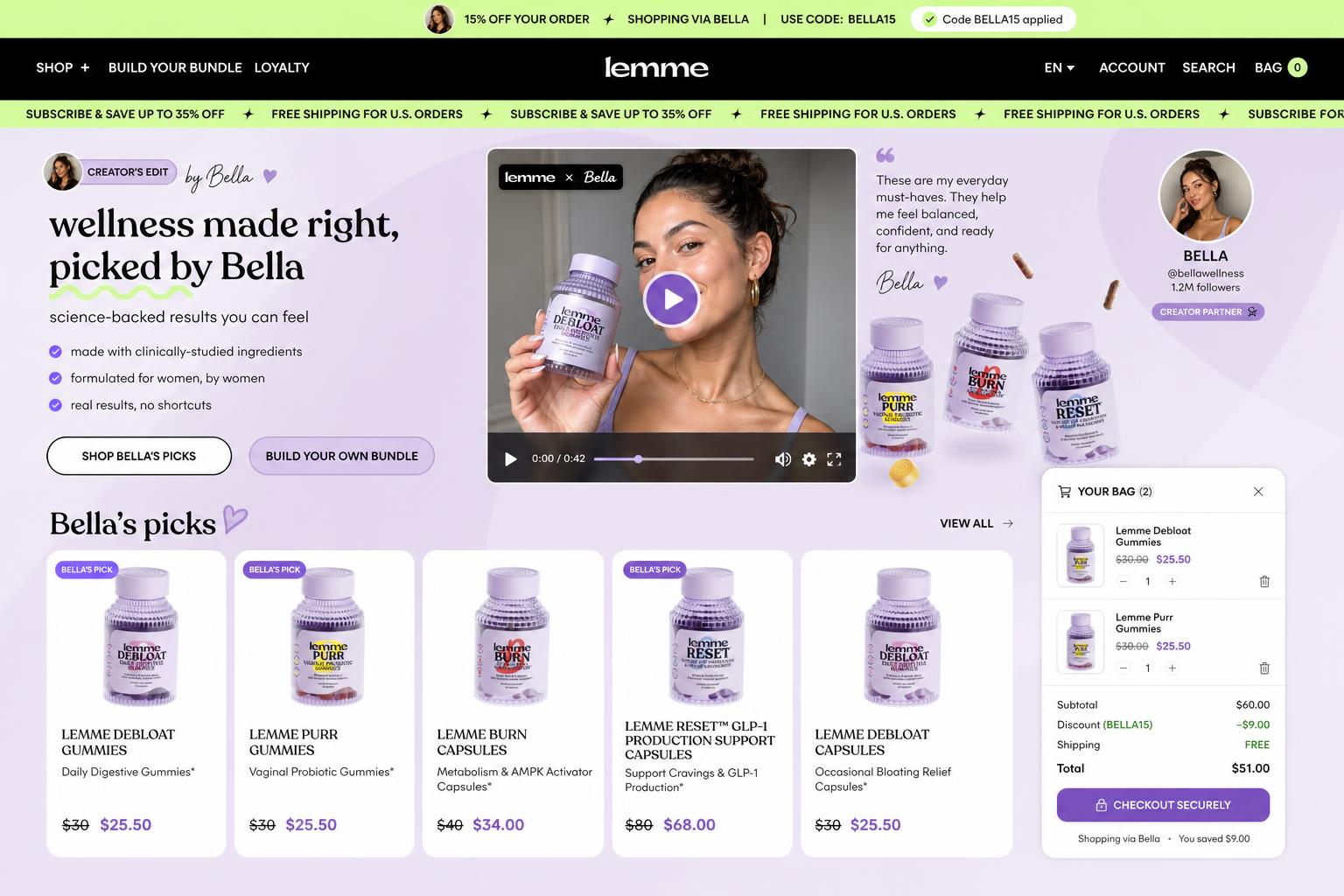


Lemme could use CreatorCommerce to turn creator and affiliate traffic into co-branded shopping experiences that keep the recommendation visible from the first click through cart. The core goal would be simple: give every high-potential partner a brand-native storefront that feels like Lemme, but carries the partner's identity, product picks, offer, and content into the buying path. For a health / wellness brand, that matters because shoppers rarely buy from one link click alone. They buy when the recommendation is specific, the products feel curated, and the page answers the next question without forcing them to hunt through the main site.
CreatorCommerce would sit on top of the commerce layer rather than replacing the stack. Lemme could keep Shopify, the existing theme, and the current affiliate or creator tools, then use CC to generate the post-click experience that most programs are missing. The benchmark is clear: brands typically see 30%+ higher CVR and 67% higher AOV when creator traffic lands on a personalized experience instead of a generic homepage or collection link. The mockup for this page shows the concept in Lemme's own visual language, with creator attribution, curated picks, UGC, discount continuity, and cart attribution added without changing the brand's funnel architecture.
0. Segment strategy
The first move would be to segment partners by the kind of trust they bring. Lemme should not treat every partner link the same. The best program would separate wellness creators, coaches, practitioners, ambassadors, and loyal customers into cohorts with different storefront templates, content prompts, and merchandising rules. A practitioner or expert partner needs education and credibility. A lifestyle creator needs personal favorites, fast social proof, and a strong visual hook. A loyal customer or ambassador needs a simple way to explain why the products fit their day-to-day routine.
The storefronts should then match those segments. For Lemme, the product language should center on stacks, protocols, daily rituals, bundles, habit education, proof points, and replenishment flows. The existing site context already points to merchandising surfaces like wellness made right, science-backed results you can feel, what everyone is talking about, Lemme Play Gummies, Lemme Colostrum Liquid, Lemme Tone Gummies, with navigation cues such as Skip to content, Essentials Bundle, Lemme Matcha Gummies, Shop all, Lemme Chill Gummies, Lemme Curb Capsules. CC could turn that structure into partner-specific edits: a creator's starter routine, a stylist's outfit rail, a coach's stack, a best-seller bundle, or a giftable collection. The strategy is not to create more pages for the sake of volume. It is to make every partner link feel like a real recommendation.
1. Partner enrollment
Lemme could strengthen partner enrollment by making the offer concrete before the partner ever posts. Instead of asking creators to join a broad affiliate program and figure out what to promote, the brand could show each partner a first draft of their own storefront: profile module, product favorites, offer code, UGC section, and a tracked link. That gives the partner a reason to activate quickly because the brand is handing them a finished asset, not another login and a bare affiliate URL.
Enrollment can still come from the channels the team already uses: inbound applications, product seeding, outbound emails, influencer platforms, referrals, and customer community flows. CC would improve the conversion moment after acceptance. A partner could submit a short form with their handle, audience, content style, favorite products, and top use cases. CC could use that data, plus order history or selected products, to create the first version of the partner storefront. The activation email would then lead with a preview, a live link, and a clear next step.
2. Partner activation by segment
Activation should feel different for each segment. A creator could receive a page titled around their edit, with a short note, their UGC, and a row of picks. A practitioner could receive a more educational page that explains the protocol and why each item belongs. A customer ambassador could receive a simpler favorites page that feels authentic and fast to share. This segmented approach gives Lemme more useful tests than one universal landing page.
The strongest activation moment is the first preview. When a partner sees their name, profile photo, content, and product choices inside a page that still looks like Lemme, the program feels more valuable. That is the practical 'shock and awe' moment. From there, CC could trigger email and SMS prompts, remind partners to finish missing content, and support whitelisted Meta ads where the partner authorizes the brand to boost high-performing creative. The page becomes the hub for content, commerce, and attribution.
3. Co-branded storefronts and funnel tests
The storefront tests should be concrete. Lemme could test creator UGC versus product-first heroes, single routine pages versus bundle pages, creator notes versus review quotes, discount-led copy versus education-led copy, and partner-curated product order versus best-seller order. The visual system should stay close to the current theme. The mockup keeps the logo, navigation, product-card density, and CTA treatment intact while adding the creator layer on top.
This is where the 30%+ CVR benchmark becomes reachable. A shopper clicking from a creator should not have to rebuild the context in their head after landing on the site. The page should say whose recommendation brought them there, which products that partner chose, what the offer is, and why the products fit the use case. For Lemme, that could mean routine pages, creator stacks, coach picks, practitioner protocols, quiz-led recommendations, and replenishment reminders. The experience stays shoppable, but it feels guided.
4. Funnel details
The business case gets stronger when the creator context carries beyond the first page. CC could extend the same attribution into product pages, pop-ups, carts, and checkout-adjacent modules. A shopper might see 'Bella's code applied' in the cart, a small creator note near the product recommendation, or a reminder that the bundle was selected by the partner they came from. This continuity protects the trust that created the click in the first place.
The cart should be especially explicit. Many affiliate programs lose value because the partner disappears after the landing page. For Lemme, cart continuity could show the code, savings, selected products, and the partner attribution in a compact module. Cart abandonment emails could also carry the same context: the creator's name, the products left behind, the offer, and a return-to-cart CTA. That makes follow-up feel like a continuation of the recommendation rather than a generic discount reminder.
5. Launch and track
The launch could start with a controlled cohort of 25 to 50 partners across the highest-fit segments. CC would generate the first storefronts, connect them behind existing affiliate links, and measure performance against the brand's current baseline. The metrics to watch would be conversion rate, AOV, add-to-cart rate, email capture, discount usage, repeat purchase, and partner activation. The question is not only whether a page converts. The question is which partner format should become the operating model.
The integration path should be practical. Lemme appears to have Shopify/DTC ecommerce, Klaviyo/email capture, Reviews/social proof, Payment/installments. CreatorCommerce would connect to Shopify and work alongside the affiliate stack rather than asking the team to rebuild the program. If the brand already uses tools like GRIN, Refersion, Impact, Social Snowball, ShopMy, Modash, Shopify Collabs, or another platform, CC can act as the conversion layer that those tools send traffic into.
6. Optimize
After launch, Lemme could optimize in monthly cycles. The team could identify which product edits drive higher AOV, which creators need stronger education, which UGC formats lift CVR, and which cart messages recover the most revenue. Seasonal campaigns would give the team natural test windows: new-year resets, summer travel routines, training blocks, sleep and recovery campaigns, and holiday wellness kits. Each campaign could produce a set of partner storefront templates that remain useful after the campaign ends.
Optimization should also include partner retention. Creators are more likely to keep posting when they can see that the brand invested in their storefront, their picks, and their audience. CC gives the program a visible asset that partners can improve over time. Instead of a static affiliate link, the partner has a page that can be refreshed with new products, new content, and new seasonal angles. That gives Lemme a defensible reason for partners to stay active.
7. Advanced
For practitioner and coach partners, the same system could support protocol pages, education-led product embeds, and white-labeled storefronts for high-trust audiences.
Health and wellness brands like Healf have seen 40%+ higher CVR when creator traffic lands on a personalized storefront instead of a generic homepage. For Lemme, the near-term opportunity would be to pilot co-branded storefronts with a focused partner cohort, keep the existing brand architecture intact, and measure whether creator-specific shopping paths outperform the current link destination. If the results follow the broader CC benchmark, the program could scale from a few high-touch storefronts to hundreds of partner experiences without adding manual page-building work for the ecommerce team.
Pilot shape
- Start with 25 to 50 high-fit creator, practitioner, and ambassador partners.
- Generate one storefront per partner with profile, content, product picks, discount code, and cart attribution.
- Route existing affiliate links into the new storefronts without replacing the current affiliate platform.
- Measure CVR, AOV, add-to-cart rate, code usage, partner activation, and retention against the current baseline.
- Refresh winning pages with seasonal products, UGC, and cart-abandonment flows.

.png)

.jpeg)

.jpeg)


%201.png)
%201.png)