



The Playbook for Peppermayo
Peppermayo already has what most brands are trying to buy: real creator demand, a thriving influencer program, and a product that looks better when it is styled on a person. The problem is that most influencer traffic still lands on experiences that are not built for how people shop fashion today. A standard affiliate link sends someone to a generic product page or collection, asks them to do their own styling work, and forces them to remember a code (or worse, do mental math). When the shopper loses the thread, conversion drops and baskets stay smaller than they should.
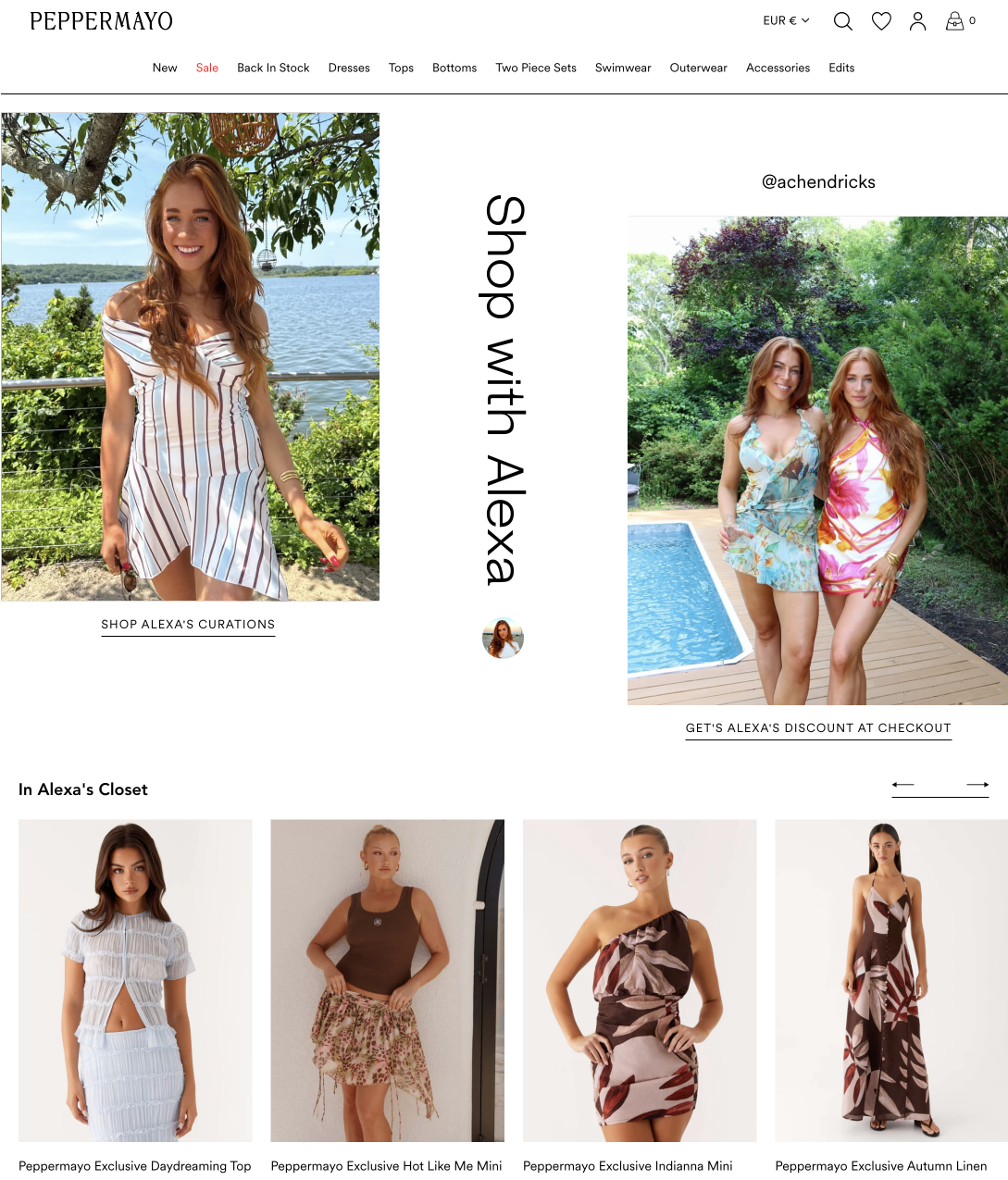
CreatorCommerce is designed to fix that exact gap: turn each creator's click into a co-branded shopping experience on your Shopify theme. The goal is not to replace your GRIN workflow, but to upgrade what happens after the click. In practice, brands typically see 30%+ higher CVR and 67% higher AOV versus regular affiliate links because shoppers land in a curated story with an offer that applies automatically and products that are presented as an outfit, not a grid.
Below is a concrete rollout plan tailored to Peppermayo's needs: keeping the party going, building a moat around coordinated shopping experiences at scale, and aligning activations to seasonality and event moments like Coachella, festivals, vacations, and party season. This is written for a Head of Influencer lens: partner segmentation, activation, content extraction, page templates, measurement, and an operating rhythm you can run every month.
Step 0: Segment Strategy (who gets what experience)
Start by deciding which partner segments you want to win and what each segment's storefront should do. Fashion programs perform best when the experience matches the creator's role in the consumer's mind: some creators drive discovery and vibes (festival looks), some drive decision making (fit + quality), and some drive repeat purchases (weekly outfit ideas). Your segmentation will determine the templates you build, the content you request, and the cadence of refreshes.
Recommended Peppermayo segments:
- Micro creators (5k–75k) with high trust: These partners often drive the best conversion when the page is simple, shoppable, and clearly tied to one moment (for example 'My Coachella weekend looks'). Give them a lightweight storefront template and a fast activation path. The win is volume and consistency.
- Mid-tier 'it girl' creators (75k–500k): These partners need a more editorial storefront: outfit capsules, hero video, and a stronger brand/creator co-identity. The win is higher AOV via complete looks and stronger click-to-cart rates during drops.
- Top talent / event headliners: The goal here is not just conversion; it is cultural moments and defensibility. Give them premium templates, early access edits, and the option to run whitelisted ads (Meta) to scale what is already working.
- Ambassador / repeat-post partners: These are the 'always-on' partners. Their storefront should be evergreen, updated each drop, and used as the default link in bio. The win is repeat revenue and program retention.
Geography note: You are global. You can keep one experience and localize key pieces: currency, shipping callouts, and a featured section like 'Ships fast to the US' or 'AU bestsellers'. If inventory differs by region, you can render region-available SKUs dynamically so the creator link never lands shoppers on sold-out frustration.
Step 1: Partner Enrollment (turn recruitment into an easy yes)
Your program is already thriving, so the enrollment goal is less about 'more partners' and more about 'more partners that activate into storefronts.' The pitch changes when you offer a co-branded shop: instead of 'post and use this link,' you offer a destination the creator can proudly share because it looks like their edit, on Peppermayo, with their name on it.
Enrollment funnel upgrades Peppermayo could run:
- Seeding with a storefront included: When you seed product, include a one-pager: 'We built your Peppermayo shop. Add it to your bio for your next GRWM.' The storefront is the gift alongside the product.
- Inbound recruitment: Add an application question that powers personalization: 'What are your top 3 Peppermayo occasions? (festival, party, date night, vacation, workwear)'. This becomes the initial navigation on their page.
- Email/DM outreach: Lead with the output: 'We can set up your Coachella edit on Peppermayo with your video + auto-applied offer.' This makes it feel like a collaboration, not a tracking link.
CreatorCommerce's partner apps power these flows, but the operating principle is: collect just enough info to generate a good first version of the creator shop, and never block activation on a long form.
Step 2: Partner Activation by Segment (make the first week feel effortless)
Activation is where most influencer programs leak. Partners agree, they get a code, and then life happens. Co-branded storefronts fix this only if the first version is ready quickly and if the creator sees a clear reason to share it.
What Peppermayo could do in the first 7 days after approval:
- Auto-create the storefront using whatever partial data you already have (name, handle, profile photo, past gifted orders, historical links, category affinity). If order history exists, generate a 'Favorites' section immediately.
- Send a 'Your shop is live' message with: the link, 2 suggested post prompts, and 1 seasonal angle. Example prompts: 'Coachella try-on + pack with me,' 'Friday night GRWM featuring my Peppermayo picks,' 'Unboxing + how I'd style each piece.'
- Collect one piece of content that materially improves conversion: a 10–20 second vertical video, or 3 photos + a simple fit note. The request should be segment-specific: micro creators can deliver quickly; top talent can provide a hero clip.
- Offer auto-apply incentives: The storefront can auto-apply the creator's discount so shoppers do not forget codes. This reduces friction and increases tracked conversion.
Using automation + AI responsibly: For scale, you can generate initial copy blocks (style notes, 'how to wear') based on product titles and category tags, then allow your team to approve/adjust for tone. This avoids manual work for hundreds of pages while keeping quality controlled.
Whitelisted Meta ads (for partners who already convert): For mid-tier and top creators, add a standard option: one-click ad authorization. Peppermayo could then put spend behind the best-performing creator UGC, pointing to the creator storefront (not a generic landing page). This keeps attribution clean and reinforces the creator as the face of the shopping experience.
Step 3: Co-branded Storefronts & Funnels (design for outfit-building, not browsing)
Fashion shoppers rarely want a single SKU; they want the look. Your storefront templates should be built to produce outfit-level baskets, not just product clicks.
Core storefront modules Peppermayo could standardize:
- Hero: creator + moment (for example 'Sarah's Coachella Weekend Edit'). Include a short clip or image that signals the vibe immediately.
- Shop the look (2–4 outfits): Each outfit is a mini bundle: top + bottom + outerwear + shoes/accessories (even if Peppermayo does not sell all accessories, you can still anchor the outfit with the pieces you do sell). The goal is to lift AOV by making the next item obvious.
- New drop picks: A section that can be refreshed automatically whenever you launch a new collection. This keeps storefronts evergreen without asking creators to rebuild.
- Fit + sizing notes: Simple, standardized fields: height, usual size, size worn, and one sentence on fit (runs small/true/oversized). This reduces returns and builds trust.
- Occasion filters: Date night, festival, vacation, party, daytime. Creators choose their top 3; you prebuild the nav from that.
- Social proof blocks: 'Most re-ordered from my page' or 'Top 5 bestsellers' to help late-stage shoppers decide.
Funnel tests to run (simple A/Bs):
- UGC-first vs product-first: Does a hero video above the fold lift CVR more than showing the top products first?
- Outfit capsules vs single product grid: Measure AOV lift when you present complete looks.
- Auto-apply offer vs code reveal: Many brands see lift when the discount is applied automatically and clearly shown in-cart.
- Creator note vs no note: A 30-word 'why I picked these' can materially increase add-to-cart.
Step 4: Funnel Details (go beyond a landing page)
Most brands stop at a creator landing page. The conversion leverage is often deeper: product page modules, cart, and post-purchase.
On-site experience upgrades Peppermayo could add:
- Co-branded pop-ups: When a shopper arrives via a creator link, show a light banner: 'Shopping Sarah's Peppermayo edit — offer applied at checkout.' Keep it subtle, but explicit.
- Creator callouts on product pages: If a product is in the creator's edit, show 'In Sarah's picks' with a link back to the storefront. This increases loopback and keeps the shopper in a curated journey.
- Cart co-branding: Display the creator name and applied offer in-cart. This reinforces trust and reduces abandonment caused by uncertainty.
- Cross-sells designed as outfits: Instead of 'You may also like,' show 'Complete the look' with 2–3 creator-picked add-ons. This is where AOV often moves.
- Back-in-stock capture tied to creator: If an item in the creator edit is sold out, offer a back-in-stock sign-up that keeps the creator attribution when the shopper returns. This protects commissions and improves customer experience.
Step 5: Launch & Track (ship behind existing links, measure like performance marketing)
The cleanest rollout is to keep your GRIN links and codes, but change the destination to the co-branded experience. That way you do not retrain creators, and you keep continuity in attribution.
Launch plan Peppermayo could run:
- Pilot cohort (30–50 partners) across the segments above. Include at least: 20 micro creators, 8–10 mid-tier, 2–3 top partners, and 5 ambassadors who post consistently.
- One event-led campaign (Coachella / festival) plus one evergreen campaign (weekly 'party-night looks'). This lets you measure both spike performance and steady-state value.
- Dashboards and reporting: Track CVR, AOV, revenue per session, and returning customer rate for storefront traffic versus standard affiliate traffic. Also track partner retention metrics: partners who post again within 30/60 days.
Attribution and measurement detail: Cart-based attribution can capture incremental orders that would otherwise fall through, especially when shoppers browse around before buying. Treat this as a revenue recovery lever, not just reporting.
Step 6: Optimize (turn seasonal moments into a repeatable calendar)
Once the pilot works, the program becomes a content and merchandising system. Your best creators become recurring 'channels' with a shop that updates each drop. Optimization is about building a calendar, standardizing briefs, and continuously refreshing the storefront assets that move conversion.
Must-have retention flows Peppermayo could implement:
- Co-branded cart abandonment: Email/SMS that references the creator: 'Your Peppermayo picks from Sarah are still in your cart' and re-shows the products. This keeps the emotional connection and reduces drop-off.
- Co-branded post-purchase: Styling follow-ups: 'How to wear your new pieces' plus 'Add the matching item from Sarah's edit.' This can lift second order rate and expand outfits after the initial purchase.
- Drop alerts per creator shop: When a new collection lands, notify shoppers who opted in on that creator's page. This builds a creator-led owned audience on your domain.
Seasonal campaign calendar ideas (fashion-specific):
- Festival season (Coachella + beyond): 'Weekend 1 vs Weekend 2 outfits,' 'Day-to-night transitions,' 'Pack with me' capsules.
- Euro summer / vacation: 'Airport outfit,' 'Dinner in Ibiza,' 'Beach club set' edits; emphasize lightweight fabrics and mix-and-match.
- Wedding guest / formal season: Curations by dress code; add simple guidance blocks (cocktail, formal, black tie optional).
- Holiday party: Sequins, minis, sets; highlight 'photo-friendly' picks and last-minute shipping callouts.
- New Year / going-out reset: 'Night-out uniform' edits for repeat wear; encourage multi-item baskets with complete looks.
- Weekly evergreen: 'Friday night GRWM' rotating capsules that keep top ambassadors posting consistently.
Each campaign should have a template: the same page structure, the same content requests, the same reporting. That is how you scale without burning your team.
Step 7: Advanced (for top partners and publishers)
For your most valuable partners, you can go beyond a single storefront and build deeper integrations that feel like real collaboration.
Advanced options Peppermayo could offer:
- Whitelabel co-branded microsites on your domain for top creators during major moments (for example a 'Coachella HQ' powered by a creator). This can include multiple creators, schedules, and rotating edits.
- Embeddable product modules for partners who run their own blogs or editorial sites. They can embed 'Sarah's Peppermayo picks' and the shopping happens with Peppermayo checkout, keeping the experience consistent.
- Creator-led drops or capsules: Use storefront data (top clicked, top added, most purchased) to inform what a creator capsule should include, then launch with a ready-made shop that converts from day one.
The strategic moat is simple: when your best partners have a higher-performing, more personalized shopping destination on Peppermayo, they have less incentive to send their audience elsewhere. And when your customers associate a creator's style with a Peppermayo shopping experience that always works (easy offer, clear curation, fast decisions), you capture more revenue from every session and build a repeatable system for every seasonal moment.



%201.png)
%201.png)