

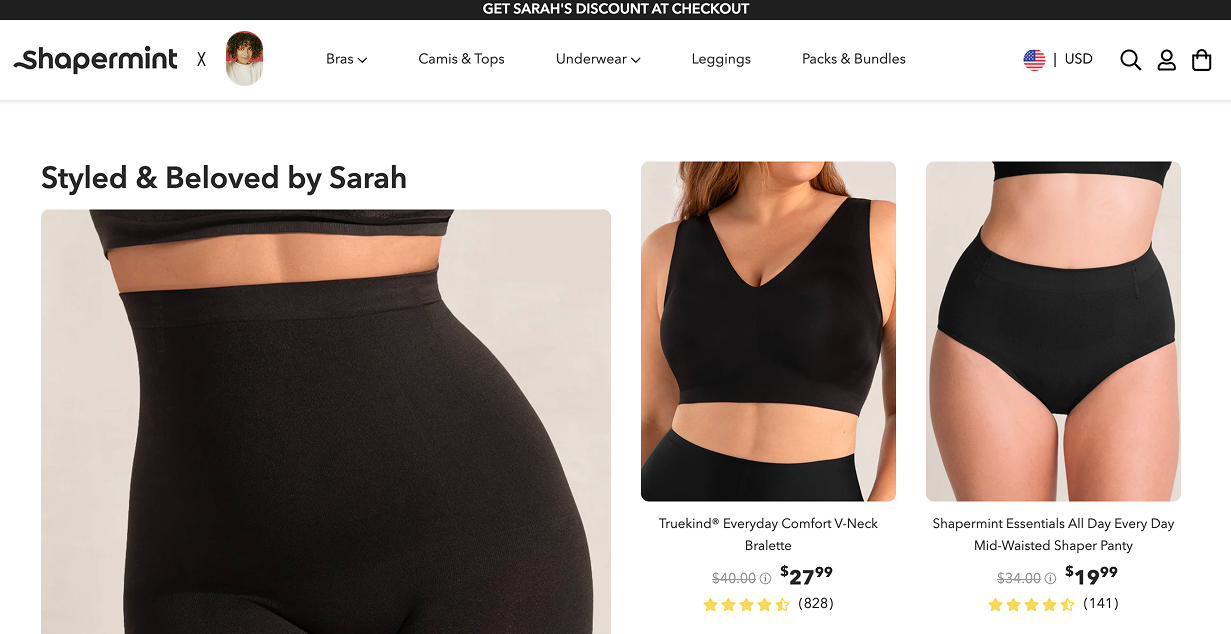


The Playbook for Shapermint (Apparel/Shapewear, US) with GRIN
Shapermint already has scale (12M+ customers), a strong value proposition (size-inclusive XS-4XL), and a clear trust lever (60-Day Fit Guarantee). The gap is not awareness. The gap is turning partner traffic into a shopping journey that feels personally guided, starts with shapewear (your wedge), and reliably leads to higher conversion and larger baskets across different buyer mindsets.
Today, most influencer programs send people to a generic landing page or a product page that was not made for that creator’s audience. Shoppers then have to do the hard work: figure out what to buy, how it fits, what to pair it with, and whether they can trust sizing. That friction is exactly where co-branded commerce wins. CreatorCommerce is built to spin up co-branded shopping experiences on your Shopify theme so each partner’s traffic lands in a page that looks and feels like it was made for them, with merchandising, content, and offers aligned to their niche.
Below is a practical plan that Shapermint could run using CreatorCommerce alongside GRIN. It is written to support segment-led selling (Moms vs Athletes vs working professionals), to emphasize content styles that bleed into shopping (GRWM, try-ons, fit overviews that begin with shapewear), and to unlock more value from GRIN through cleaner recruiting vs activation separation and stronger affiliate tracking.
Step 0: Segment Strategy (the foundation)
First, pick the segments you want to win and define what ‘success’ means for each. In shapewear, segments are not just demographics; they are use cases and constraints. The right segmentation makes your storefront templates, offers, content, and creator brief obvious.
Recommended core segments for Shapermint:
- Moms / Postpartum / Busy family life: comfort-first, smoothing under casual clothes, confidence for daily wear, easy sizing, breathable fabrics. Content that works: GRWM for school drop-off, before/after under leggings or jeans, ‘all day wear test’.
- Athletes / Fitness / Performance lifestyle: movement, sweat testing, no-roll waistbands, support without restriction. Content that works: workout try-on, squat test, running test, ‘what I wear under my gym set’, plus recovery and posture angles.
- Working professionals: office outfits, smoothing under dresses, blazers, trousers, bras that disappear under tops. Content that works: ‘5 work outfits, one foundation layer’, fit overview under different fabrics, ‘desk-to-dinner’ transitions.
- Plus-size confidence & fit specialists: creators whose audience needs real sizing guidance and trust. Content that works: detailed fit notes, comparison across sizes, fit guarantee reassurance, ‘how I choose my size’.
- Occasion / event-based buyers: weddings, holidays, vacations, swim season. Content that works: occasion outfit try-on, ‘what I wear under’ series, packing lists.
For each segment, define the Hero Shapewear Start (the first product that anchors the story) and the Attach Items (bras, intimates, swim, add-ons) that raise AOV. With ~200 products and an average price around $65, your opportunity is consistent multi-item baskets through guided curation, not just single-item conversion.
What changes when segmentation is done right: you stop asking creators to send traffic to ‘Shapermint’ and start asking them to send traffic to ‘Shapermint for my audience’s exact need’. That is what typically drives the step-change lift (30%+ CVR, 67% higher AOV vs regular affiliate links).
Step 1: Partner Enrollment (more partners, better fit)
Next, tighten the recruitment and enrollment loop so you bring in creators who match your segments and can reliably produce shopping-first content. Because you use GRIN, you already have discovery, outreach, and relationship management. The upgrade is how you position the offer and how fast a creator can go from ‘yes’ to a live, personalized storefront.
Enrollment approach Shapermint could run:
- Segmented recruiting lists: build three lists (Moms, Athletes, working professionals) plus a plus-size fit list. Each list gets different pitches and different starter kits.
- Seeding with a purpose: instead of sending a random best-seller, seed the ‘Hero Shapewear Start’ per segment (plus one attach item). The goal is to produce a fit overview that begins with shapewear and naturally leads to a bundle.
- Inbound capture: add an ‘Apply to Collaborate’ flow that asks 6-8 questions that matter for merchandising: audience segment, typical clothing sizes, preferred content style (GRWM vs try-on vs review), and top 3 products they would start with.
- Fast path to ownership: the best enrollment incentive is not a higher commission; it is a co-branded shop on Shapermint.com with their name, curated products, their content, and an auto-applied discount that removes mental math for the shopper.
CreatorCommerce’s partner apps can power the enrollment forms and intake, then flow that data directly into page creation so you are not manually building assets for each creator.
Step 2: Partner Activation by Segment (turn ‘signed’ into ‘selling’)
Then, activate partners with a segment-specific ‘shock & awe’ moment: a live storefront that already looks merchandised, already has a discount, and already tells the right fit story. Activation is where most programs leak—partners join but do not post, or they post once and then go quiet. Your activation system should reduce effort, increase confidence, and give creators a repeatable content plan.
Activation system Shapermint could run:
- Welcome flow by segment: creators receive a short email/SMS sequence: Day 0 ‘Your shop is live’, Day 2 ‘Your 3-post plan’, Day 7 ‘Your first results and next test’. Each message links to their storefront dashboard.
- Data collection with minimal friction: use a short form to collect (1) preferred name/handle, (2) best audience segment, (3) sizing notes they want displayed, (4) preferred products, (5) discount preference. Anything missing can be generated with AI and flagged for moderation.
- AI-assisted first draft storefront: if you have partial data (e.g., their past seeding order, content captions, or GRIN profile), generate a first version: hero products, a short intro, and a ‘Fit Notes’ block. A human can approve or adjust at scale in an admin view.
- Content extraction that sells: for each segment, require one ‘fit overview that begins with shapewear’ plus one ‘outfit try-on’ and one ‘GRWM’. These become modules in their storefront (videos, quote snippets, images, Q&A).
- Whitelisted Meta ads: offer a 1-click authorization option so Shapermint can run paid amplification from the creator handle (where appropriate). Route ad traffic to the creator’s co-branded storefront, not your generic pages. This keeps the creator’s identity intact while improving tracking and conversion.
Activation should also include a clear promise: their audience gets the easiest path to the right shapewear, and the creator gets a shop that performs better and tracks better than a basic link.
Step 3: Co-branded Storefronts & Funnels (design for each niche)
Now build storefront templates that map to each segment’s buying logic. The key is that each page should feel like a mini ‘fit concierge’ experience, not a collection page. Start with shapewear as the foundation, then attach bras/intimates/swim to grow AOV.
Recommended storefront components (all segment-aware):
- Creator header: creator image + ‘What I wear under everything’ positioning; set expectations that this page starts with shapewear.
- Hero module: 1-2 hero shapewear items with a ‘why it works’ note written in the creator’s voice, plus an auto-applied discount.
- Fit notes: size worn, height, typical size range, and any notes about compression preference. This reduces returns and hesitation.
- Try-on gallery: videos or image tiles with captions like ‘under jeans’, ‘under a fitted dress’, ‘under workout leggings’.
- Bundle blocks: ‘My 2-item start’ and ‘My 3-item weekly rotation’. If AOV is ~$65, these bundles target $130-$195.
- Trust block: highlight the 60-Day Fit Guarantee and shipping/returns clarity next to the buying decision, not hidden in the footer.
Funnel tests Shapermint could run quickly:
- UGC-first vs product-first hero: test whether the page opens with a creator try-on clip vs a product grid.
- ‘Start here’ quiz: a 3-question selector (goal: smoothing vs support vs comfort; outfit type; compression preference) that routes to the right starter item.
- Size guidance emphasis: test a prominent ‘Fit notes’ callout vs a standard size chart link.
- Guarantee positioning: test guarantee copy directly under the add-to-cart vs lower on page.
Because these experiences live in Shopify Liquid on your theme, you can iterate without rebuilding a separate site or sending customers off-domain.
Step 4: Funnel Details (beyond the landing page)
Most programs stop at the landing page. The real lift comes from carrying co-branding through product pages, cart, and post-purchase—where trust and clarity are most needed.
On-site elements Shapermint could add:
- Co-branded sticky offer: ‘Sarah’s code applied’ or ‘Creator code applied’ in cart to remove mental math and reduce discount anxiety.
- Co-branded cart: show the creator’s photo/name in cart with a short reminder: ‘Picked for [segment]’, plus an add-on module (‘Most people add a wireless bra’).
- Product page creator module: when a shopper enters via a creator shop, add a block: ‘Why [Creator] recommends this’ + their fit notes + their try-on clip.
- Pop-ups used sparingly: exit-intent that offers ‘Find your starter shapewear in 20 seconds’ or ‘See how it fits on [Creator]’ rather than a generic email capture.
- Cross-sell logic that fits the segment: Moms: comfort bras + everyday smoothing. Athletes: no-roll shorts + sweat-friendly options. Professionals: invisible under workwear + smoothing slips.
Attribution improvement: cart-based attribution can capture incremental orders that basic link tracking misses (often when shoppers browse, return, or check out later). This is especially important in apparel where consideration time is common.
Step 5: Launch & Track (use GRIN links, upgrade the destination)
Next, launch without disrupting how creators already share links. Keep GRIN as the system of record for recruitment and partner management, and use CreatorCommerce to upgrade the destination experience behind those links. This reduces change management and speeds adoption.
Launch plan Shapermint could use:
- Pilot cohort: 30-50 creators split across Moms, Athletes, and working professionals.
- Template set: 3 storefront templates (one per segment) with optional modules (UGC hero, fit quiz, bundle block).
- KPIs: CVR, AOV, revenue per session, attach rate (2+ items), repeat purchase rate/CLTV, and partner retention (posting cadence and active sellers).
- Tracking: run links through existing GRIN tracking; validate cart-based attribution and compare to baseline.
Success should be measured against your current ‘regular affiliate link’ performance. The goal is to prove that co-branded commerce drives materially better outcomes, not just nicer pages.
Step 6: Optimize (content campaigns + retention flows)
Then, operationalize a cadence that keeps creators active and keeps shoppers coming back. In shapewear, repeat purchase is driven by rotations, new colors, seasonal use cases, and wardrobe changes. Your program should produce recurring reasons to shop.
Must-have lifecycle flows (co-branded):
- Co-branded cart abandonment: subject line and content that includes creator name and the applied code (‘Your discount is still applied’), plus a small ‘fit guarantee’ reminder.
- Post-purchase education: ‘How to wear it’, ‘fit check’, ‘care instructions’, and ‘what to try next’ personalized by segment and credited to the creator where appropriate.
- Replenishment/rotation nudges: 30-60 days later, suggest complementary items (bras/intimates/swim) using the same creator identity to reinforce trust.
Content campaigns Shapermint could run (seasonal calendar):
- Q1 (Jan-Mar): ‘Back to routine’ GRWM series; ‘foundation layer for work outfits’; fitness ‘squat test week’.
- Q2 (Apr-Jun): wedding season ‘what I wear under dresses’; Mother’s Day comfort edits; swim previews and try-ons.
- Q3 (Jul-Sep): travel packing lists; heat-friendly comfort tests; back-to-school mom routines.
- Q4 (Oct-Dec): holiday party outfits; giftable intimates; ‘3 looks, one base layer’ campaigns.
Each campaign should ship with a storefront update (new curated set), a content prompt pack (what to film), and a measurable goal (attach rate, AOV, repeat purchase).
Step 7: Advanced (professional/publisher partners)
Finally, for higher-leverage partners (publishers, fit experts, or professional stylists), consider deeper integrations beyond a standard creator storefront.
Advanced options Shapermint could offer:
- Whitelabel co-branded microsites on Shapermint: a fully co-branded experience for a major partner, still on your domain and theme, with deeper editorial content (fit guides, outfit planners).
- Embeddable product modules: ‘Shop my shapewear base layer’ embeds for partner blogs or newsletters that open into their co-branded funnel on-site.
- Program tiers: standard creators get storefronts; top performers get enhanced modules (exclusive bundles, early access to drops, co-branded email placements).
The purpose of the advanced tier is to create a moat: partners feel real ownership and see better economics, and shoppers develop a habit of buying Shapermint through trusted, repeatable creator-led journeys.
What Shapermint could expect from this approach
With Shapermint’s product depth (~200 items), clear trust drivers (60-Day Fit Guarantee), and strong content formats (try-ons, GRWM, fit overviews), co-branded commerce is a natural fit. The near-term goal is to lift conversion and AOV by making every creator link land in a segment-specific funnel. The medium-term goal is to strengthen retention: creators stay active because their shop performs and feels like theirs, and customers return because the shopping experience stays guided and personal.
If you want a clean starting point: pilot three segment templates (Moms, Athletes, working professionals), launch with 30-50 creators in GRIN, and measure against baseline links. The winner will be obvious in CVR, AOV, attach rate, and partner reactivation—and you can scale from there to hundreds or thousands of co-branded experiences.



%201.png)
%201.png)