



The Playbook for Skims
Skims already has what most brands are trying to manufacture: attention, taste, and the ability to create product demand through cultural moments. The gap is that a lot of partner traffic still lands in a generic place (homepage, collection, a single PDP) where the shopper has to do the work: find the right 'solution', decide on color, understand fit, and build a cart. That friction shows up as lower conversion and smaller baskets—especially when the traffic comes from athletes, NIL talent, fitness creators, and style influencers whose audiences want to buy exactly what they just saw.
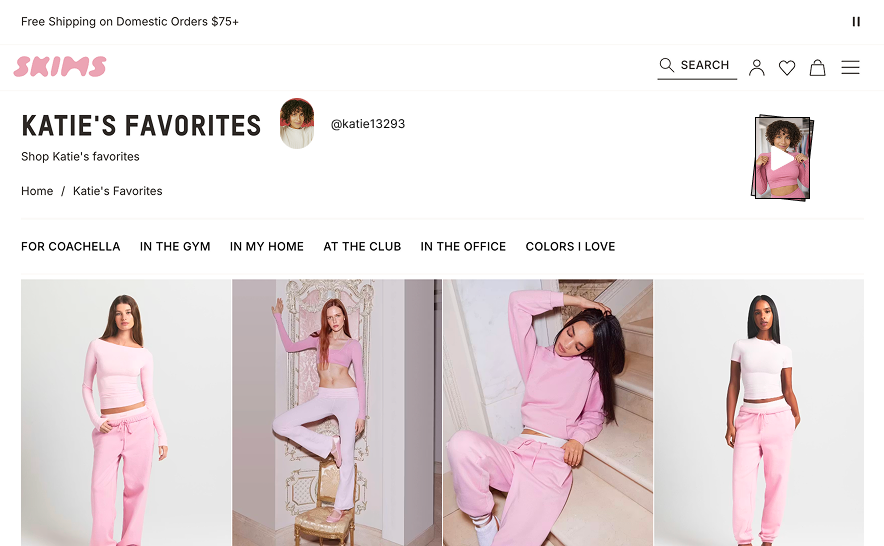
CreatorCommerce is built to reduce that friction by turning every GRIN-driven click into a co-branded shopping experience on skims.com. Instead of sending a follower to a standard page, you could send them to a storefront that already reflects the partner, the use-case, and a pre-built cart path. Across top Shopify brands, these co-branded experiences typically drive 30%+ higher conversion rate and 67% higher AOV compared to regular affiliate links because the page does the selling: it merchandises the right products, adds proof, and makes the offer obvious.
Step 0: Segment Strategy
First, decide which partner segments Skims wants to win globally, and what each segment should sell. Because you have ~500 products across shapewear, underwear, and athleisure/loungewear, the winning strategy is to map segments to 'solutions' instead of forcing everyone into the same catalog.
Recommended core segments for Skims:
- Athletes + NIL talent (college + pro): performance-adjacent comfort, recovery/lounge, travel sets, game-day layers. Their audiences respond to simple uniforms and repeatable bundles.
- Fitness influencers (training + lifestyle): 'what I wear to train', 'errands to gym', sweat-to-shower routines, supportive basics, and color drops that match seasonal fitness content.
- Style/fashion creators: outfit builds, seasonal edits, 'capsule' wardrobes, drop coverage, and co-branded 'collections' that feel like a mini collab.
- Creator communities by region (global): localized fit notes, language, shipping/returns reassurance, and curated product sets based on climate and seasonal calendars.
Then, define 6–10 repeatable storefront 'templates' that match these segments. Templates keep brand consistency while still letting partners personalize. Example templates: 'Athlete Travel Kit', 'Gym Essentials', 'Everyday Shapewear Solutions', 'Lounge Uniform', 'Underwear Reset', 'Seasonal Drop Edit'.
Step 1: Partner Enrollment
Next, tighten the enrollment funnel so Skims can add volume without adding operational drag. The goal is to make it easy for the right partners to say yes, and to ensure you collect the minimum data needed to launch a storefront immediately.
Enrollment channels Skims could run in parallel:
- Product seeding with a storefront attached: every seed goes out with 'your shop is ready' rather than 'here is your link'. That increases first-post rate and time-to-first-sale.
- Inbound recruitment: add a simple 'Become a Skims partner' application that routes applicants into the right segment template (athlete, fitness, style, regional).
- Outbound email/DM: a short pitch: 'We built you a Skims storefront with your edit + auto-applied code. Want it?'
- Drop-based recruiting: for limited drops and collabs, recruit a cohort 10–14 days before launch, give each partner a drop-specific storefront with a countdown and a curated set of items they will feature.
CreatorCommerce’s partner apps could power these flows so you can enroll at scale, while still keeping approval and brand guardrails centralized.
Step 2: Partner Activation by Segment
Then, focus on activation. Most affiliate programs lose money not because the offer is bad, but because partners never get to a repeatable posting routine. Co-branding is the 'shock & awe' that gets partners to take action quickly: when a creator sees their name, image, and curated products on skims.com, the ask becomes easy to fulfill.
Activation system (built for speed):
- Day 0: partner is approved; their storefront is auto-generated from a template plus any available data (social handle, region, category, initial products).
- Day 1: partner receives an email/SMS: 'Your Skims shop is live. Approve your photo + pick your top 12.' Include a one-click review form.
- Day 2–3: CC uses automation + AI to propose product picks based on the segment and what Skims wants to push (newness, hero items, high AOV sets). A human can moderate exceptions.
- Week 1: partner is nudged into a 'first post' play: one reel/tiktok + one story set that drives to their storefront, not a generic link.
Segment-specific data collection (lightweight):
- Athletes/NIL: team colors, travel schedule (optional), preferred fits, top 3 use-cases (travel, recovery, game-day, training).
- Fitness creators: training style, most asked questions (support, sweat, comfort), and 3 'go-to' outfits.
- Style creators: aesthetic tags (minimal, street, elevated basics), seasonal palette, and 5 'must-have' pieces.
Whitelisted Meta ads (performance layer): for partners who opt in, Skims could run whitelisted ads from the creator handle that drive directly to the creator’s storefront. This keeps the social proof while letting Skims control spend, creative iteration, and landing experience. The key is to send paid traffic to the co-branded shop where you can merchandise and raise AOV, not to a single PDP.
Step 3: Co-branded Storefronts & Funnels
Now build storefronts that match how Skims actually sells: through solutions, sets, and cultural moments. The storefront should feel like a mini collab page, but it should behave like a conversion-optimized funnel.
What each storefront could include:
- Hero module: partner name + a simple promise (e.g., 'My travel uniform', 'My training-day essentials', 'My everyday shapewear solutions').
- Curated 'shop the look' blocks: 3–6 outfits/sets that make sense together (top + bottom + underwear + layer). This is the AOV lever.
- Best-sellers + newness: mix partner picks with Skims priorities (new drops, seasonal colors, high-margin items).
- UGC + fit notes: short clips, photos, and plain-language notes (how it fits, what size they wear, what it’s for).
- Auto-applied offer: code preloaded so there is no mental math and no 'did I forget to apply it?' issue.
Funnel tests Skims could run (high impact, low risk):
- UGC-first vs product-first: for fitness segments, lead with video; for style segments, lead with outfit grids.
- Solution routing: a 3-button chooser at top: 'Smoothing', 'Support', 'Everyday comfort' (or athlete variants: 'Travel', 'Recovery', 'Off-duty'). Route to pre-filtered sections.
- Bundle framing: 'Complete the set' vs 'Build your kit' vs 'My uniform'. Track AOV lift.
- Drop mode: countdown + waitlist + 'notify me' capture for limited editions.
Step 4: Funnel Details (not just landing pages)
Conversion and AOV move most when the co-branding continues through the entire shopping path. The goal is that the shopper never loses the context of who sent them and what they should buy next.
On-site modules Skims could add:
- Co-branded pop-up: 'Shopping Sam’s Skims Edit' with the offer and the top 3 sets. This can appear on entry and on exit intent.
- Co-branded PDP blocks: when a shopper lands on a product from the storefront, show 'Also in this creator’s edit' and 'Complete the look'.
- Cart co-branding: show the creator name, the applied code, and 2–3 creator-recommended add-ons (socks/underwear/basic top) to lift AOV.
- Dynamic recommendations by segment: athletes get travel/recovery add-ons; style creators get layering and color-coordinated items.
Attribution and trust: keep the creator identity visible in cart and checkout so customers understand the offer and do not question whether they are in the right place. This reduces abandonment and support tickets related to 'my code didn’t work'.
Step 5: Launch & Track
Next, launch in a way that does not require you to rebuild your tracking stack. The simplest rollout is to keep GRIN as the backbone and swap the destination: existing affiliate links can resolve to the partner’s co-branded storefront instead of a generic destination.
Launch plan (first 30 days):
- Week 1: pilot with 25–50 partners across the 3–4 core segments (athlete/NIL, fitness, style, regional).
- Week 2: publish storefront templates, finalize brand guardrails, and add the cart/PDP co-branding modules for the pilot cohort.
- Week 3: enable whitelisted ads for 10–15 top performers; test two landing variants per segment.
- Week 4: review performance by segment and by template; expand to 200+ partners if KPIs hold.
What to measure: conversion rate lift vs baseline affiliate traffic, AOV vs your ~$120 average, revenue per session, repeat purchase rate, creator retention (partners posting again in month 2), and attribution coverage (orders correctly tied back to a partner).
Step 6: Optimize
Then, turn the program into a calendar so partners have a reason to post repeatedly and shoppers have a reason to return. For apparel, consistency wins: recurring formats that creators can execute quickly, plus seasonal edits that match how people actually shop.
Always-on retention (must-have):
- Co-branded cart abandonment: emails/SMS that say 'Your Skims cart from [Creator] is waiting' and keeps the discount applied.
- Post-purchase follow-up: 'How to style it' and 'Complete your set' recommendations tied to the creator’s edit.
- Back-in-stock + drop alerts: send alerts from the creator storefront context for items they featured.
Seasonal campaign calendar ideas (global-ready):
- Jan–Feb: 'Reset basics' kits (underwear refresh, lounge uniform). Fitness creators run 'week 1–4 fits'.
- Mar–Apr: spring color edits; 'travel-ready sets' for athletes during away games.
- May–Jun: summer lightweight layers; 'airport uniform' bundles; graduation/NIL moments.
- Jul–Aug: 'heat + comfort' edits; back-to-campus NIL kits.
- Sep–Oct: fall layering; capsule wardrobe edits; 'game day off-duty' for athletes.
- Nov: gifting and 'my top 10' creator picks; bundles for AOV.
- Dec: holiday lounge and travel; 'year-end favorites' and limited drops.
Optimization is mostly about repeating what works by segment: which template yields the best AOV, which UGC format yields the best CVR, and which add-ons consistently attach in cart.
Step 7: Advanced (If Relevant)
Finally, for higher-leverage partners (publishers, large fitness platforms, athlete-led brands, and major creator teams), Skims could go beyond a single storefront and offer deeper integrations.
- Whitelabel co-branded microsites on your domain: a full experience that still runs through Shopify and your theme, but feels like 'Skims x Partner'. Useful for athlete teams, training apps, or large creator networks.
- Embeddable product blocks: 'Skims picks' widgets embedded on the partner’s site that deep-link into their Skims storefront, keeping attribution and raising conversion with a consistent on-site experience.
The point is not to replace your existing partnership model. It’s to make every GRIN click land in a place that sells the way Skims sells: through curated solutions, strong visual storytelling, and tight merchandising that turns attention into revenue.


%201.png)
%201.png)