



The Playbook for Superfeet (GRIN) to grow revenue per partner session
Problem: Superfeet already does big collaborations, but scaling what works into college/NIL, athletes, and working-on-your-feet segments usually breaks down at the last click. Most partners still send people to a generic product page or home page with a code. Shoppers have to do mental math, figure out which insole is right, and decide whether they trust the claim enough to spend ~$50. That friction shows up as lower conversion, smaller carts, and weak partner retention because a partner cannot build an asset that compounds over time.
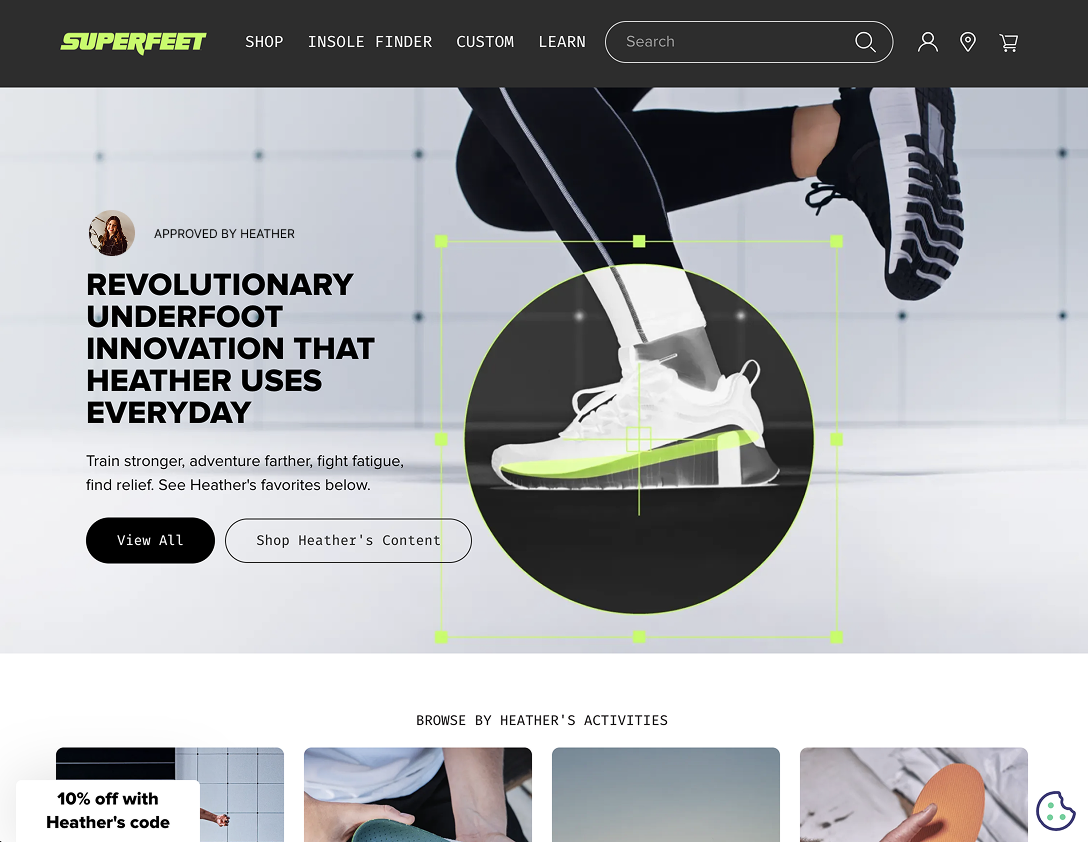
Answer: CreatorCommerce turns each GRIN partner into a co-branded shopping funnel that lives on Superfeet.com. Instead of 'traffic → generic page → bounce,' the flow becomes 'partner story → partner storefront → fit-guided product picks → bundle → checkout with auto-applied discount.' Brands using CreatorCommerce typically see 30%+ higher CVR and 67% higher AOV versus regular affiliate links because the page matches the user intent and reduces uncertainty.
Step 0: Segment strategy (who to win, and what each segment needs)
Superfeet sits in a category where trust, fit, and use-case clarity matter. That usually means a blended partner program works best: influencers for reach and culture, plus professionals/practitioners for authority, plus niche communities for high-intent conversion.
Recommended segments for the U.S. market:
- College/NIL + competitive athletes: runners, soccer, basketball, golf, baseball/softball. They sell performance and consistency. Their audience wants 'what do you actually wear' and quick decision-making.
- Everyday athletes + weekend warriors: running clubs, CrossFit-style gyms, hiking groups, trail communities. They convert on relatable pain points and routines.
- Working-on-your-feet creators: nurses, service industry, warehouse, teachers, retail, trades. They drive high-intent traffic because discomfort is urgent and daily.
- Condition/problem communities: plantar fasciitis, heel pain, knee/back pain, overpronation. These audiences need reassurance, clear guidance, and credible testimonials.
- Professional voices (adjacent to podiatry): PTs, trainers, biomechanics educators, run coaches, outdoor guides. They build authority and reduce returns by setting expectations.
- Retail and small business partners: local running stores, physical therapy clinics, orthotics-focused shops. These partners want co-branded pages that feel like their 'recommended kit' while keeping checkout on Superfeet.com.
How this informs the build: each segment gets its own storefront template, merchandising logic, and content prompts. One size will not fit all: a NIL athlete page should feel like performance gear; a nurse page should feel like shift survival; a PT page should feel educational and precise.
Step 1: Partner enrollment (increase volume without lowering quality)
Enrollment should be two lanes: high-touch for priority partners (top athletes, top creators, key professionals) and scaled onboarding for long-tail creators and worker ambassadors. CC works with your existing GRIN workflows so partners can still apply/accept in the system you already run, then instantly receive a storefront that looks intentional.
High-touch enrollment (priority cohorts):
- College/NIL cohort: seed product plus a pre-built storefront URL that includes their name, sport, and a starter curation (e.g., 'Run + Recovery'). Include a single form to capture footwear type, arch height guess, and the top 3 situations they want relief in.
- Pro cohort (PT/trainers/run coaches): invite with an 'education + commerce' angle. Offer a storefront that includes a short 'how to choose an insole' module, plus a curated set for different arch profiles and shoe volumes. This reduces their risk of recommending the wrong thing.
Scaled enrollment (long tail):
- Use a simple landing page for applications that asks for: primary audience, typical footwear category (running shoes, work boots, casual sneakers), and content style (UGC, education, humor, routines).
- Approve quickly, then auto-generate a storefront with a 'starter kit' and an auto-applied discount.
What to avoid: do not force partners to pick from the full catalog. With ~20 products, you still want a partner to promote 3 to 6 items max at first. Conversion improves when the page feels like a recommendation, not a catalog.
Step 2: Partner activation by segment (make the first 14 days count)
Activation is where most programs lose money. Partners get a link, post once, and move on. The fix is to create 'shock & awe' through co-branding and make the partner feel like they have a real asset to build on Superfeet.com.
Activation package (all segments):
- Instant storefront: partner name/photo, their short story, their picks, their discount auto-applied.
- One form, then automation: collect 5 inputs and let AI/workflows fill the rest (headline, FAQs, product rationale, 'who this is for'). Admin moderation keeps quality high at scale.
- Content prompts that map to the funnel: 3 short prompts that directly become modules on the page (e.g., 'My biggest foot pain trigger,' 'What I changed,' 'How long until I noticed it').
Segment-specific activation:
- NIL/athletes: build 'game day kit' and 'training week kit' sections. Add a simple routine timeline: pre-training, post-training, travel day. Add a 'what shoes I wear' field so the page can recommend the right insole volume.
- Workers on feet: build '8-12 hour shift kit' sections by footwear type: clogs, work boots, slip-resistant shoes. Add 'my shift length' and 'surface' (concrete, hospital, kitchen) to tailor copy and product ordering.
- Problem communities: add a 'what I tried before' module and a '60-day guarantee' reassurance block. Use clear language: support, stability, comfort, and when to swap the insole (500 miles / 12 months guideline).
- Professionals: add a 'recommended for' matrix (arch height, activity, shoe volume). Include a short 'how to fit' section that reduces returns.
Whitelisted ads (Meta): offer a 1-click partner ad authorization flow so Superfeet can run ads from the partner handle to their co-branded storefront. This is especially strong for NIL and worker creators: you keep brand safety and targeting, while the ad still carries the partner's identity. The destination page matches the ad creator exactly, which is where CVR gains show up.
Step 3: Co-branded storefronts & funnels (turn trust into checkout)
Each partner storefront should feel like a small shop built around a person and a use-case. For Superfeet, the key conversion lever is reducing choice overload and increasing 'fit confidence.'
Core storefront modules (template-based):
- Hero: partner image + 'Why I use Superfeet' in 2 lines + auto-applied code.
- My picks (3-6 items): rank-ordered with 'what it solves' labels (e.g., 'high arch support,' 'running,' 'work boots').
- Fit guidance: quick selector: activity + shoe type + arch height (self-reported). Route to the best insole(s).
- Social proof: UGC clips, short quotes, 'last updated' to feel current.
- Guarantee + longevity: 60-day satisfaction guarantee and the 500 miles/12 months guideline, stated plainly.
Funnel tests to run first (high impact, low complexity):
- Auto-apply discount vs manual code: reduce mental math. Track CVR lift.
- 3-product curation vs 6-product curation: test which drives higher CVR at ~$50 AOV starting point.
- Bundle offers: '2-pair pack' for workers; 'train + trail pack' for athletes. Bundles are the easiest AOV lever.
- Education-first vs product-first layout: professionals might convert better with education first; athletes might convert better with picks first.
Step 4: Funnel details (beyond the landing page)
Most programs stop at a landing page. The biggest compounding gains come when co-branding continues through product page, cart, and post-purchase.
Co-branded product pages:
- Show 'Recommended by [Partner]' on PDP when coming from that partner storefront.
- Add partner-specific FAQs: 'Will this fit in work boots?' 'How do I trim?' 'How long to break in?'
- Add a short partner clip or quote near the add-to-cart to reduce hesitation.
Co-branded cart:
- Auto-applied discount visible with partner name (reduces code errors and support tickets).
- Order bumps that match the use-case (e.g., second pair discount for workers; 'trail + run' for outdoor athletes).
- Cart-based attribution to capture orders that would otherwise be missed when shoppers browse around before checkout (often ~2.5% more orders tracked).
On-site pop-ups (used sparingly):
- 'Not sure which model?' quick quiz that feeds the fit selector and tags the session.
- 'Get my picks by email' to capture leads for partners with longer consideration cycles (pain/condition shoppers).
Step 5: Launch & track (keep links the same, upgrade the destination)
Launch should not require partners to change behavior. Keep GRIN links/codes, but route the click to the partner storefront or a partner-specific collection page. Start with a controlled pilot cohort so you can compare performance apples-to-apples.
Pilot recommendation (4-6 weeks):
- 20 partners total: 5 NIL/athletes, 5 workers-on-feet, 5 run/outdoor micro-creators, 5 professionals.
- Baseline: current CVR, AOV, EPC per segment using regular links.
- Success metrics: storefront CVR, AOV, add-to-cart rate, bundle attach rate, attributed orders, and partner repeat posting (retention proxy).
What you will learn fast: which segment responds most to fit guidance, which responds to bundles, and which partners create on-site content that keeps converting after the post expires.
Step 6: Optimize (turn storefronts into a content and retention engine)
Optimization should be a monthly cadence: update storefront modules, rotate offers, and run seasonal campaigns. The goal is to keep partner pages feeling alive and to give partners reasons to post again.
Must-have retention flows:
- Co-branded cart abandonment: email/SMS that references the partner name and keeps the discount applied.
- Post-purchase re-engagement: 'how to fit and break in' email signed with the partner name, plus 'add a second pair' at day 14 for workers, or 'swap at mileage' education for runners.
- Review capture: ask for a review with a partner context ('Tell [Partner] how it went'). Feed best quotes back into the storefront.
Seasonal campaign calendar (Superfeet-specific):
- Jan-Feb (new routines): 'Start running without foot pain' 6-week journey pages with weekly check-ins from run club partners.
- Mar-May (training ramp): 'Half marathon build' kits; trail season packs; spring sports NIL drops.
- Jun-Aug (travel + work peaks): travel-day comfort kits; hospitality/service worker spotlight series; outdoor guide picks.
- Sep-Nov (back to campus + work): NIL back-to-campus, teachers and nurses 'long day' bundles, fall hiking content.
- Nov-Dec (gifting + replacement): 'Replace your insoles' reminder based on 12-month guidance; giftable bundles and stocking-stuffer add-ons.
Content-to-commerce loop: every campaign should produce 3 assets: a partner clip, a quote, and a short checklist. Those assets become storefront modules that improve conversion long after the campaign ends.
Step 7: Advanced (for professionals, publishers, and retail partners)
For high-authority partners (PTs, coaching platforms, running store blogs), go beyond a single storefront. Offer a more complete co-branded experience that still checks out on Superfeet.com.
- Whitelabel-style hubs: a 'Foot Support 101' hub branded to the professional with embedded product recommendations by patient/client type.
- Embeddable product modules: lightweight 'recommended insoles' widgets that partners can place on their own sites, driving to a co-branded checkout path on Superfeet.com.
- Clinic/store bundles: 'work boot bundle' or 'runner starter kit' with clear fit notes to lower return risk.
Why this matters: professionals and retailers think in programs, not posts. If you give them a durable on-site asset, they will keep sending traffic for months, and their audience will trust the recommendation more than a generic ad.
What Superfeet could implement first (a simple, actionable starting plan)
- Pick 4 storefront templates (NIL/athlete, worker, run/outdoor, professional) with fixed modules and 3-6 default products each.
- Launch a 20-partner pilot sourced from existing GRIN relationships plus targeted recruitment for worker creators and run clubs.
- Require only 5 partner inputs via a form; use automation/AI to generate the initial copy and FAQs; approve in a moderation queue.
- Turn on auto-apply discounts and keep partner identity visible through cart and checkout.
- Run 3 tests in parallel: 3 vs 6 products, bundle vs no bundle, education-first vs product-first layout.
- Add co-branded abandon + post-purchase flows so the partner keeps earning and the customer keeps feeling guided.
If Superfeet does this well, the program becomes easier to scale because every new partner is not a new custom build. It is a new instance of a proven template, with personalization where it matters: the partner story, the curation, and the fit guidance that removes uncertainty at the last click.


%201.png)
%201.png)