



The Playbook for Windsor
Windsor already wins when the customer is shopping with intent: a specific event, a specific vibe, and a short timeline. The gap most influencer programs create is that they send that high-intent traffic to a generic PDP or collection where the shopper has to do the work: find the right dress, decide on shoes, add accessories, apply a code, and trust sizing without context. That friction shows up as lower conversion rates, smaller baskets, and weaker attribution—especially when creators are doing the hard work to generate demand.
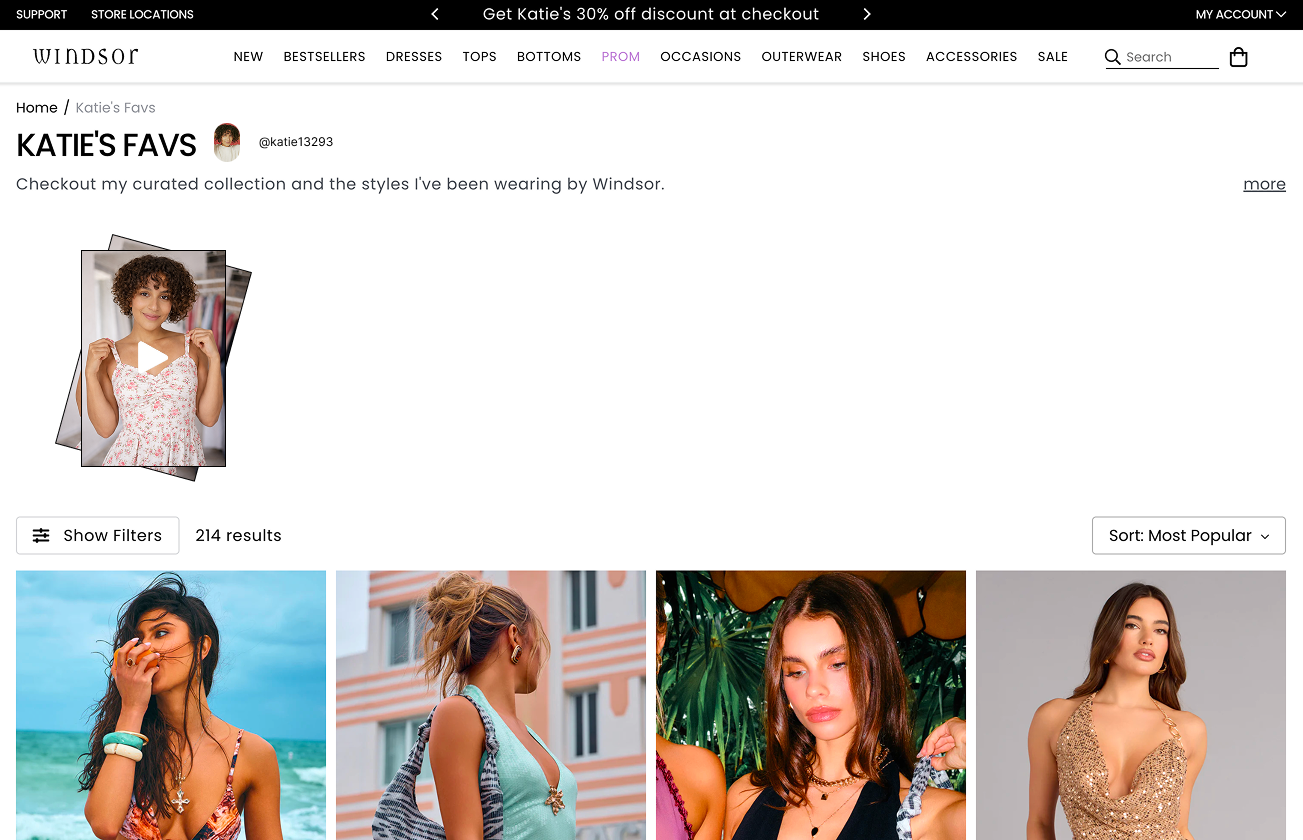
CreatorCommerce is designed to make every creator session feel like a guided shopping trip on windsorstore.com: co-branded, merchandised for the occasion, and built to move the shopper from 'love the outfit' to 'buy the full look' fast. Brands typically see 30%+ higher CVR and 67% higher AOV compared to regular affiliate links because the funnel is tailored and the offer is easier to act on (auto-applied discounts reduce mental math and drop-off).
Step 0: Segment Strategy
First, Windsor could define partner segments that match how people actually shop your catalog. Fashion is not one-size-fits-all; the best-performing funnels are different for a prom creator vs a nightlife creator vs a mom shopping with her daughter. A clean segmentation makes recruitment, page templates, and seasonal campaigns much easier to scale across ~2,000 products.
A practical segmentation for Windsor in the United States could look like this: (1) Occasion Specialists (prom/homecoming/formal) who post try-ons and event planning content; (2) Night Out & Trend Creators (going-out dresses, club fits, birthday outfits); (3) Wedding & Party Creators (wedding guest, bachelorette, rehearsal dinner); (4) Campus/Career Gen Z (graduation, internship outfits, 'first job' looks); and (5) Value/Deal Affiliates who convert on price and urgency. Each segment gets its own storefront template, its own bundle logic, and its own content prompts.
Step 1: Partner Enrollment
Next, Windsor could tighten enrollment so you are not just adding partners, but adding the right partners for each event season. The goal is to increase the number of creators who can drive measurable sessions in the next 30 days, not just grow a list. Enrollment should feel like: 'we will build you a shop on our site, with your name, your edit, and your discount, and it will update with new drops.'
A strong enrollment flow could include: product seeding with a clear ask ('film 1 try-on + pick your top 12 items for your shop'); inbound applications that capture segment ('prom', 'night out', 'wedding guest'), sizing, and content style; and outbound email/DM outreach to creators already posting Windsor or adjacent brands. CreatorCommerce’s partner apps could power the data capture and the initial storefront setup, so the creator sees a finished page fast and feels immediate ownership.
Step 2: Partner Activation by Segment
Then, Windsor could activate partners with a 'shock & awe' co-branding moment: the creator gets a link to their own Windsor shop on your domain, pre-filled with product picks, an event-based hero banner, and an auto-applied discount. Activation is where most programs lose momentum; the fix is to reduce time-to-first-share and give partners a page that looks like a collaboration, not a tracking link.
Activation could be automated. For creators with past sales or prior gifting, Windsor could use order history, wishlists, or engagement signals to pre-populate a first draft: top dresses in their size range, matching accessories, and a couple 'complete look' bundles. For new creators, a short form could collect: event focus, preferred silhouettes, size/fit notes, and 3 reference outfits. AI and workflows could generate initial copy blocks like 'How it fits' and 'What I’d wear this to,' which your team can moderate for brand safety and accuracy.
For paid amplification, Windsor could add a whitelisted Meta ads option: partners authorize one-click access so Windsor can run ads from the creator handle to their co-branded storefront. This is especially effective for event-driven windows (prom season, graduation, wedding season) where you want to scale the best-performing creator funnel without asking the creator to post more frequently.
Step 3: Co-branded Storefronts & Funnels
After activation, Windsor could standardize storefront templates by segment so pages are consistent, on-brand, and optimized. The core concept is: one creator, one shop, multiple funnels. The same partner should be able to share different entry points depending on the shopper intent (e.g., 'Prom Guest', 'Night Out', 'Wedding Guest') while still crediting the same partner.
For Fashion/Apparel, the highest-leverage page elements tend to be visual and curated: above-the-fold outfit grid, a 'shop the look' module, and a simple reason-to-buy section ('I picked these because…'). For Windsor, each shop could lead with a hero occasion (Prom 2026, Homecoming, Birthday Weekend, Wedding Guest) and then present complete looks, not just single dresses: dress + shoes + bag + jewelry. With an average product price around $150, small cross-sells can materially lift AOV if they’re presented as a finished outfit instead of add-ons.
Key funnel tests Windsor could run across storefronts: (1) creator UGC first vs product grid first; (2) 'complete the look' bundles vs standard recommendations; (3) event-based navigation tabs vs one long page; (4) size-confidence modules (creator height, typical size, fit notes) vs none; and (5) urgency framing for event deadlines (shipping cutoff, 'last chance for prom').
Step 4: Funnel Details (Beyond the Landing Page)
To capture more of the 2.5%+ of orders that often go unattributed and to increase conversion, Windsor could extend co-branding deeper into the experience: product pages, cart, and checkout-adjacent UI. The customer should feel continuity: they arrived via a creator, and the store remembers that creator while making it easier to buy.
On PDPs, Windsor could show 'Styled by [Creator]' modules: alternative sizes, how they would accessorize it, and a short clip or image carousel. In-cart, Windsor could include an auto-applied partner discount (so there is no code copy/paste), plus a 'complete your outfit' section tied to the creator’s picks. A simple co-branded pop-up could collect email/SMS with the creator name in the header ('Get restock + event reminders from [Creator]’s Windsor edit') which makes the opt-in feel personal rather than purely transactional.
Because Windsor is both online and in 200+ stores, an additional test could be 'store-ready' funnel components: show nearest store availability for hero products, and an option to 'reserve this look' or 'find in store' where supported. Even if purchase happens online, acknowledging offline intent can reduce bounce for shoppers who want the outfit quickly.
Step 5: Launch & Track
Once templates are ready, Windsor could launch by turning existing GRIN links into these co-branded experiences without asking partners to change their behavior. The key is to keep partner workflow simple: they still share a link, but the destination is better. Internally, Windsor gets cleaner measurement: conversion rate, AOV, and retention by partner segment and by funnel template.
Reporting should focus on a few metrics that map to revenue outcomes: CVR lift vs control (regular affiliate link to collection/PDP), AOV lift (especially attachment rate of accessories/shoes), revenue per session by segment, and partner retention (how many partners continue to drive sales after 60/90 days). Attribution quality matters too: cart-based attribution can capture incremental orders that traditional last-click affiliate setups miss, which helps you justify investment into the partners who are actually driving demand.
Step 6: Optimize
Optimization is where Windsor could build an advantage over other fashion retailers that run the same influencer playbook. The theme: create repeatable content campaigns, then turn the best content into permanent on-site assets that keep converting. Every month, you should be extracting fresh UGC and updating the highest-performing storefronts rather than starting from scratch.
Must-have retention flows: co-branded cart abandonment and post-purchase follow-ups that include the creator’s name, their discount, and next-best recommendations. For example: if a shopper buys a dress from a creator’s 'Night Out' shop, the post-purchase email could feature 'Your next night-out add-ons' and 'My next drop to watch,' keeping the creator relationship alive. For event-based shopping, a simple 'event countdown' automation (shipping cutoff reminders, exchange window reassurance, last-minute accessories) can lift conversion and reduce returns pressure.
Windsor could also run seasonal campaigns as a calendar that creators understand. Instead of vague 'new arrivals' pushes, you could set clear moments creators can plan around and you can merchandise for: Prom (Jan–May), Graduation (Apr–Jun), Wedding Season (Apr–Sep), Homecoming (Aug–Oct), Holiday Parties (Nov–Dec), and 'Birthday/Going Out' year-round. Each moment gets a storefront refresh kit: new hero banner, updated product caps, and 3 content prompts that feed directly into modules on the page.
Step 7: Advanced (If Relevant)
For larger partners—publishers, high-performing stylists, or creators with strong SEO—Windsor could offer deeper integrations: whitelabel mini-sites or embedded product modules that live on their own domains while still powering checkout on Windsor. This can be valuable for 'occasion guides' like 'What to wear to homecoming' or 'Wedding guest dress guide' where a partner ranks on Google and wants a more owned shopping experience than a standard affiliate link.
Even without a full whitelabel build, Windsor could support advanced partners with product embed widgets that match their editorial layout, pulling in real-time pricing and availability. The goal is the same: keep the creator’s voice and curation intact while ensuring the shopping path is fast, on-brand, and accurately tracked.
What Windsor could do in the first 30 days
First, pick 3 segments (Prom/Formal, Night Out, Wedding Guest) and recruit 25–50 partners total across them. Next, launch a standardized co-branded storefront template per segment with room for personalization (hero products, top 12 items, 3 UGC tiles, fit notes, and auto-applied discount). Then, run an A/B test: half of partner traffic goes to the co-branded shop, half to your current GRIN destination. Measure CVR and AOV lift, plus attachment rate of accessories.
From there, Windsor could scale by automating page creation, adding whitelisted ads for the top 10% of partners, and building co-branded retention flows so the creator relationship persists after purchase. Over time, the program becomes more than a link strategy—it becomes a set of creator-led shopping experiences that make Windsor easier to buy from for every event and every season.


%201.png)
%201.png)