

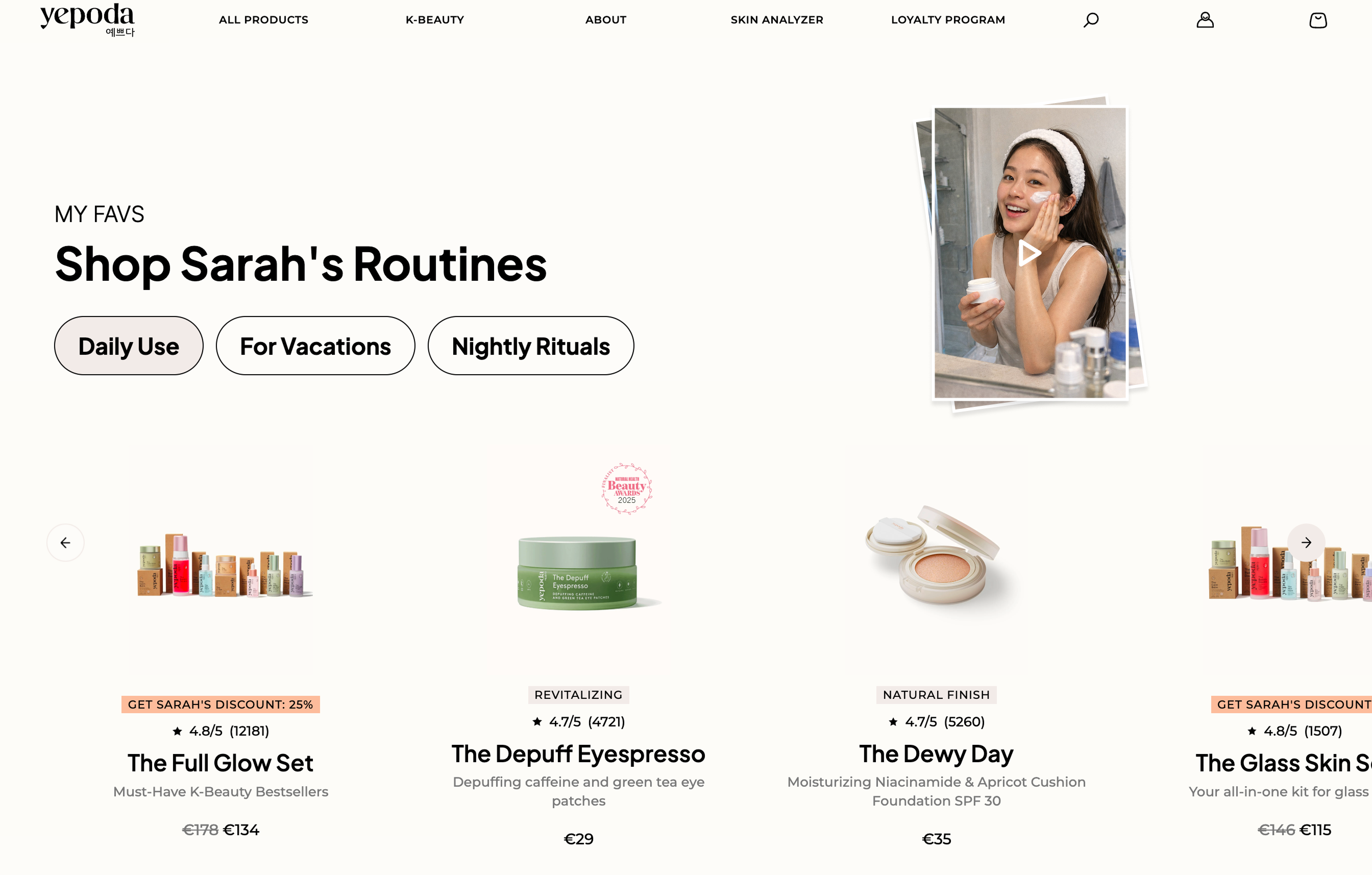


The Playbook for Yepoda (EU-first, routine-led co-branded commerce)
Yepoda is already a strong DTC brand with clear product-market fit in European K-beauty: sustainable, vegan, cruelty-free formulas made in Korea, with an accessible ‘glass skin’ promise and a broad catalog (~200 products). The challenge now is not ‘should we run partnerships?’—you already do. The challenge is scaling partnerships without losing performance, attribution clarity, and partner excitement across Italy, Germany, France, Spain, and Poland while you migrate to Refersion and keep content workflows organized through Kolsquare.
This playbook focuses on one idea: every partner click should land into a shopping experience that feels like a routine built by a trusted person, not a generic storefront. CreatorCommerce is the mechanism: it lets you spin up co-branded experiences on your Shopify theme that can increase conversion rate by 30%+ and AOV by 67% on average (vs standard affiliate links). For Yepoda, the ‘AOV lever’ is routine-building and curation. The ‘CVR lever’ is trust (creator identity, proof, education) plus reduced friction (auto-applied discounts, faster product selection, localized messaging).
Step 0: Segment Strategy (who to win, and what each segment should sell)
Start by segmenting partners by what they can credibly deliver in Beauty/Skincare: education, transformation, frequency, and trust. You do not need one program; you need one system that supports multiple segments with different page templates and offers.
Segment A: Micro-influencers + UGC-first creators (high volume, routine education)
These are creators in the 5k–75k follower range who can produce consistent GRWM videos, ‘night routine’, ‘morning routine’, and ingredient education. They should drive your highest number of monthly activations across Italy, Spain, Poland, and France. Their storefront template should be simple: 3-step routine bundles, a ‘why this routine’ note, 2–4 UGC clips, and an auto-applied discount.
Segment B: Skin experts and professionals (derm nurses, estheticians, educators)
Even when they are not prescribing, they bring authority. Their funnel should be deeper: ingredient rationale, skin goal guidance, FAQ, and a ‘recommended for’ section. They can drive higher AOV because their audience expects structure. In Germany and France especially, these partners can win trust quickly if the page is careful about claims and focuses on routines and ingredients rather than medical outcomes.
Segment C: Publishers + deal/curation sites (scale, seasonal surges)
These are not ‘influencers’ but they can drive volume around moments: Black Friday, holiday gifting, ‘best K-beauty routine’, ‘vegan skincare’, ‘B Corp brands’. Their storefront template should be optimized for speed: curated collections, comparison tables, and localized offers. This segment will benefit most from bulk page creation and strict offer governance.
Segment D: Brand ambassadors + community leaders (retention + repeat)
Ambassadors can be long-term: they earn more when the page becomes their home base. Their funnel should include a personal story, routine updates, and a post-purchase re-engagement loop. This segment is where you build partner retention and a moat.
Each segment maps to an experience. The goal is to build 3–4 repeatable templates, not 500 custom builds.
Step 1: Partner Enrollment (make joining fast, local, and routine-based)
Enrollment should feel like: ‘Pick a skin goal and a routine; we will build your page; you share one link.’ If enrollment asks for too much, partners stall. If enrollment is too generic, your pages will be bland. The solution is progressive profiling: collect only what you need at the start, then enrich later.
Enrollment paths you could run in parallel:
1) Product seeding with activation requirements
Offer a ‘routine kit’ seed (e.g., cleanser + serum + mask) tied to a minimum deliverable: one GRWM + one story + one pinned routine link for 30 days. The deliverable is not only content; it is also a storefront activation. The partner’s reward is that their audience gets a personalized routine page and a clear discount.
2) Inbound partner application (localized by market)
Create an application page per key market (IT/DE/FR/ES/PL) with simple fields: market, language, skin focus (acne, glow, hydration, sensitivity), channel (TikTok/IG/YouTube/blog), and audience profile. CreatorCommerce pages can use this data to pre-select templates and recommended product sets.
3) Outbound recruitment (short, specific outreach)
Instead of asking creators to ‘join an affiliate program’, ask them to ‘launch your own Yepoda routine page’. The message should include one example and one promise: a personalized landing page on Yepoda.com, auto-applied discount, and a routine that matches their content style. This framing increases reply rates because it is an asset, not a link.
Keep the tool mention minimal in the pitch. Internally, your workflow can use Kolsquare lists to source creators and Refersion to manage payouts, but the partner experience should feel like: apply → approve → page goes live → share.
Step 2: Partner Activation by Segment (shock-and-awe comes from co-branding)
Activation is where affiliate programs usually fail: partners get a link and do nothing. Co-branding fixes this because it gives partners a ‘thing’ to show and a reason to talk about it beyond a discount.
Activation workflow (common across segments):
First: collect minimal inputs with forms
Ask for: preferred name, social handles, market/language, top 3 products (or skin goal), one short routine blurb, and one piece of content (or permission to reuse). For micro creators, you can accept ‘send a TikTok link’. For professionals, accept a ‘routine rationale’ paragraph. For publishers, accept a product list and a category angle.
Next: auto-generate the first version of the storefront
Use automation + AI to draft the page structure based on the skin goal and the products selected. This reduces the time-to-live to hours, not weeks. Your team then moderates and publishes. The partner receives a single URL on Yepoda.com that is their home base.
Then: notify and drive action with simple sequences
Send a 3-message sequence (email/SMS/DM depending on what you have): (1) ‘Your Yepoda routine page is live’ with preview, (2) ‘Here are 3 content prompts that fit your style’, (3) ‘Here is how to boost earnings: add a second routine or a bundle.’ The CTA is always: share the page, not the generic store.
Whitelisted Meta ads (for high-performers)
For partners who already have proven creative, enable a 1-click ad authorization flow so your team can run their best video as an ad (with their handle and face) to their audience or lookalikes. The key is that the ad should land on the partner’s co-branded routine page so the experience matches the creative. This closes the loop between content and conversion.
Segment-specific activation ideas:
Micro/UGC: a ‘30-day glass skin challenge’ page with weekly swaps (hydration week, glow week).
Professionals: a ‘skin goal intake’ quiz on their page that routes to 2–3 routines (gentle, balanced, advanced).
Publishers: a ‘best of Yepoda’ list with comparison blocks and a localized gift set module.
Ambassadors: a ‘monthly favorites’ module they can update, creating a reason to reshare.
Step 3: Co-branded Storefronts & Funnels (your core templates)
To scale across Europe, you need templates that fit the way skincare is bought: by routine, not by SKU. With ~200 products, the worst case is giving partners too many choices. Your best case is guiding shoppers to a complete set, then upselling with purposeful add-ons.
Template 1: The 3-step routine storefront (best for most creators)
Above the fold: creator name + ‘My Yepoda routine for [skin goal]’ + auto-applied discount + a 3-product bundle. Below: 2–4 UGC clips, short ‘how to use’ steps, and a ‘swap options’ section (sensitive vs oily). This template should be localized in language and currency by market.
Template 2: The GRWM funnel (TikTok-first)
A video-first page that starts with the creator’s routine clip, then lists the products in the exact order used, with ‘add all to cart’. This reduces decision fatigue and improves CVR because the shopper does not have to interpret a long product grid.
Template 3: The expert routine guide (professional authority)
Structured content: ‘Who this is for’, ‘Ingredient rationale’, ‘How to layer’, ‘Common mistakes’, and ‘FAQ’. Add a gentle disclaimer about not being medical advice, and keep claims compliant. This template typically drives higher AOV because it supports a larger routine and optional ‘supporting products’ (toner, SPF, mask rotation).
Template 4: The seasonal gift/curation page (publishers + Q4)
Collections, best-sellers, and gift sets with a few story blocks: B Corp, sustainable packaging, vegan and cruelty-free. This template is designed for speed and SEO-friendly structure, and it can be cloned per publisher and per market.
Funnel tests you should run early:
1) ‘Add routine to cart’ vs ‘Shop collection’ as the primary CTA.
2) Auto-applied discount vs code reveal (auto-apply usually wins because it removes mental math).
3) Bundle-first merchandising vs single-product-first.
4) UGC above the fold vs below the fold.
5) Market-specific hero copy: ‘glass skin’ wording may work differently by country; test localized variants.
Step 4: Funnel Details (beyond the landing page)
The landing page is only one part. To capture the full lift in CVR and AOV, co-branding should carry into product pages, cart, and retention touchpoints.
Co-branded product pages
When a shopper clicks into a product, keep the partner context persistent: ‘Recommended by [Creator]’ plus the routine step (‘Step 2: serum’). Add a short snippet of the creator’s tip (‘Use 2–3 drops, press in’). This maintains trust and keeps the narrative intact.
Co-branded cart
Show the partner name and discount clearly, and add ‘complete the routine’ cross-sells that are actually logical (e.g., if cleanser + serum, suggest moisturizer or mask rotation). Cart-based attribution also helps capture orders that might otherwise be missed when shoppers browse around—this is where you can recover incremental tracked orders.
Pop-ups and micro-conversions
Instead of a generic newsletter pop-up, use a co-branded one: ‘Get [Creator]’s routine updates + a first-order offer’. That email is more valuable because it connects to a person. Collect skin goal and market, so future flows are localized and routine-driven.
On-page proof modules
Beauty needs reassurance. Add modules like: short reviews, ‘before/after’ content where compliant, ‘how long until you notice’ expectations (careful language), and routine frequency. This reduces purchase anxiety and supports the price point.
Step 5: Launch & Track (migrate to Refersion without breaking momentum)
You are planning to migrate to Refersion to automate payments and support multi-store and multi-currency. The launch plan should avoid a ‘big bang’ migration that pauses partner revenue. Instead, you can run a staged rollout where co-branded pages sit behind existing links first, then migrate tracking when stable.
First: integrate and map identity
Map partner IDs so every co-branded page is tied to a Refersion partner record. Ensure each market has the right currency and localized offer rules. Keep Kolsquare as the creator relationship layer; use Refersion as payout and affiliate management; use CreatorCommerce as the on-site conversion layer.
Next: launch a controlled cohort
Start with 25–50 partners across your top markets (a mix of micro creators, one or two professionals, and one publisher). Give them the new co-branded page, keep their link stable, and measure lift vs their baseline.
Then: define the scorecard
Track: conversion rate, AOV, revenue per click, attach rate (items/order), discount usage, and repeat rate (30/60/90 days) for traffic originating from co-branded pages. Also track partner activation rate: % who share within 7 days, and % who publish 2+ pieces of content in 30 days.
Step 6: Optimize (content campaigns, retention loops, and always-on improvements)
Optimization is where you turn a good program into a durable growth channel. The goal is to create reasons for partners to reshare monthly, not only during launches. This is especially important in skincare, where consistency and routine updates drive repeat purchasing.
Always-on: co-branded cart abandonment + post-purchase
Make abandonment emails show: the partner name, the routine, and the discount already applied. Post-purchase should include: ‘How to use your routine’, a short note from the partner, and a recommended next step (e.g., add a mask rotation in 21 days). This builds attachment and increases repeat purchases without adding more acquisition spend.
Monthly content moments (simple calendar you could run)
January: ‘Reset routine’ + hydration focus.
February: ‘Sensitive skin month’ (gentle routine, barrier support).
March/April: ‘Spring glow’ (exfoliation education, careful claims).
Summer: ‘Lightweight routine’ and travel kits by market.
September: ‘Back to routine’ (habit building).
Q4: gift guides, sets, and limited drops.
Each moment becomes a set of page updates: swap hero modules, update product curation, add 1–2 fresh UGC clips, and refresh the offer logic. Partners get an email: ‘Your page is updated for [campaign]. Here is what to post.’
Routine bundling to drive AOV
Because your average product price is ~€50, a routine bundle (2–4 items) is the cleanest path to lift AOV. Build bundles that match common content narratives: ‘minimal routine’, ‘advanced routine’, ‘mask rotation’, ‘travel routine’. Even if the products are purchased individually, the merchandising should present them as a set.
Localization (EU markets)
For Italy/Spain, short-form video + routine order works well. For Germany, ingredient clarity and sustainability/B Corp messaging can carry more weight. For France, aesthetic + routine education + premium feel matters. For Poland, value clarity and straightforward routine guidance can reduce friction. The templates stay the same; the copy blocks and featured UGC change.
Step 7: Advanced (publishers, professionals, and deeper co-branding)
Once the core is working, you can offer select partners deeper integrations that create defensibility.
Professional partners: whitelabel ‘clinic-style’ experiences
For top experts, build a more complete co-branded experience that looks like their own mini-site on your domain: intake quiz, routine builder, and educational hub. This can be framed as a public resource, not just a sales page, increasing shareability and long-term traffic.
Publishers: product embeds and modules
Instead of sending publishers a link, give them embeddable product modules that preserve co-branded attribution and keep the shopper’s experience consistent when they click through. The landing page still matters, but embeds can improve click quality and reduce mismatch.
Multi-store / multi-currency governance
Use rules for which discounts are allowed by market, how bundles are priced, and which creators get whitelisted ads. This keeps the program scalable and compliant.
What success could look like in 90 days
Weeks 1–2: finalize сегments and templates; connect Shopify + Refersion; define offer rules by market; build the first 3–4 templates.
Weeks 3–6: launch a 25–50 partner cohort across IT/DE/FR/ES/PL; generate pages via forms + automation; run the first funnel tests (bundle-first, auto-apply discount, UGC placement).
Weeks 7–10: add co-branded cart + email flows; enable whitelisted ads for top 5–10 partners; expand to 100–200 partners using the same templates.
Weeks 11–13: run the first seasonal moment (e.g., ‘glass skin routine month’) and refresh pages at scale; publish a partner leaderboard and retention plan focused on keeping top creators active.
The overarching strategy is simple: make every partnership feel like a co-owned routine experience on Yepoda.com. You will recruit faster because the offer is tangible, partners will activate because the page is already built for them, and you will see measurable lifts because the experience is designed around skincare buying behavior: routines, trust, education, and low-friction checkout.


%201.png)
%201.png)