



Young Days x CreatorCommerce: a practical playbook to grow Refersion recruitment, activation, and revenue
You already have the foundations: a clear point of view (gender-neutral, mix-and-match), a values story (ethical + sustainable), and a product set that solves a real parent problem (comfort + durability for play). The gap most kids apparel affiliate programs hit is not 'more links.' It is that the shopping experience after the click looks the same no matter who sent the traffic, so you get low engagement, shallow content, and modest conversion.
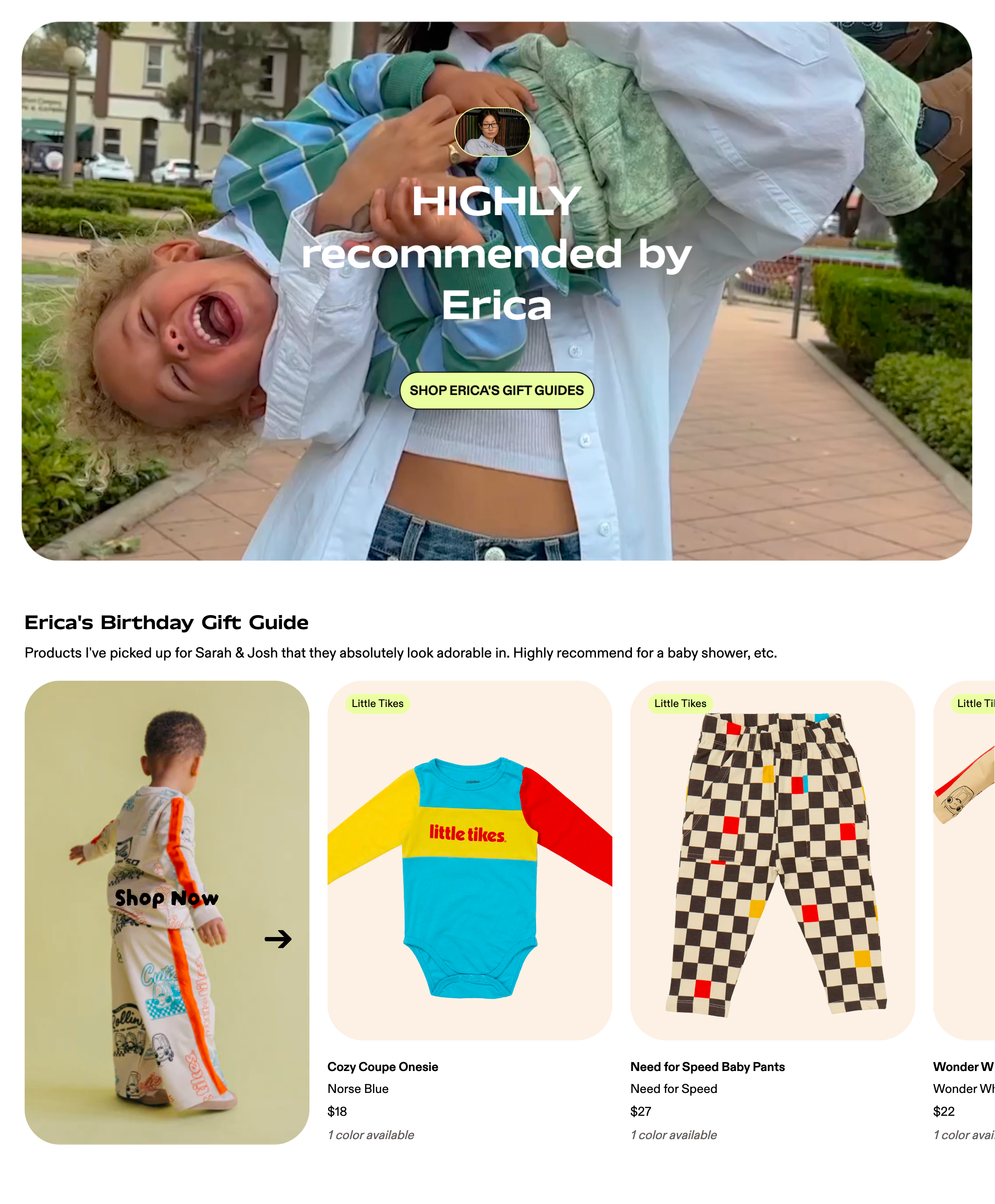
CreatorCommerce is built to fix the post-click experience: instead of a generic landing, each partner sends shoppers to a co-branded page on youngdays.com with their name, their product picks, their content, and an auto-applied offer. Across Shopify brands, these co-branded experiences typically drive 30%+ higher conversion rates and 67% higher AOV versus standard affiliate links because they reduce friction and increase trust.
Step 0: Segment strategy (who to win, and what each segment needs)
Before recruiting harder, decide which partner segments you want to win in the next 90 days and what 'good' looks like for each. Kids apparel works best with partner types that can show product on real children and earn trust with parents. With a ~$30 average item price and ~400 products, segmentation should also guide how you curate (you do not want every partner pushing every SKU).
Core segments for Young Days
1) Micro parent creators (primary growth engine)
These are parents creating content about newborn/toddler life, minimalist wardrobes, sustainable swaps, travel with kids, daycare routines, and gift guides. They will not all have massive reach, but they produce the highest-trust content and can drive steady conversions. Your goal is volume + consistency: hundreds of active micro creators each month.
2) Ambassador-style community partners
Think doulas, postpartum groups, parenting newsletters, local mom groups, and family photographers. They can be smaller, but they bring qualified intent and repeat exposure. These partners are perfect for evergreen 'capsule wardrobe' pages and seasonal gift guides.
3) B2B-adjacent partners (later)
Daycares, kids play spaces, kids boutiques, and registry/gift-list services. These partners often need a more formal offer (tiers, store credit, custom bundles). They can become your higher AOV channel if you build sets and packs.
What to measure per segment
Set expectations upfront so the program does not turn into 'send free product and hope.' For example:
- Micro creators: activation rate (page completed + first post), clicks, CVR, AOV, content submissions per month.
- Community partners: email clicks, CVR, repeat purchase rate, list growth driven to Young Days.
- B2B-adjacent: AOV, bundle attach rate, reorder cadence.
This segmentation becomes the blueprint for what pages you generate, what content you collect, and what automation you build.
Step 1: Partner enrollment (make joining easy, and make the offer feel different)
Most affiliate recruitment funnels are built around commissions and generic links. For Young Days, the differentiator should be: 'You get your own Young Days shop.' That message is simple, tangible, and immediately shareable.
Enrollment flows to build
1) A dedicated 'Creator + Community Partner' landing page
Position the program as a collaboration (not a coupon farm). Explain: partners get a co-branded shop page, a unique code, and the ability to curate capsule sets for newborn–24 months. Include an example screenshot of what a partner shop looks like and a short form to apply.
2) A fast-track path for existing customers
Some of your best partners are already buying. Offer a 'turn your order history into your shop' flow: if they are a customer, they can join, pick their favorites, and start sharing within a day. This tends to increase activation because they already know sizing and fabric feel.
3) Outreach sequences that lead with curation
Your outreach should not start with 'commission rate.' Start with: 'We built a mini capsule shop for your audience' (even if it is a draft). For kids apparel, curations are the hook: 'daycare essentials set,' 'newborn coming-home list,' 'toddler playwear that holds up,' 'gender-neutral baby shower gifts.'
Seeding strategy (lightweight, not wasteful)
With a ~$30 average item price, you can seed efficiently by offering a limited 'starter pack' option: one core top + one core bottom, or a seasonal set. The goal of seeding is content and page activation, not just goodwill. The application should ask for: kid age range, typical content format (Reels/TikTok/Blog/Email), and which capsule theme they want to own.
Step 2: Partner activation by segment (turn sign-ups into live pages and live content)
Activation is where most programs leak. Partners join, get a link, and then nothing happens. Your goal is to deliver a 'shock & awe' moment within 24–72 hours: a co-branded page on Young Days with their name, their story, and a curated set that makes sense for parents.
Activation system (common to all segments)
1) Collect the minimum data to build a great page
Use a short form immediately after approval (and in a reminder email). Ask for: display name, profile photo, kid age(s), their top 10 Young Days picks (or choose a capsule theme), sizing notes they recommend, and one short paragraph on why they like gender-neutral + durable clothing.
2) Automate page creation using partial data
If you have limited info, generate a strong first version anyway: use Shopify product data, best-sellers by size, and any order history. Then give partners a simple dashboard to edit: swap products, reorder, add a short note, add a photo. The goal is speed: a decent page today beats a perfect page next month.
3) Notify and guide with a 3-touch activation sequence
Email/SMS could be: (a) 'Your shop is live' with the link and suggested first post script, (b) 'Add your photo + pick your capsule' (one-click edit), (c) 'Your first 10 orders unlock a bonus' (optional performance incentive).
Segment-specific activation
Micro parent creators
Give them a 'content kit' that matches how parents shop: a short list of talking points (fabric, washability, durability), 3 outfit ideas, and a pre-built capsule on their page. Add UGC prompts: 'before daycare,' 'playground test,' 'packing list,' 'hand-me-down durability.'
Community partners
Give them an evergreen page built around a need: registry/gift guide, minimalist capsule wardrobe, or seasonal layering. Offer them a 'recommended list' they can embed in a newsletter (links to their co-branded page) so it is not social-only.
Whitelisted Meta ads (optional, high leverage)
For top partners who have proven organic performance, offer 1-click ad authorization so Young Days can run paid amplification from the partner handle. The co-branded page becomes the destination, not the generic homepage. This keeps the partner’s identity intact while letting you scale winners.
Step 3: Co-branded storefronts & funnels (what the pages should look like for kids apparel)
The advantage of kids apparel is that shoppers want guidance. Most parents are trying to buy quickly, avoid sizing mistakes, and feel confident the fabric is safe and comfortable. Your co-branded pages should reduce choice overload across ~400 products by making the page feel like a small, thoughtful shop.
Recommended page templates (build a few, then scale)
Template A: Newborn essentials (0–3 months)
Feature: the 'coming home' set, soft staples, easy changes, and simple colors that mix. Add a short section: 'What I pack in the diaper bag.'
Template B: Daycare durability (6–24 months)
Feature: playwear staples that hold up. Add a 'wash test' note and 'stain-prone moments' tips. Parents love practical guidance more than aesthetic claims.
Template C: Gift guide (baby shower / first birthday)
Feature: best-selling gifts, gender-neutral sets, and a 'gift-ready bundles' section. This is where you can lift AOV with curated multi-item sets.
Template D: Minimalist capsule (year-round)
Feature: 10–15 items that mix-and-match. Add a visual '3 outfits from 5 pieces' section. This drives confidence and higher cart size.
Core funnel tests to run
- UGC-first vs product-first: lead with a partner photo grid vs best-seller grid.
- Auto-applied discount messaging: show the applied offer at the top + in cart to reduce drop-off.
- Capsule bundles: 'buy the full set' button vs add-to-cart per item.
- Age gate: quick selector (newborn / 3–6 / 6–12 / 12–24 months) that filters the page.
- Fabric callouts: small badges (organic cotton, recycled poly) near the add-to-cart actions.
Because CreatorCommerce pages live in your Shopify theme (Liquid), you can iterate like a normal Shopify experience while still scaling partner personalization.
Step 4: Funnel details (beyond the landing page: product page, cart, and on-site moments)
The highest lift usually comes from improving the full path, not just the entry page. Parents often add one item and leave because they are unsure what else they need. This is where co-branding and merchandising can increase AOV.
On-page modules to add
1) Co-branded pop-up: 'Get [Partner]’s code applied'
When a shopper lands from a partner, a small pop-up can confirm: 'You are shopping [Partner]’s Young Days picks. Code is applied.' This prevents coupon hunting and builds trust.
2) Size + age guidance written by the partner
A short 'my sizing notes' section converts well in kids apparel because parents fear wrong sizing. Even simple notes like 'my toddler is 18 months and wears 18–24' reduces hesitation.
3) 'Complete the set' upsells on PDP and cart
If someone adds a top, show matching bottoms or a layering piece chosen by the partner. Keep it curated to 2–4 items, not a huge recommendation wall.
4) Reviews and Q&A in context
Pull 2–3 relevant reviews into the partner page (comfort, washability, durability). Add a quick Q&A like 'Is this daycare safe?' or 'Does it shrink?' These are high-intent objections.
Cart and checkout
Cart-based attribution matters because kids apparel often involves comparison shopping and returning later. Use cart-aware tracking to capture more orders that would otherwise be missed when a parent comes back from another device or later in the day. This also reduces partner frustration about 'missing commissions.'
Co-branded cart experience: keep the partner name visible in cart and on checkout-adjacent pages so the shopper understands the relationship and does not feel bait-and-switched.
Step 5: Launch & track (ship quickly without breaking your existing Refersion motion)
Implementation should avoid forcing partners to change habits. The best launch is: keep Refersion as the tracking layer and map existing partner links to the new co-branded pages. That way, partners keep sharing what they already share, but the destination is better.
Launch plan (first 30 days)
- Week 1: integrate, design 2–3 page templates, and create internal QA rules (naming, images, product caps).
- Week 2: activate 20–30 partners across the micro creator segment; collect content; iterate pages.
- Week 3: expand to 100+ partners; add the gift guide template; start measuring CVR and AOV lifts vs control traffic.
- Week 4: identify top 10 performers; offer whitelisted ads to 2–3; begin building a 'graduation' path to paid collaborations.
Metrics that matter
Track: CVR, AOV, revenue per click, attach rate (second item added), repeat purchase rate, and partner retention (active partners month-over-month). The goal is not just more partners; it is more partners who stay active because their page converts.
Step 6: Optimize (content campaigns + retention flows that keep partners and customers coming back)
Optimization is a mix of seasonal moments and always-on retention. Kids apparel has natural seasons (back-to-daycare, fall layering, holiday gifting) plus recurring needs (growth spurts, replacements, sibling hand-me-downs).
Must-have: co-branded retention email
Build co-branded cart abandonment and post-purchase flows that include the partner name and their curated recommendations. This does two things: (1) improves conversion and repeat rate, and (2) makes partners feel ownership because the customer journey visibly includes them.
Cart abandonment: 'Your cart from [Partner]’s Young Days shop' + a reminder that the discount is applied + 2 partner-selected add-ons.
Post-purchase: 'How to care for your fabrics' + 'Here are 3 pieces that match what you bought' + invite to share a photo for a monthly giveaway.
Seasonal campaign calendar (simple and repeatable)
- January: 'Minimalist reset capsule' (parents declutter after holidays).
- March/April: 'Spring playwear + travel set' (lighter layers, trips).
- August/September: 'Back-to-daycare essentials' (durability + extras).
- October: 'Fall layering guide' (mix-and-match outfits).
- November/December: 'Gift guides' + 'holiday photo outfits' (bundles for AOV).
Each campaign should come with: a page banner, a partner email template, 3 short scripts for Reels/TikTok, and a curated bundle section on the partner storefront.
Step 7: Advanced (high-performing community partners and B2B-adjacent opportunities)
Once you identify partners who consistently drive sales (not just clicks), you can offer deeper integrations that feel like real collaboration without creating manual work for your team.
Options to consider
1) Fully co-branded whitelabel shops for top partners
For a parenting newsletter, a photographer with a strong client base, or a local community group, you can create a deeper co-branded experience that looks like a mini site: multiple collections, multiple landing pages (newborn, toddler, gifting), and a custom about page.
2) Embeddable product sets
Let publishers embed a 'Young Days Capsule' module on their own site that routes into their co-branded cart. This is ideal for partners who do not rely on social and want evergreen SEO traffic.
3) Paid collaboration graduation path
Use performance to decide who becomes paid: for example, partners who hit a revenue threshold or maintain a target CVR/AOV on their co-branded page. When you move to paid, you keep the same destination (their shop), so you are scaling a proven funnel rather than rebuilding.
What this solves for Young Days (mapped to common pain points)
- Low partner engagement: partners get their own page to share, edit, and feel proud of.
- Traffic but no purchases: co-branded trust + auto-applied discounts + curated sets reduce drop-off.
- Plateaued ROI: bundles and capsules lift AOV; on-site content lifts CVR.
- Poor attribution: cart-aware attribution captures more orders and reduces partner complaints.
- Retention problems: partners stay because they are building an on-site asset; customers repeat via co-branded email and seasonal updates.
If you want a clean starting point, begin with 3 templates (Newborn Essentials, Daycare Durability, Gift Guide), activate 30 partners, and treat the first month as a measurement sprint. Once you see which template and segment performs, scale page generation across your Refersion base and shift recruitment messaging to the thing that makes you different: 'Your own Young Days shop, built for your audience.'


%201.png)
%201.png)