

Beauty is the most saturated vertical in creator commerce. Every new launch ships with a creator roster, every Sephora shelf is reverse-engineered from TikTok, and the creator-to-shopper purchase funnel runs faster than in any other category. That saturation is both the opportunity and the problem: creator-driven shoppers expect a beauty brand to feel creator-native at every touchpoint, not just on the storefront. A generic post-purchase flow in beauty reads as tone-deaf in a way it doesn't in home goods or food.
This post is a vertical-specific playbook for beauty brands running the seven-surface creator-aware stack. It walks through how each downstream surface shifts when the product is beauty: why Klaviyo flows need shade-specific branches, why Gorgias macros carry more risk of brand damage, why loyalty programs must anchor on replenishment, why returns need a more generous exchange window, and what good looks like across every touchpoint.
What makes the beauty vertical structurally different?
Three things. First, SKU sensitivity: a beauty shopper picks a specific shade, formula, or undertone: "Rare Beauty Soft Pinch in Joy" is a different purchase than "Rare Beauty Soft Pinch in Bliss." Every downstream surface has to respect that SKU-level specificity or it breaks immediately.
Second, replenishment cadence: good beauty products have predictable reorder windows. A mascara runs out at 60-90 days. A serum at 45-60. A cleanser at 30. This creates a retention economics structure where subscription, loyalty, and email flows can all hook onto the replenishment curve, and where a brand that misses the reorder window by a week loses that cycle to a competitor creator's recommendation.
Third, creator-audience overlap: beauty creators often recommend multiple brands, so shoppers acquired through a creator arrive already aware of competing options. The creator-aware stack has to work harder to keep the brand-shopper relationship primary. The creator's endorsement alone isn't a moat.
What does a creator-aware beauty storefront actually look like?
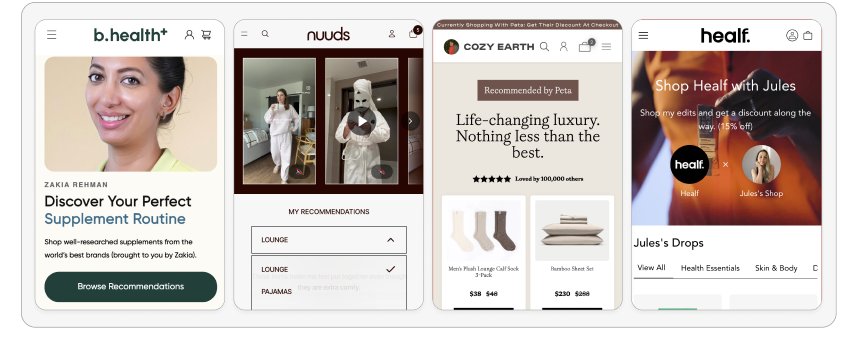
Beauty storefronts on CreatorCommerce tend to center on three elements: the creator's edit (the 5-12 products they've curated), shade-matching tools or quizzes the creator has endorsed, and before/after content the creator has produced. The storefront isn't a generic brand page with a creator's headshot attached; it's a point-of-view page where the creator's taste shapes every module.
Buttah Skin's creator storefront program is the reference case. Customers acquired through creator storefronts convert at a 30% lift vs. their catalog baseline, with AOV up 78%. The lift comes from the quality of the creator's edit: the creator picks the two or three products that make sense for their audience and the storefront cuts the rest out of the conversion path.
How do Klaviyo flows change for beauty brands?
Beauty-specific Klaviyo flows layer two dimensions on top of the standard creator-aware flow pattern from the Klaviyo how-to: SKU-level replenishment and shade/formula continuity.
Replenishment: for every product the creator has in their edit, Klaviyo should carry a replenishment flow with reorder windows tuned to the product's consumption rate. For a mascara purchased on day 0, fire a reorder reminder on day 75 with copy voiced in the creator's register: "it's been about a tube. Want me to send another?" Don't default to a brand-voiced reminder.
Shade continuity: if the shopper bought a foundation in a specific shade, every follow-up communication that touches that product should lead with that shade. A "you might like" flow recommending the same formula in a different shade is creepy if the shopper's skin-tone shade is already set. Flag the shade and recommend across formula lines instead.
| Flow | Beauty tuning | Trigger window |
|---|---|---|
| Welcome | Lead with creator's shade/formula pick | Day 0-3 |
| Post-purchase | Creator's how-to-use content | Day 5-7 |
| Replenishment | Product-specific reorder reminder | 60-90 days |
| Cross-sell | Next product in creator's routine | Day 14-21 |
| Win-back | Creator's new drop in same category | Day 120+ |
What about Gorgias for beauty support?
Beauty support has a higher sensitivity floor than most categories. A ticket about a returned product in home goods is a transaction; a ticket about a reaction to a skincare product is a health and brand-reputation moment. Creator-aware macros in Gorgias for beauty should:
Lead with the creator context in the agent-facing view ("customer acquired through Creator A's retinol capsule, ordered Day 0, reaction reported Day 4") so the agent has the full story before they respond. Escalate reaction-related tickets automatically regardless of creator cohort. There's no world where a reaction complaint from a creator-cohort shopper gets handled differently from a generic cohort on safety grounds.
For non-safety tickets, the creator-aware macro library should have beauty-specific branches: "I bought the wrong shade," "formula didn't match my skin type," "ran out faster than expected." Each branch pulls from the creator's specific product notes. If the creator has public content on how to pick the right shade, link it in the agent's macro. For the full Gorgias pattern, see the how-to post.
How do Yotpo review requests differ for beauty?
Beauty reviews are a distinct content format: they carry shade, skin-type, age, and routine context that a generic review request can't capture. A creator-aware Yotpo flow for beauty should prompt for shade, skin type, and whether the shopper bought through a specific creator's capsule, then surface reviews filtered by matching shopper attributes.
This changes the economics of social proof. A generic review from a shopper with no context is marginally useful. A review that says "I'm NC35 with combination skin, bought this through Creator X's oily-skin capsule, and the finish is matte without drying" is load-bearing social proof. For the Yotpo configuration path, see the creator-aware Yotpo post.
Why does loyalty need to anchor on replenishment for beauty brands?
Most loyalty programs reward cumulative spend: earn 1 point per dollar, hit a tier at $500. For beauty, that structure misses the actual retention lever, which is getting the shopper to reorder at the right cadence. A shopper who buys a $60 serum every 60 days for a year is economically identical to a shopper who spends the same $360 in four lumpy purchases, but the replenishment shopper is the retained one.
Beauty loyalty programs should stack a replenishment bonus on top of the generic earn rate. Every reorder within the "on-schedule" window earns 2x or 3x points, and falling off the replenishment cadence drops the shopper back to the base rate. This aligns the program with the retention curve the brand actually needs.
Creator-aware loyalty adds a third dimension: creator-cohort badges. A shopper who has bought through a specific creator's capsule three times earns a "Creator X regular" badge that unlocks creator-specific rewards: early access to new drops from that creator, a discount on products in that creator's replenishment cadence. The loyalty how-to covers the technical setup.
How do beauty subscriptions differ from generic subscriptions?
Beauty subscriptions are the best-fit category for creator-aware subscription flows because the replenishment cadence is already obvious to the shopper. Unlike coffee or protein powder where subscriptions feel slightly forced, a mascara subscription at 60 days just matches usage.
The creator-aware angle: default the subscription cadence to the creator's recommended reorder window, not the platform default. If Creator X tells their audience "I replace this mascara every two months," the ReCharge or Skio default for shoppers acquired through that creator's storefront should be 60 days, not the platform's 30-day default. The creator's authority carries over into the cadence setting.
For full subscription setup including skip and swap logic by creator cohort, see the subscription how-to.
What does creator-aware returns look like for beauty brands?
Beauty returns are complicated by a hard constraint: most formulas can't be resold once opened. This caps the brand's upside on traditional "exchange for refund" flows. The returned product is a write-off either way. The creator-aware return flow has to play a different game: capture the data, offer a more generous credit for an exchange within the creator's capsule, and use the return moment to re-engage the shopper on a different SKU.
Practically: for a beauty return initiated from a creator-cohort order, offer 110% store credit on an exchange for another product in the same creator's edit. The 10% bump is a small giveaway relative to what the brand loses on the refund. Copy should voice-match the creator: "not the right match? [Creator] has three other picks that might work better." The returns how-to covers platform setup.
What SMS flows work for beauty creator programs?
Beauty SMS is high-engagement, high-sensitivity. Shoppers opt in at a higher rate than most categories, but they also unsubscribe fastest when a brand feels generic or spammy. Creator-aware SMS flows solve this by voicing the messages in the creator's register.
The three highest-ROI flows for beauty: new-drop alerts voiced by the creator ("I've been testing the new blush. Here's my full review."), replenishment nudges ("Hey, you're about due for another of these. Want me to send one?"), and exclusive-shade drops ("Got early access to the new shade range. Creator X is using X3."). All three should be scoped to the creator cohort. Shoppers who weren't acquired through that creator get a different message, or no message for that specific creator's content. The SMS how-to covers Attentive and Postscript setup.
What about Meta CAPI for beauty?
Beauty ad accounts benefit from creator-tagged CAPI events more than almost any other category, because the ad platform's lookalike model gets much better signal from creator-cohort LTV data. A beauty brand that sends Purchase events tagged with creator_id to Meta can train lookalike audiences specifically off the shoppers who bought through Creator X, and the resulting audience tends to massively outperform generic Purchase lookalikes.
This is the single highest-leverage place to ship creator attribution into paid media for a beauty brand. The CAPI how-to covers the technical setup.
How do these surfaces stack for a beauty brand?
The stacking matters more than any individual surface. A beauty brand that runs creator-aware Klaviyo but generic Gorgias, or creator-aware returns but generic loyalty, gets a fraction of the lift available. The stack compounds: each surface reinforces the creator relationship at a different moment, and the brand's creator-cohort LTV only moves meaningfully when every surface is tuned.
Practical order of operations for a beauty brand starting from scratch: storefront first (attribution depends on it), then Klaviyo (biggest flow-level ROI), then returns (biggest retention leverage), then loyalty and subscriptions (stack replenishment economics), then CAPI and SMS (amplify acquisition), then Gorgias and Yotpo (protect downstream trust). Most brands over-invest in CAPI and SMS before they've fixed Klaviyo and returns, which is why their creator program economics stall.
What numbers should a beauty brand track?
Six metrics, each cut by creator cohort vs. catalog baseline:
- CVR on creator storefronts (baseline vs. catalog CVR)
- AOV on creator-driven orders (baseline vs. catalog AOV)
- Reorder rate at the 60-day mark (the beauty-specific replenishment indicator)
- Subscription enrollment rate post-first-purchase
- Return-to-exchange conversion (creator cohort should exceed catalog)
- 90-day retention (the leading indicator of whether the stack is working)
Beauty brands running the full creator-aware stack typically see the reorder rate at 60 days climb 20-35 percentage points vs. their pre-stack baseline. That single metric is the clearest signal the downstream surfaces are doing their job.
What's the minimum viable version of this for a small beauty brand?
A small brand with three-to-five creators in the program should focus on exactly two surfaces: the storefront (for attribution) and Klaviyo (for replenishment). Skip the rest until the core is working. Beauty brands at this stage don't need loyalty tiering or SMS flows; they need the creator-to-purchase-to-reorder loop to close cleanly.
Once reorder rate is tracking, expand to returns (cheapest high-leverage project) and then subscriptions (economics get meaningful at scale). Leave Gorgias macros, Yotpo review flows, and Meta CAPI for later.
Frequently Asked Questions
Does this playbook apply to skincare, color cosmetics, and haircare equally?
The structural pattern is the same: SKU sensitivity, replenishment cadence, creator-audience overlap. The specific tuning differs. Skincare has longer reorder windows (45-90 days), color cosmetics shorter (30-60 for anything high-use), haircare variable. The replenishment flows in Klaviyo should be product-specific, not category-blanket.
How does this compare to the food and beverage playbook?
Food and beverage has shorter replenishment cycles (7-21 days), lower SKU sensitivity (a shopper is more flexible on "protein bar brand A vs. brand B" than on "foundation shade NC35 vs. NC37"), and higher subscription adoption. The flows look similar but the cadence is 3-5x faster. We'll cover that in a future vertical playbook.
What's different about fashion vs. beauty here?
Fashion has return rates 3-5x higher than beauty, no replenishment cadence, and much higher SKU variety. The returns surface matters more for fashion (why returns are the most under-invested creator surface), and the creator-aware stack tilts more toward exchange flows and less toward replenishment. Subscriptions are mostly not relevant in fashion.
Does creator-aware beauty work for indie brands that can't afford CreatorCommerce?
The attribution primitives (clean customer metafield, downstream surfaces reading from it) are buildable without CreatorCommerce; they just require more custom Shopify Flow work and more maintenance. Indie brands often start with one or two creator storefronts built manually and graduate to the full platform once creator-driven volume justifies it. The playbook logic applies either way.
How do I handle cross-creator shoppers?
Beauty shoppers often follow multiple creators. If a shopper bought through Creator A's capsule and later re-engages through Creator B's content, attribution should follow the most recent touchpoint that drove the conversion, not the lifetime first-touch. For downstream flows already running (existing Klaviyo sequences, active subscriptions), don't retroactively switch attribution. That breaks the continuity of the ongoing flow.
What if a creator leaves the program?
Keep historical attribution intact, disable live flows that depend on the creator's current content, and route shoppers who would have received that creator's messaging to the brand's generic flow. Don't try to reassign their shoppers to another creator. That breaks the shopper-creator relationship the brand paid to build.
How often should the creator's content in these flows refresh?
Beauty creator content degrades faster than in other categories because the product cycle is fast. A creator's spring skincare edit shouldn't still be the reference content in fall. Aim for quarterly refresh cycles on Klaviyo creator flows, monthly on SMS (which moves faster), and whenever the creator drops new content on the storefront.
Does subscription cannibalize one-time purchase revenue?
In beauty, subscriptions typically pull from the same customer. The shopper either becomes a subscriber or churns. Subscriptions almost always lift net revenue at the cohort level, but individual-purchase revenue may look flat. Measure cohort LTV, not per-order AOV, when evaluating subscription impact.
What's the biggest mistake beauty brands make with creator programs?
Over-investing in the acquisition surface (more creators, more storefronts) before fixing the downstream retention surfaces. Adding a tenth creator when the existing nine have a 20% reorder rate is a worse investment than fixing the Klaviyo replenishment flow that could push all nine to a 40% reorder rate.
Is there a beauty-specific dashboard I should build?
Yes. Cohort the data by creator, then slice by: CVR, AOV, 60-day reorder rate, 90-day retention, exchange-to-refund ratio, subscription enrollment, and lifetime revenue. Most beauty brands don't cut their data this way by default, which is why they can't tell which creators are economically valuable past the initial sale.
How do you measure the stacking effect?
Run the numbers as a counterfactual: compare creator-cohort LTV on the full stack to creator-cohort LTV in a single-surface configuration. If the full stack is only 10-15% better than storefront+Klaviyo alone, something in the middle surfaces is failing. A well-tuned stack typically produces 40-60% LTV lift over storefront+Klaviyo alone.
What about brands that sell beauty at retail as well as DTC?
The creator-aware stack only applies to DTC. Retail beauty sales are effectively unattributed from the brand's perspective. The retailer owns the customer relationship. Some brands treat creators as top-of-funnel drivers for retail and measure success in retail sell-through, but that's a different economic model. This playbook is for brands where DTC creator-driven orders are the retention unit.
Do these same patterns work internationally?
The stack works anywhere Shopify is running, but the specific surfaces available differ by region. Klaviyo, Yotpo, and Aftership are globally available; Gorgias and Attentive are strongest in North America and Europe; ReCharge and Skio are mostly US-focused. For international creator programs, the storefront + Klaviyo core is portable; the full stack requires regional platform choices.
How does this compare to what L'Oreal or Estee Lauder do?
Prestige conglomerates run creator programs differently. They're positioned more like advertising channels than retention channels, and the downstream retention stack is typically run at the brand level (separate for Kiehl's vs. Youth to the People vs. CeraVe) rather than at the creator level. The playbook here is indie-to-mid-sized-DTC-brand logic. The prestige model works, but the economics require different infrastructure.
Is there a reference brand doing this well?
Buttah Skin's creator storefront program is the closest reference. Strong storefront attribution, clear Klaviyo replenishment flows, and visible creator-cohort economics. Most of the numbers cited across this series come from that program or similar programs CC runs.
When will you publish the fashion and food vertical playbooks?
Soon. Each vertical warrants its own deep dive. The structural pattern (tune the seven-surface stack for the category's specific economics) generalizes; the tuning values don't.
Related Articles
- The Seven-Surface Creator-Aware Stack
- How to Make Loop, Parcel Panel, and Aftership Creator-Aware
- How to Make ReCharge, Skio, and Ordergroove Creator-Aware
- How to Make Smile, LoyaltyLion, and Yotpo Loyalty Creator-Aware
- How to Trigger Creator-Native SMS Flows in Attentive and Postscript
- How to Tie Yotpo Review Requests to Creator Storefronts
- How to Make Gorgias Creator-Aware for Post-Purchase Support
- How to Pipe Creator Attribution Into Meta CAPI and Lookalikes
- How to Build Creator-Native Email Flows in Klaviyo
- The Real Estate and PropTech Playbook for Creator-Aware Commerce


%201.png)
%201.png)
