
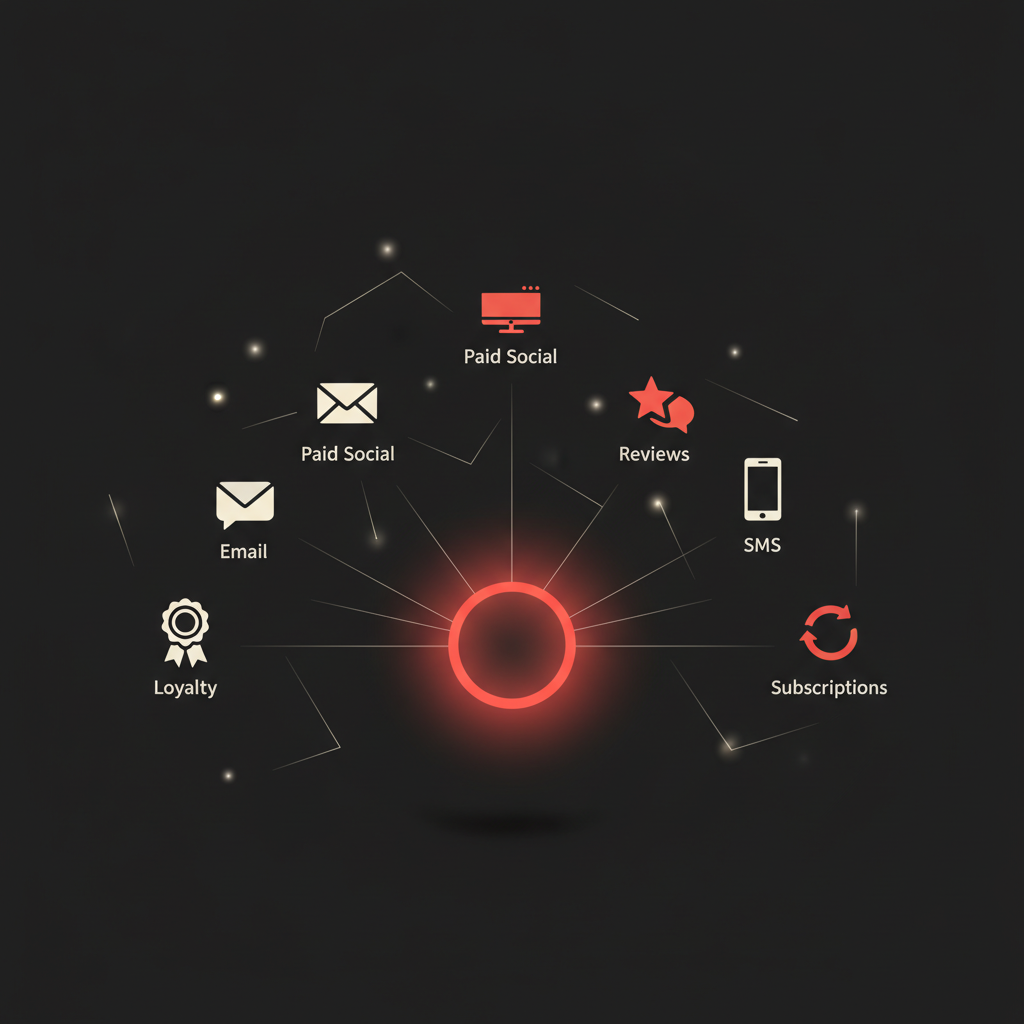
Every creator-commerce program has an acquisition story and a retention problem. The acquisition side is well understood: pick the right creators, give them a storefront, measure first-order conversion. The retention side is where most brands lose the plot. A customer acquired through a creator is handed back to the brand the moment they complete checkout. Every downstream channel (email, SMS, support, paid social, reviews, loyalty, subscriptions) treats them as a generic brand customer. The creator relationship that produced the sale is erased over the next 24 hours.
That handoff is the single biggest reason creator programs plateau. It is also the single easiest structural problem to fix. The fix is not a new platform or a new agency. It is a data-layer discipline: let one creator metafield on the customer record propagate into every downstream surface, and fork each platform's existing flows on that metafield. Seven surfaces, one data primitive, one customer experience continuously reinforced by the creator who drove the original purchase.
This is the capstone for a seven-part how-to series that walks through the specific fork for each platform category. If you have read the individual posts, this is the reference that ties them together. If you haven't read them, this is the end-to-end picture that explains why each individual build compounds more than the previous one, and why the seventh surface is worth building even though the first three already produce measurable lift.
The structural problem: creator identity stops at checkout
Shopify's native customer and order objects do not carry creator attribution. A creator drives a customer to a storefront, the customer checks out, and Shopify records a customer record with an order, with no reference to the creator relationship that produced the sale. Every downstream platform ingests that customer record, treats it as a standard brand customer, and fires its default flows.
In practice:
- Klaviyo sends a generic Welcome email.
- Meta CAPI reports a purchase event with no creator segmentation.
- Gorgias creates a ticket with no creator context.
- Yotpo sends a brand-branded review request.
- Attentive/Postscript sends a generic SMS Welcome.
- Smile/LoyaltyLion enrolls the customer in a generic tier.
- ReCharge/Skio/Ordergroove runs a generic enrollment flow.
Seven downstream channels, zero references to the creator. The customer's experience flattens into a generic brand lifecycle. The creator becomes a one-time acquisition lever instead of an enduring relationship. The 90-day test shows up in the data: creator cohorts perform identically to paid-media cohorts after the first 30 days, because everything downstream is identical to paid-media flows.
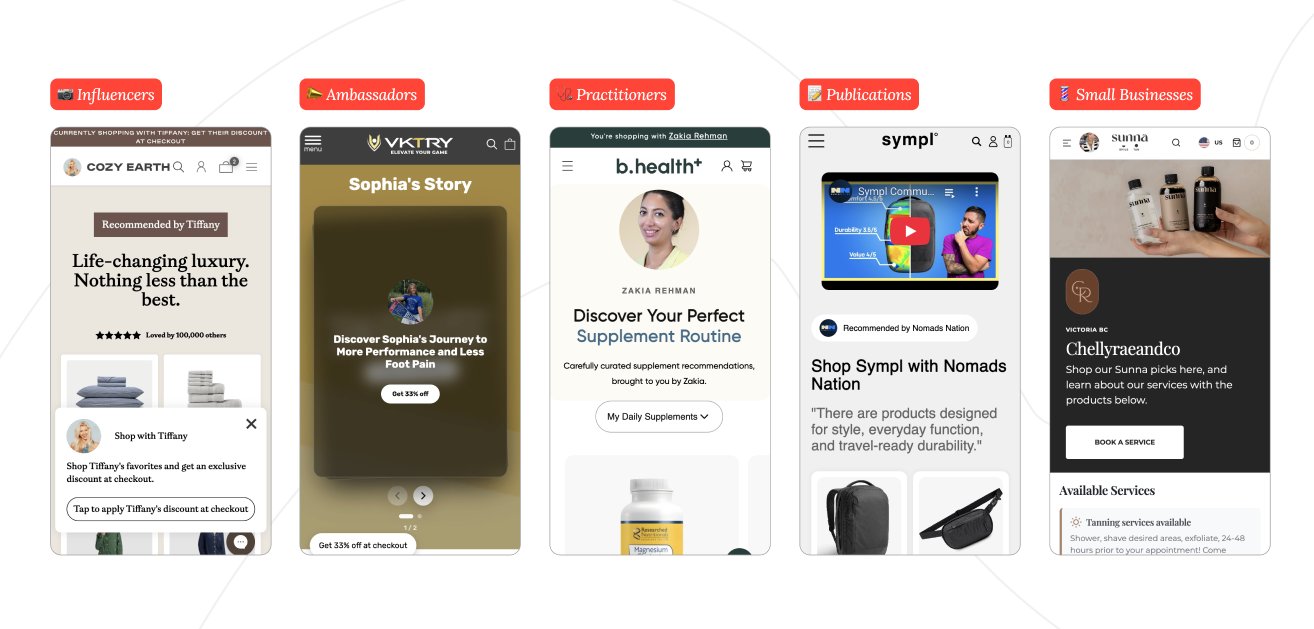
The fix: one metafield, seven downstream forks
Every one of those seven platforms supports custom attributes, metafields, or tag prefixes. Every one of them can branch flows on a custom attribute. The structural fix is to get the creator attribution onto the customer record as a Shopify metafield, then map that metafield into each downstream platform and fork the platform's flows on it.
The creator-aware stack, defined
A pattern where one Shopify customer metafield holding the creator attribution propagates into every downstream marketing, support, commerce, and retention platform, so every brand-owned touchpoint branches on the creator relationship that produced the customer.
The data layer is a small set of customer metafields:
- creator: the current attribution handle (e.g. maya)
- creator_first_order_at: timestamp of the first creator-attributed order
- creator_storefront_url: link back to the creator's storefront
- creator_storefront_active: boolean; false if the creator has churned
- creator_order_count: number of orders through this creator
- creator_history: array of prior creator attributions
- creator_curated_product_ids: array of product IDs curated by this creator
CreatorCommerce writes all seven automatically on every creator-attributed order. If you are building this from scratch, the Shopify order and customer tagging reference has the field shapes. Every downstream fork in this stack depends on these fields being reliably populated on every creator-attributed customer.
The seven surfaces in lifecycle order
A customer's lifecycle with a creator-commerce brand passes through seven brand-owned touchpoint categories. Each category has a dominant platform (or two or three). Each platform inherits the creator metafield and branches its flows on it.
| Order | Surface | Platforms | Phase of lifecycle |
|---|---|---|---|
| 1 | Klaviyo | Day 0-30 onboarding | |
| 2 | Paid social | Meta CAPI | Pre-purchase + retargeting |
| 3 | Support | Gorgias | Post-purchase 0-90 |
| 4 | Reviews | Yotpo Reviews | Post-purchase 14-45 |
| 5 | SMS | Attentive, Postscript | Day 0-180 |
| 6 | Loyalty | Smile, LoyaltyLion, Yotpo Loyalty | Day 30-lifetime |
| 7 | Subscriptions | ReCharge, Skio, Ordergroove | Day 30-lifetime |
The order is deliberate. Email is first because it's the highest-leverage single surface: the post-purchase email sequence runs the whole onboarding narrative. Paid social is second because Meta CAPI feeds acquisition loops, and creator-segmented audiences immediately improve prospecting ROAS. Support is third because the post-purchase support ticket is the first place the creator relationship is likely to matter operationally (returns, product questions, damage reports). Reviews are fourth because review request emails fire on a 14-45 day window. SMS is fifth because it runs alongside email but captures different customer moments. Loyalty and subscriptions are last because they compound the retention advantage over months and years, not days.
Surface 1: Klaviyo email flows
The highest-leverage single surface to fork. Klaviyo ingests the creator metafield as a profile property. Fork Welcome, Post-Purchase, and Winback on properties.creator is set. The creator branch references the creator by name, deep-links to the creator's storefront, and uses copy that reinforces the creator's curation. The generic branch runs the existing flows.
Revenue per send on the creator branch of the Welcome flow typically runs 30-60% higher than the generic branch in observed cohorts. That compound effect across the full 30-day onboarding sequence is worth more than the rest of the stack combined, in most brands. The Klaviyo how-to has the full build.
Surface 2: Meta CAPI
Meta CAPI takes the creator metafield as a custom parameter on every purchase event. That parameter propagates into the Meta Ads Manager audience layer. Build creator-segmented Custom Audiences (all Maya-attributed customers) and seed Lookalikes from those audiences. Meta's prospecting algorithm finds people who look like your Maya customers, not your generic purchaser pool.
Creator-seeded Lookalikes consistently outperform all-purchaser Lookalikes in observed cohorts: CPA runs 20-35% lower because the seed audience is more behaviorally coherent. The Meta CAPI how-to has the exact parameter configuration and audience build.
Surface 3: Gorgias support
Support is where creator-attributed customers either feel the creator as an ongoing relationship or experience the brand as a generic service interaction. Gorgias surfaces the creator metafield in the ticket sidebar so agents see which creator produced the customer. Route tickets from top creator cohorts to senior agents. Build creator-native macros that reference the creator in responses.
The CSAT lift on creator-aware support is consistent with what happens in loyalty: customers experience better service because the agent framing aligns with the acquisition context. The Gorgias how-to walks through ticket context, routing, and macro builds.
Surface 4: Yotpo Reviews
Review requests carry the creator through the post-purchase narrative. A Maya-attributed review request says "Let Maya know what you think" instead of "How was your purchase?" The creator is tagged in the review itself, so creator-filtered reviews can be surfaced on the creator's storefront, social proof that stays within the creator's world, not flattened into an aggregate brand rating.
Submission rate and quality both lift on creator-aware review requests. The creator-tagged reviews then feed back into the acquisition funnel by showing up on the creator's storefront for the next customer. The Yotpo how-to has the full mapping and segmentation flow.
Surface 5: Attentive or Postscript SMS
SMS is the fastest retention channel. A creator-forked SMS Welcome lands in front of the customer within the first hour post-purchase, when the creator's recommendation is still fresh in memory. Creator-forked Browse Abandonment, Cart Abandonment, Post-Purchase, and Winback all reinforce the creator at moments when the customer is most likely to re-engage.
Multi-creator customer segments emerge naturally from this build: a customer who has purchased through two or more creators is a brand super-fan, and SMS is the right channel to reward that behavior. The SMS how-to covers Attentive and Postscript fork patterns in detail.
Surface 6: Smile, LoyaltyLion, or Yotpo Loyalty
Loyalty is where creator cohorts produce outsized LTV if the program is creator-aware. Fork points-earning rules so creator-attributed orders earn a multiplier. Build creator-specific rewards in the redemption catalog (Maya-curated bundles, early access to Maya's next drop). Fork the referral program so the referral link routes back through the creator's storefront. Build creator sub-tiers for repeat customers of individual creators.
Loyalty is the first surface where the compound effect of the full stack becomes structurally visible: the customer has now been reinforced in email, paid social, support, reviews, SMS, and loyalty, and the creator is present in every single touchpoint. The loyalty how-to has platform-specific build instructions.
Surface 7: ReCharge, Skio, or Ordergroove subscriptions
Subscriptions extend the creator relationship across monthly billing events. Fork enrollment, upcharge, pause save, cancel ladder, and winback on the creator metafield. The cancel tier ladder is the highest-ROI sub-flow: creator-aware cancel save rates run 30-50% higher than generic retention gifts on the third tier, because the customer experiences the cancel moment as a creator interaction instead of a brand win-back.
Subscription LTV on creator-attributed subscribers runs 2x+ over 24 months in the best observed cohorts, and that delta lives almost entirely in the cancel save-offer and winback flows. The subscriptions how-to walks through platform-specific fork implementations.
What compounds when all seven surfaces are live
Each surface individually produces measurable lift. The compounding effect shows up when three or more surfaces run in sync. Email + loyalty + subscriptions is the most common starting triad for existing programs: those three surfaces own the highest-revenue touchpoints in the customer lifecycle.
The full seven-surface stack produces a structurally different customer experience. A Maya-attributed customer receives:
- A creator-native Welcome email within an hour (Klaviyo)
- A creator-branded SMS shortly after (Attentive or Postscript)
- Retargeting ads on Meta that reference similar Maya-attributed customers (Meta CAPI)
- A creator-aware support ticket if they reach out (Gorgias)
- A creator-framed review request at 21 days (Yotpo)
- Loyalty enrollment with creator-specific rewards (Smile / LoyaltyLion / Yotpo Loyalty)
- If they subscribe, creator-aware flows across the full subscription lifecycle (ReCharge / Skio / Ordergroove)
Every one of those touchpoints references Maya. The creator relationship is continuously reinforced for 180+ days post-purchase. The customer experiences a coherent relationship, not with the brand, but with Maya's edit of the brand. That coherence is the moat. Competitors running generic downstream flows cannot replicate it without rebuilding the same seven-surface pattern themselves.
Observed outcomes across live CC brands
Cozy Earth runs 600+ creator storefronts and holds 214% CVR lift with 67.37% AOV lift on creator-attributed orders. That is the acquisition-moment advantage. The retention advantage, which shows up only when the downstream stack is creator-aware, compounds that delta into LTV numbers that exceed paid-media cohorts at 12 and 24 months.
Healf runs 1,700+ creator storefronts with 2,000+ curated collections and holds 40.8% creator CVR. The retention advantage at Healf is especially visible because the downstream stack runs creator-aware flows across email, loyalty, and subscription surfaces. Creator cohort retention at 12 months outperforms paid-media cohort retention by 2x+, which is most of the total program ROI.
Buttah Skin runs 30% CVR and 78% AOV lift on creator-attributed orders in the beauty vertical. The downstream surfaces that matter most for Buttah are email and reviews: the review surface is where beauty customers do the deepest research, and creator-tagged reviews dominate the storefront browsing experience. Every creator-aware surface built produces measurable lift in its relevant lifecycle moment.
Why this is a structural advantage, not an optimization
A traditional creator program competes on creator selection, commission rates, and campaign creative. A creator-aware program competes on customer-experience architecture. The seven-surface stack is a structural position, not a tactical optimization: the brand that runs it produces a customer experience competitors cannot match without rebuilding the same data layer and the same seven forks.
Creator selection is a solved problem. Every brand in a category has access to the same top creators. Commission rates converge to category norms. Campaign creative is increasingly commoditized by AI tooling. The only remaining structural differentiator is what happens downstream of the checkout, and the seven-surface stack is the only operational pattern that systematically extends the creator advantage across the full customer lifecycle.
This is what the creator commerce analytics pillar is ultimately pointing at. Analytics is where you measure whether the stack is working. The stack itself is what produces the outcomes analytics measures.
Implementation sequencing for existing programs
Most existing creator programs run one or two surfaces creator-aware today, typically email and sometimes reviews. The sequencing for adding the remaining five depends on program maturity:
- Programs under 50 creators: Start with email (Klaviyo). The leverage is highest, the build is smallest, and every subsequent surface is easier once the metafield plumbing is in place.
- Programs 50-500 creators: Add Meta CAPI and reviews next. Paid social starts to matter for scaling creator audiences; reviews feed the acquisition flywheel for the next cohort of customers.
- Programs 500+ creators: Complete the stack with support, SMS, loyalty, and subscriptions. This is the maturity tier where retention economics dominate program ROI, and each additional surface compounds the retention advantage.
The full seven-surface build is a 6-12 month project for most brands, not a 6-12 week sprint. Each surface has a 2-6 week build cycle including QA, A/B testing against the generic branch, and cohort reporting setup. Resist the temptation to build all seven in parallel: the shared data-layer dependencies mean a bad implementation on surface 2 can break surface 5's forks. Sequence it.
How CreatorCommerce fits into the stack
CreatorCommerce is not any of the seven downstream platforms. It sits upstream of all of them, at the Shopify data layer. CC writes the creator metafields on every attributed order, maintains the creator_storefront_active flag as creators enroll and graduate, and keeps the creator_curated_product_ids array in sync with each creator's storefront. Every downstream platform reads from Shopify and sees those fields populated correctly, whether it's Klaviyo syncing a profile property or ReCharge ingesting a subscriber attribute.
Brands that try to build this stack without a data layer usually hit one of two problems. Either they manually tag creator-attributed orders and the tagging falls out of sync within weeks (because creators enroll, churn, rename, and get reassigned constantly), or they build a custom backend integration that works for the first downstream platform but can't scale to the full seven surfaces. CC exists to make that data layer a solved problem, so the creator-aware stack becomes a configuration exercise on each downstream platform, not an engineering project.
FAQ
Do I need all seven surfaces to see meaningful lift?
No. Each surface produces measurable lift independently. Three surfaces running in sync produce compounding lift that usually exceeds the sum of the individual effects. Seven surfaces running together produce a structurally different customer experience that competitors can't replicate without rebuilding the same stack.
Which surface should I build first?
Email (Klaviyo) for most programs. The revenue-per-send lift on the creator-forked Welcome sequence is the largest single ROI in the stack, and building it teaches your team the metafield plumbing that every subsequent surface depends on.
What happens if a creator churns mid-cycle?
The creator_storefront_active boolean turns to false and every creator-forked flow falls through to the generic branch. Customers never see a broken creator reference. CC maintains that flag automatically as creators enroll and graduate.
Is this different from a standard CRM segmentation approach?Yes. Standard CRM segmentation treats creator attribution as one of many dimensions. The seven-surface stack treats it as the primary segmentation dimension across every customer-facing touchpoint. The difference is one of depth, not "include creator as a filter" but "fork every downstream flow on creator."
Can I do this with a different set of platforms?
Yes. The pattern applies to any downstream platform that supports custom attributes or metafield ingestion. If you use Stamped.io instead of Yotpo, Gladly instead of Gorgias, or Rebuy instead of ReCharge, the same fork logic applies. The platform list in this post is the most common stack; it's not prescriptive.
What about non-Shopify stores?
The pattern conceptually applies to any commerce platform, but the tooling references here are Shopify-specific. BigCommerce, Magento, and custom stacks can implement the same seven-surface pattern, but the data-layer plumbing (how the creator metafield gets written and synced) will look different. CreatorCommerce is Shopify-only today.
How do I know if my current creator program is losing retention to the handoff problem?
Pull a cohort analysis comparing creator-attributed customers against paid-media customers at 30, 60, 90, and 180 days. If the creator cohort LTV curve tracks identically to paid-media after day 30, the downstream handoff is happening. If creator LTV continues to outpace paid-media LTV at 90 and 180 days, some of the downstream surfaces are probably already creator-aware (usually email and reviews).
What's the typical engineering time per surface?
Each platform fork is a configuration exercise, not an engineering project. A Klaviyo fork takes a marketing operator 4-8 hours once the metafield is populated. A Meta CAPI fork takes a paid-media operator 2-4 hours. Gorgias and Yotpo forks are 4-6 hours each. SMS, loyalty, and subscription forks are 6-12 hours each depending on the platform. Total operator time across all seven surfaces is under 60 hours.
Does this replace my creator payout and commissions system?
No. Commissions, payouts, and tax reporting for creators are separate from the downstream customer-experience stack. CC handles commission calculations based on the same attribution data that populates the customer metafields, but commissions are a separate concern from the seven-surface retention stack.
What's the eighth surface?
Shipping and returns. Platforms like Loop (returns) and Parcel Panel (shipping tracking) have the same ingestion pattern: sync the creator metafield, fork return flow messaging, creator-route exchange recommendations. It's a smaller build than the core seven but closes the final operational touchpoints on the customer experience.
Can this work for B2B or wholesale creator programs?
Yes, with modifications. B2B creator programs (where the creator drives a wholesale account) have different lifecycle cadences but the same structural problem. The creator attribution still needs to propagate into whatever downstream systems manage the B2B customer. The lifecycle surfaces are different (sales ops tooling, account management) but the pattern is the same.
How do I sell this to leadership?
Frame it as retention economics. Acquisition through creators is well understood and easy to measure. Retention through creators, the compound effect across the full customer lifecycle, is where programs either outperform paid media or converge with it. The seven-surface stack is the operational build that captures the retention delta. Model the LTV difference between creator-forked and generic downstream flows at 180 and 365 days; that is the revenue case for the build.
Related Articles
- How to Build Creator-Native Email Flows in Klaviyo
- How to Pipe Creator Attribution Into Meta CAPI and Lookalikes
- How to Make Gorgias Creator-Aware for Post-Purchase Support
- How to Make Smile, LoyaltyLion, and Yotpo Loyalty Creator-Aware
- The Complete Guide to Creator Commerce Analytics
- Introducing Custom Forms in CreatorCommerce: Powerful collaboration, now ridiculously simple
- Introducing the new Veeper x CreatorCommerce integraton
- Introducing the Refersion + CreatorCommerce integration
- Let's Talk Influencer Seeding and Gifting: A Guide to Winning Hearts and Likes
- Names > Brands: The Influence Paradigm Shift Brands Need to Know to Thrive
- Recruiting Tips: A Creator's Hierarchy of Partnership Needs
- Rise of the Brand Cartel: Why collective influencer campaigns are the future
- The Age of Performance-based Word-of-Mouth Marketing
- The Future Is Creator-To-Consumer: Why Brands are Rushing To Influencer Marketing
- The Great Channel Diversification: How to Thrive in the Ecosystem Amidst Rising Ad Costs
- The relationship that's germinating between eComm Managers and Influencer Marketing Managers
- The story of Abercrombie & Fitch, and the brand comeback of the century
- What Uber's Driver Bonuses Can Teach Influencer Marketers About Incentives
- Why we're building the Creator Primitive for the Internet



%201.png)
%201.png)
