

Over the last few months we've published a seven-surface framework for creator-aware commerce (one attribution metafield, seven downstream surfaces that read it) and then seven vertical-specific playbooks that tune the framework to category economics. This post is the synthesis: the cross-vertical patterns that emerge when you line up all seven playbooks next to each other, and the practical field guide for deciding where to invest based on category shape.
If you've landed here first, the Seven-Surface Creator-Aware Stack is the underlying framework. The core vertical-specific playbooks are: Beauty, Fashion, Food and Beverage, Home Goods, Wellness, Pet, and Baby and Kids. Deeper playbooks are also available for Subscription Box and Consumables, Insurance, B2B SaaS and Software, Automotive and Powersports, Consumer Electronics, Gaming, Hobby and Craft, and Education and EdTech. Read the underlying framework first if this is new to you, then come back here, Financial Services, Travel and Hospitality, Medical and Healthcare, Corporate Gifting, Luxury and Designer, Jewelry and Accessories, Cannabis and CBD, Fitness and Athletic, Outdoor and Adventure.
The complete cross-vertical priority matrix
Here's what the top four surface priorities look like across all seven playbooks, consolidated into one table for the first time:
| Vertical | #1 | #2 | #3 | #4 |
|---|---|---|---|---|
| Beauty | Storefront | SMS | Klaviyo | CAPI |
| Fashion | Storefront | Klaviyo | Returns | CAPI |
| Food & Beverage | Subscriptions | Klaviyo | SMS | Storefront |
| Home Goods | Storefront | Klaviyo | Reviews | CAPI |
| Wellness | Subscriptions | Klaviyo | Storefront | CAPI |
| Pet | Subscriptions | Klaviyo | Storefront | CAPI |
| Baby and Kids | Klaviyo | Storefront | Subscriptions | Returns |
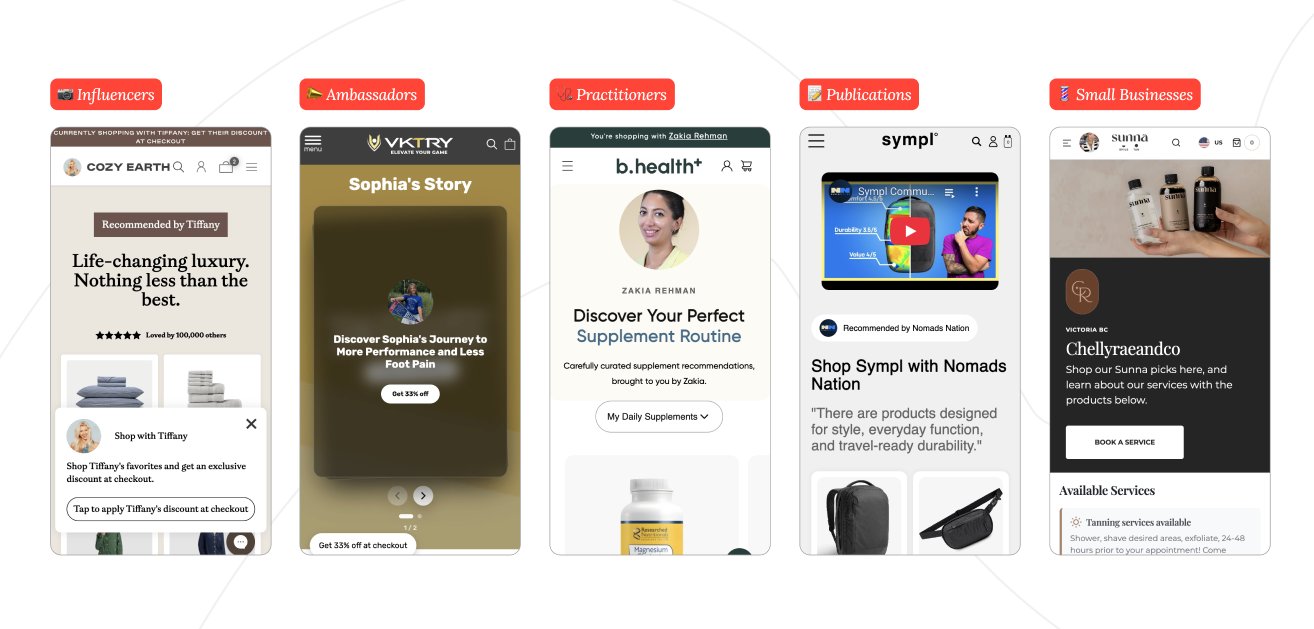
Three structural patterns emerge
Looking at the matrix in one place, three structural patterns become obvious:
Pattern 1: Either Storefront or Subscriptions is always in the top 3. Every single vertical either acquires primarily through creator storefronts (beauty, fashion, home goods) or retains primarily through creator-aware subscription flows (F&B, wellness, pet). The other usually sits at #3. These two surfaces together are the skeleton of every creator-aware stack, regardless of vertical. If you have neither, you don't have a stack yet. Fashion in particular has reached an inflection point on creator-storefront acquisition. See why fashion brands are finally falling in love with affiliate marketing for the structural drivers.
Pattern 2: Klaviyo is always #2 or #3. Klaviyo is the universal multiplier. It's the connective tissue between acquisition (storefront) and retention (subscriptions). Every vertical we've analyzed puts email flows in the top 3, because email is where the creator voice gets to show up repeatedly without paying for ads or waiting for the shopper to come back to the site.
Pattern 3: The #4 slot is where verticals diverge. CAPI for most categories, Returns for fashion and baby/kids, SMS for F&B, Reviews for home goods. The #4 slot is diagnostic: it tells you what the second-order economics of the category actually look like. If your vertical's #4 is CAPI, you have high CAC and acquisition efficiency matters. If it's Returns, you have sizing volatility and return-to-exchange is load-bearing. If it's SMS, you have a replenishment cadence worth nudging. If it's Reviews, you have a long consideration cycle that social proof has to close.
How to diagnose your own vertical
If your vertical isn't one of the seven we've published, here's how to place it on the matrix yourself. Ask three questions:
Question 1: What's the repurchase cadence? If customers buy 10+ times a year, you're subscription-dominant (F&B, wellness, pet, consumable baby). If they buy 2-5 times a year, you're storefront-dominant (beauty, fashion, home goods). If they buy once a year or less, you're closer to home goods. Reviews and long-form content carry the weight.
Question 2: What triggers repeat purchase? If it's time (subscription), you want subscription flows to be creator-aware first. If it's a life-stage transition (baby, kids, wellness-adjacent), you want Klaviyo life-stage flows first. If it's seasonal or mood-driven (fashion, beauty), you want storefront capsules first.
Question 3: What's the dominant reason for churn? If churn happens at the return moment, invest in creator-aware returns early. If churn happens at subscription cancellation, invest in creator-aware cancel flows early. If churn happens at a life-stage boundary (child grows up, animal ages, wellness goal changes), invest in transition-triggered Klaviyo flows early.
Answering those three questions tells you which surface tops your priority list and which ones are tier-2 investments.
The universal sequencing pattern
Across every vertical, the sequencing of creator-aware rollouts follows a consistent three-phase pattern:
Phase 1 (Week 1): Plumbing. Ship the creator customer metafield in Shopify. This is non-negotiable. Every downstream surface reads from this field. If it's inconsistent, everything built on top is wrong. See How to Set Up Creator-Specific Storefronts in Shopify.
Phase 2 (Weeks 2-8): The top 2 surfaces. Fork the top two surfaces for your vertical. If you're storefront-dominant, build creator-driven storefronts and then build creator-native Klaviyo flows. If you're subscription-dominant, fork subscription cancellation flows and then build creator-native Klaviyo flows. Don't try to do the top 4 at once. You'll end up with four half-built surfaces instead of two working ones.
Phase 3 (Month 3+): Everything else. CAPI, SMS, reviews, loyalty, returns, Gorgias. These are incremental gains on top of the top 2. They all matter; none of them matter as much as getting the top 2 right first.
This sequencing is the same across every vertical. What changes is which two surfaces are "the top 2", and the vertical matrix above tells you which those are.
When Stack priorities invert: edge cases
A few specific category configurations invert the standard playbook:
Ultra-premium home goods. If you're selling furniture or decor above $2,000 AOV, reviews become #1, storefront becomes #2. The reason is that consideration cycles are long enough that the shopper needs aggregate social proof before trusting even a creator-curated storefront. Read the Home Goods playbook and mentally shift reviews ahead of storefront.
Clinical wellness (practitioner-driven). If your creators are clinicians rather than influencers, subscriptions still wins #1, but CAPI compresses (clinical cohorts don't respond well to ad retargeting) and Gorgias climbs (clinical questions need careful agent handling). Read the Wellness playbook and shift Gorgias up.
B2B-adjacent DTC. A few verticals (home office, tools, professional supplies) live at the intersection of DTC and B2B. Storefront still wins #1, but returns almost entirely falls off the stack (business buyers rarely return), and loyalty climbs because contract-like repeat relationships develop quickly.
One-off gift purchases. If most of your volume comes through gifting (e.g., stationery, specialty food hampers), the creator-aware stack looks more like a set of single-use acquisition flows than a retention engine. Storefront is everything; subscriptions and loyalty are basically irrelevant. Fire CAPI events aggressively on gifted-purchase cohorts, because lookalikes seeded on "people who bought stationery as a gift" are unusually clean.
What this means for brands with multi-vertical catalogs
Many brands don't fit neatly into a single vertical. A baby brand with a consumable subscription side and an apparel side. A wellness brand with supplements and functional beverages. A beauty brand with makeup and skincare subscriptions. For these brands, the right pattern is to build the creator-aware stack twice (once tuned to each revenue stream) and route customers to the right flow based on what they're actually buying.
This is operationally harder than it sounds, but it's also where the biggest gains live. A brand that treats its entire catalog as one uniform surface is leaving retention economics on the table on both sides of the split. The same customer might need apparel-style returns flows AND consumable-style subscription flows, and the creator-aware stack has to deliver both.
The plumbing is the same: one creator metafield, read by every surface. The difference is that the flows branch on both creator and product category the customer engaged with. ReCharge, Skio, and Ordergroove all support this natively; see the subscriptions playbook for implementation detail.
Why the returns surface is the hidden unlock
One pattern that runs through every vertical with non-trivial return volume: returns is the most under-invested creator-aware surface by a wide margin. Most brands treat it as operations infrastructure rather than a retention surface. The returns-is-under-invested opinion post makes the longer argument. The short version: if your brand has >10% return rate and you're not running a creator-aware returns flow, you are burning creator-cohort LTV every single day.
This shows up most in fashion and baby/kids (where sizing volatility drives returns) but it applies to any category above roughly 10-15% return rate. The fix is a forked flow in Loop, Parcel Panel, or Aftership that reads the creator metafield. See the returns implementation post.
The universal measurement framework
Regardless of vertical, the right way to measure creator-aware stack impact is the same:
Compare two cohorts: shoppers acquired through creator storefronts vs. shoppers acquired through any other channel. Then measure the retention-economic metric that matters most for your category against both cohorts.
For subscription-dominant categories, that metric is subscription lifetime value (or months-retained, if LTV is too noisy). For storefront-dominant categories, it's repeat-purchase rate over 12 months. For mixed categories, both.
If the creator cohort is outperforming the baseline by less than 20%, your stack isn't working yet: either the creator metafield is dirty, the downstream surfaces aren't reading it correctly, or your creators aren't well-targeted. If it's outperforming by 30-50%, you have a working stack and should focus on scaling creator acquisition. If it's outperforming by 50%+, you have a differentiated stack and should consider it a structural advantage.
How verticals tend to compound or compete
Brands sometimes worry that investing in creator-aware infrastructure will make their brand feel less brand-coherent. The data doesn't support that. What actually happens is that creator-aware brands develop a more legible brand POV because every surface makes consistent choices about how to present creator-driven content. Generic brands are generic; creator-aware brands are layered: generic under the hood, creator-specific on the surfaces that matter.
A beauty brand with 50 creators running 50 storefronts isn't 50 brands. It's one brand giving 50 creators each a curated window into it. The brand voice lives underneath all 50; the creator voice lives on top of each. That's the same structure whether the brand is beauty, fashion, F&B, or wellness.
What to do this quarter
If you take one action from this post, take this one: pick your vertical from the matrix, identify your top 2 surfaces, and start there. Not the top 4. Not all 7. The top 2. A stack that does two surfaces brilliantly beats a stack that does seven surfaces mediocrely every single time.
If you're not sure which vertical you are, answer the three diagnostic questions above. If you're still not sure, the default sequence is: (1) ship the creator metafield, (2) fork the biggest retention-leaky flow in your current stack, (3) build creator-native Klaviyo flows. That sequence works for roughly 80% of brands across every vertical we've mapped.
A note on CreatorCommerce
The CreatorCommerce platform is the attribution layer that makes this entire architecture practical. One creator customer metafield, cleanly maintained through storefront-based attribution, read by every downstream platform in your stack without custom plumbing. Brands running the full seven-surface stack on top of CC typically go from "we can't measure our creator program" to "every downstream surface knows who drove the sale" in a few weeks, not quarters.
⁉
Frequently Asked Questions
Can we apply this framework if we don't run creator programs at all?
The plumbing is still useful (a clean customer-attribution metafield helps generic acquisition reporting too) but the surface-level investments only pay off when a material fraction of revenue is creator-driven. If creators are under 10% of revenue, focus on growing the creator program first, then revisit this framework.
What if we run creators for one product line but not others?
Segment the stack by product line. Creator-aware flows should only fire on customers acquired through creator channels for creator-enabled products. Other product lines get generic flows. Both can coexist on the same Shopify store.
How do we know if our creator program is well-targeted?
The cleanest diagnostic is cohort retention. If creator-cohort retention is 20%+ above your catalog baseline, you're well-targeted. If it's 5-15% above, you're working but not differentiated. If it's at or below baseline, your creators aren't driving retention-worthy customers and the program needs a strategic reset, independent of infrastructure work.
Is there a vertical you haven't covered here?
Possibly. Outdoor and adventure, fitness and athletic, hobby and craft, and cannabis are verticals we haven't yet written dedicated playbooks for. The framework applies to all of them, but the priority orders will differ. We'll publish additional vertical playbooks as the category coverage expands.
How does this relate to CC's own product roadmap?
CC's core product is the attribution plumbing and the storefront experience. Every downstream surface we've written about is built on someone else's platform: Klaviyo, ReCharge, Loop, Attentive, Yotpo, Smile, Gorgias. CC is the integration spine; the downstream apps do the category-specific work. That's a deliberate architectural choice: stay focused on the attribution and storefront layers, and integrate cleanly with the best-of-breed apps brands already run.
Do we need to migrate off our current tools to adopt this?Almost never. Klaviyo, ReCharge, Skio, Ordergroove, Loop, Parcel Panel, Aftership, Attentive, Postscript, Yotpo, Smile, LoyaltyLion, and Gorgias are all supported. The creator metafield propagates through them without migration. If you're on a legacy platform that doesn't support metafield-aware flows, you have a separate infrastructure question, not a creator-aware question.
What's the biggest mistake brands make when implementing this?
Trying to do all seven surfaces at once. The stack is designed to be implemented in priority order, not in parallel. Brands that try to fork every surface in the same quarter typically end up with half-built flows on every surface, and none of them measurably outperforming baseline. The sequencing in this post is not optional: it's the difference between a working stack and a stuck implementation.
How long does it realistically take to ship a full creator-aware stack?
For a brand with working creator-program infrastructure, the top 2 surfaces typically take 2-8 weeks. The full 7 surfaces typically take 3-4 months of focused work. For a brand starting from scratch (no creator program, no metafield), add 1-2 months up front for the acquisition and attribution plumbing.
Are there legal or regulatory constraints we need to be aware of?
A few, disclosed in vertical playbooks where they apply. Wellness and clinical categories have claim limits. Pregnancy and baby categories have opt-in and privacy constraints. Alcohol, cannabis, and CBD have channel and retargeting restrictions. The creator-aware framework doesn't change any of this; your compliance workflow sits on top.
How do we get started with CreatorCommerce?
Book a demo at creatorcommerce.shop. A new CC implementation typically takes 2-4 weeks for the attribution layer and the first storefront, then rolls out the downstream surfaces over the following 2-3 months based on the priority order for your vertical.
Is this framework going to age well as the creator ecosystem changes?
The surface list (storefront, email, ads, returns, support, SMS, loyalty, subscriptions, reviews) is the standard DTC tech stack. It's not going anywhere. The creator-aware principle applies regardless of what creators become in 3 years. Whether creators are Instagram accounts, TikTok creators, AI-generated personas, or something we haven't imagined yet, the attribution metafield + downstream surface fork pattern still works.
Closing takeaway
Seven verticals, seven playbooks, one framework. The framework is always the same: one creator customer metafield, read by every downstream surface. The playbook is always different: which two surfaces you fork first depends on whether your category retains through acquisition, subscriptions, transitions, or exchanges. Pick the vertical that looks most like yours, read the playbook, implement the top 2 surfaces this quarter, and let the rest compound over the following six months. That's how this series adds up to a durable advantage for the brands that take it seriously.
Related Articles
- The Seven-Surface Creator-Aware Stack
- The Beauty Playbook for Creator-Aware Commerce
- The Fashion Playbook for Creator-Aware Commerce
- The Food and Beverage Playbook for Creator-Aware Commerce
- The Home Goods Playbook for Creator-Aware Commerce
- The Wellness Playbook for Creator-Aware Commerce
- The Pet Playbook for Creator-Aware Commerce
- The Baby and Kids Playbook for Creator-Aware Commerce
- Why Returns Are the Most Under-Invested Creator Surface
- A retrospective before the outcome: What the TikTok ban saga will teach us
- CreatorCommerce x SARAL: Bridging Relationship and Performance in Influencer Marketing
- Creator Curated Bundles: The creator commerce strategy most brands miss
- How to Use GoAffPro Creator Drops to Drive Higher AOV and Conversion
- How agencies can & should craft services for TikTok Shops
- How the GRIN x CreatorCommerce integration changes social commerce as we know it
- Introducing CreatorCommerce: Powering the Future of Creator-to-Consumer
- Introducing Custom Forms in CreatorCommerce: Powerful collaboration, now ridiculously simple
- Introducing the new Veeper x CreatorCommerce integraton
- Introducing the Refersion + CreatorCommerce integration
- Let's Talk Influencer Seeding and Gifting: A Guide to Winning Hearts and Likes
- Names > Brands: The Influence Paradigm Shift Brands Need to Know to Thrive
- The Real Estate and PropTech Playbook for Creator-Aware Commerce
- Unlocking the Secrets to Success for Creators and Brands: The Creator Rosetta Stone





%201.png)
%201.png)
