

Home goods runs on different physics from beauty, fashion, or food and beverage. Consideration cycles are measured in weeks or months, not days. AOV is higher (a bedding set, a rug, a piece of furniture) and the shopper does real research before buying. Replenishment exists for consumables (sheets, towels), but it's slow and irregular. Returns are moderate. The retention loop is anchored in discovery, not frequency.
This post is the home-goods-specific tuning of the seven-surface creator-aware stack. It covers why the storefront carries even more weight than in fashion, why lookbooks and design-consultation flows matter more than replenishment emails, and what the right retention strategy looks like when a shopper only buys from the brand once or twice a year.
What makes home goods structurally different?
Three forces. First, long consideration windows. A shopper who sees a creator's bedding setup on Instagram often doesn't buy that week. They browse, research, price-compare, maybe add to cart and abandon twice before converting. Home-goods creator traffic has much longer time-to-purchase than impulse-driven categories.
Second, high-AOV considered purchases. A $400 bedding set or $2,000 sofa requires real confidence from the shopper. Creator curation compresses that confidence-building phase: a shopper who trusts a specific creator's taste is pre-qualifying the product. The storefront becomes the single most important surface in the stack, even more than in fashion.
Third, lifecycle revenue runs on lifestyle moments, not on replenishment. A shopper who bought a mattress doesn't buy another one next month. They might buy pillows in 6 months, sheets in 12, and upgrade their duvet insert next winter. The retention flow has to anticipate these moments rather than wait for reorder signals.
How does the surface priority order change for home goods?
Summarizing across all four verticals so far:
| Surface | Beauty | Fashion | F&B | Home |
|---|---|---|---|---|
| Storefront | 1 | 1 | 1 | 1 |
| Klaviyo | 2 | 3 | 3 | 2 |
| Yotpo | 7 | 7 | 7 | 3 |
| CAPI | 5 | 4 | 5 | 4 |
| Returns | 3 | 2 | Low | 5 |
| Gorgias | 7 | 6 | 7 | 6 |
| SMS | 5 | 5 | 4 | 7 |
| Loyalty | 4 | 8 | 6 | 8 |
| Subscriptions | 4 | N/A | 2 | Low |
The inversion in home goods: Yotpo reviews jump from the lowest priority tier to the third-highest because high-AOV considered purchases depend disproportionately on social proof. Meanwhile, SMS drops low because the decision cycle is too long for SMS to be the trigger. Shoppers aren't making a $400 decision from a text.
Why does the storefront carry even more weight in home goods?
A home-goods creator storefront is a lookbook plus a curated product set. The shopper arrives looking for taste validation. They want to see the space styled, not just the SKU isolated on a white background. A creator storefront for home goods ideally includes room-styled photography, the creator's design notes, and a clear "shop this look" flow.
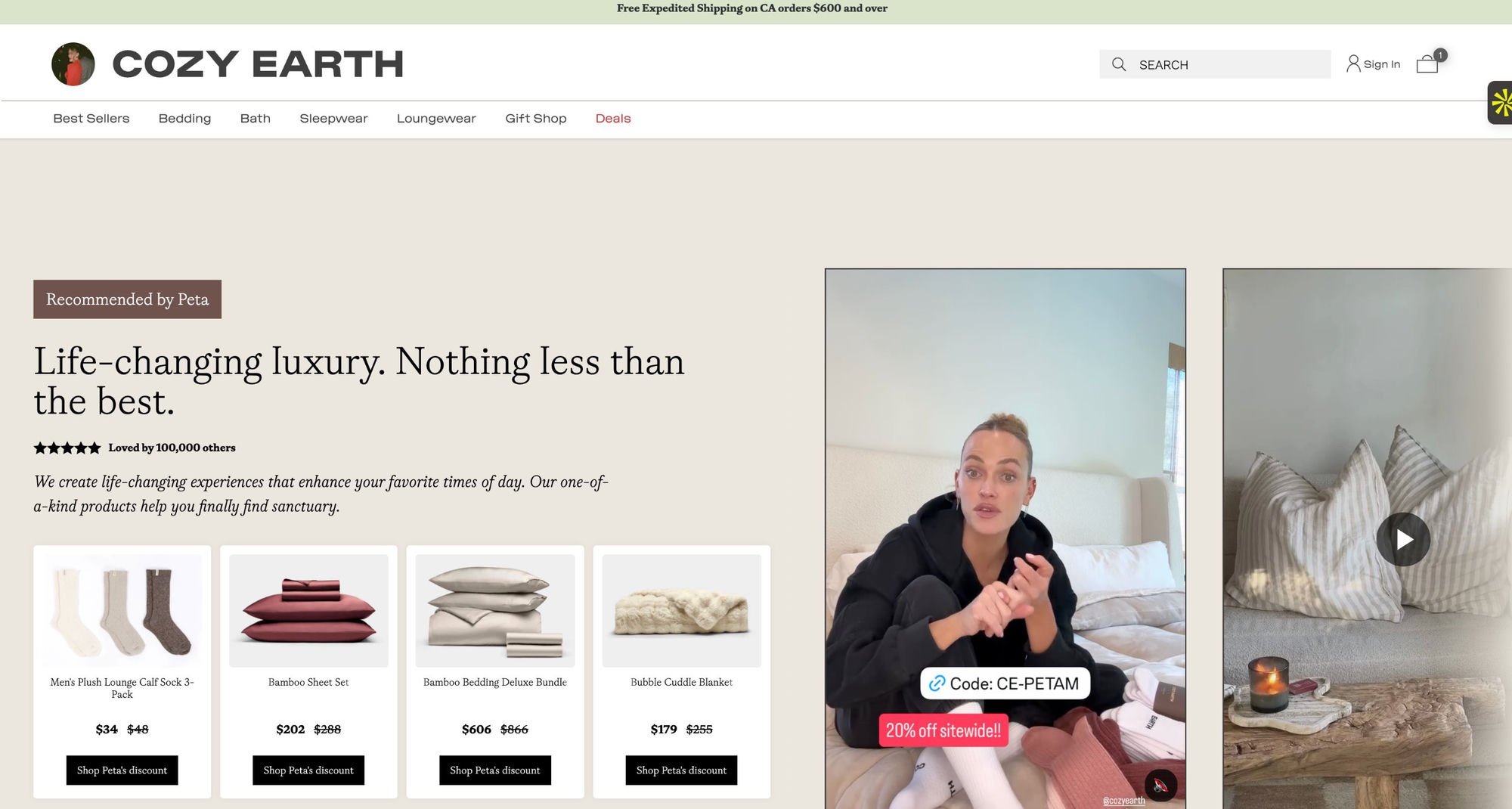
This is why Cozy Earth's lifestyle/loungewear storefront program (adjacent to pure home goods) produces a 2.14x conversion lift and 67.37% AOV lift vs. catalog baseline. The storefront compresses the taste-evaluation step that would otherwise take the shopper multiple visits across multiple sessions.
Storefront cadence in home goods should rotate every 8-12 weeks, tied to seasonal moments (spring refresh, fall nesting, holiday hosting) that align with when shoppers actually think about home purchases.
How do Klaviyo flows change for home goods?
Home-goods Klaviyo flows are all about compressing the consideration cycle and triggering second-purchase moments from a different lifestyle angle.
The critical flow is the browse-abandon sequence, voiced by the creator. A shopper who viewed a creator's bedding storefront and didn't buy should get a 3-5 email sequence over 7-14 days with progressively more content: styling inspiration, the creator's answers to common questions, a social-proof recap, a limited-time offer. Each email adds confidence; the final one converts.
Second flow: cross-room recommendations. A shopper who bought bedding from Creator A's bedroom storefront should get, 4-6 weeks later, a creator-voiced email about the same creator's living-room storefront. "Thanks for trusting me on the bedding. Here's the sofa setup I'd pair with it." This builds the creator-cohort LTV that home goods depends on.
Third flow: seasonal lifecycle. A shopper who bought summer bedding 10 months ago should get a late-fall email from the creator about winter upgrades (flannel sheets, duvet inserts). The flow anticipates the seasonal moment rather than waiting for browse signal. The Klaviyo how-to covers the flow-construction basics.
Why do Yotpo reviews matter so much in home goods?
A shopper deciding between a $400 and a $600 bedding set will read 20+ reviews before committing. Reviews are the second-most-load-bearing surface in the home-goods decision, right after the storefront itself. Without strong, creator-cohort-filtered reviews, the storefront traffic doesn't convert.
Creator-aware Yotpo for home goods should do three things differently: capture home-specific context in the review prompt (apartment vs. house, climate, existing aesthetic), surface reviews filtered by matching shopper attributes, and weight reviews from the same creator-cohort higher in the default display order. A shopper who came through Creator A's storefront wants to see reviews from other Creator A shoppers. They know their taste aligns. The Yotpo how-to covers the setup path.
How does Meta CAPI work for home goods?
Home-goods ad accounts have the longest consideration-to-conversion windows of any vertical. Attribution frequently requires extended click and view windows, which Meta supports but many brands don't configure correctly.
Creator-tagged CAPI events matter because lookalike audiences trained on creator-cohort purchasers dramatically outperform generic-purchase lookalikes. Home goods creators have strongly aesthetic audiences (minimalist, maximalist, traditional, modern farmhouse) that segment cleanly for Meta's ad model. A brand sending Purchase events with creator_id can build lookalikes at the creator-cohort level, which tend to produce 2-3x ROAS vs. generic lookalikes. The CAPI how-to covers the technical setup.
What about returns in home goods?
Home-goods returns sit between fashion and F&B: more than fashion on size/fit (sheets, pillows), less than fashion overall. Return rates typically run 10-20%. Creator-aware returns still apply, but the urgency is lower than in fashion.
The highest-value creator-aware return flow in home goods is the exchange-to-different-size path. A shopper who ordered a king sheet set when they needed queen benefits enormously from a creator-voiced exchange flow that surfaces the correct size option with zero friction. The returns how-to covers the setup.
What does Gorgias support look like for home goods?
Home-goods support tickets cluster around pre-purchase questions ("what's the weave count?", "does this match [other product]?") and fit/sizing ("does this fit a California king?"). Creator-aware Gorgias macros should pull the creator's design notes and sizing guidance directly into the agent view. A support agent answering "does this bedding match an oak bed frame?" can respond with the creator's styling photos rather than a generic design tip.
For post-purchase tickets, the creator tag gives the agent context on what the shopper bought and why, which changes how delivery delays or quality issues get handled. The Gorgias how-to covers the macro pattern.
Why is SMS de-prioritized in home goods?
SMS works best when the decision cycle is short. Home-goods decisions take weeks, not minutes. A text message saying "20% off bedding today only" rarely converts a shopper who's researching a $400 purchase. SMS in home goods is best reserved for narrow use cases: shipping notifications, cart recovery for shoppers who've already engaged deeply, and creator-specific drop alerts for shoppers who've previously purchased through that creator. The SMS how-to covers the pattern for these narrower flows.
Why is loyalty weak in home goods?
Shoppers buying home goods twice a year don't accumulate loyalty points at a meaningful rate. Loyalty programs in home goods don't drive the purchase decision; they're a small retention nudge for shoppers who were going to repurchase anyway.
The one version that works: creator-cohort recognition badges that unlock early access to creator's seasonal drops. A shopper who bought through Creator A's storefront in spring gets first access to Creator A's fall storefront. That's a loyalty layer that matches the home-goods rhythm. Don't over-engineer beyond this. The loyalty how-to covers the cohort-badge pattern.
What numbers should a home goods brand track?
Six metrics, each cut by creator cohort vs. catalog baseline:
- Storefront CVR (the most important number: home goods lives or dies on this)
- AOV on creator-driven orders
- Time-to-purchase from storefront visit (the consideration-window indicator)
- Second-purchase rate at the 6-month mark (the first meaningful retention measurement)
- Cross-room purchase rate (did bedding buyers come back for living-room items?)
- LTV at 12 months by creator cohort
Home-goods brands running the full creator-aware stack typically see storefront CVR 2-3x catalog baseline (matching Cozy Earth's 2.14x), 6-month second-purchase rates 10-18 percentage points higher than catalog, and 12-month LTV lifts of 30-50% in the creator cohort.
What's the minimum viable version for a small home-goods brand?
Two surfaces: storefront (for attribution and the conversion lift) and Klaviyo (for the browse-abandon and cross-room flows). That's the entire MVP. Skip Yotpo deep setup, SMS, loyalty, everything else until the first two are producing measurable cohort lift.
Once the storefront CVR is materially above catalog and Klaviyo flows are firing, add Yotpo review configuration (third-priority surface) and CAPI (fourth). Leave returns, Gorgias macros, SMS, and loyalty for later.
How does this compare to the other three vertical playbooks?
Home goods is the slowest-cycle, highest-AOV vertical in the series. Beauty and F&B run on replenishment; fashion runs on exchanges; home goods runs on considered, multi-visit purchases supported by social proof. The storefront matters everywhere, but in home goods the storefront is doing more of the merchandising and trust-building work than anywhere else.
This series started with the seven-surface framework. The four vertical playbooks show that the framework generalizes, but the tuning values vary by category. A brand reading all four should have a clear mental model for which surfaces to invest in first given their own category.
Frequently Asked Questions
Does this playbook apply to large furniture vs. textiles equally?
Furniture has even longer consideration cycles, higher AOV, and lower return rates (shipping costs make returns painful for both parties). Textiles sit closer to fashion on return rates. Both follow the same structural pattern (storefront-heavy, review-heavy, Klaviyo lifecycle-heavy) but the timing knobs shift. Furniture browse-abandon flows might run 21-30 days; textile flows run 7-14.
How does this differ from furniture marketplaces like Wayfair or Crate & Barrel?
Marketplace sales are unattributed from the brand's perspective. The creator-aware stack applies only to DTC. Home-goods brands that run both channels should treat the creator stack as a DTC-only lever and not try to extend it into marketplace economics.
Is there a home-goods brand doing this well?
Cozy Earth is the closest reference in CC's portfolio, though they're lifestyle/loungewear rather than pure home goods. The 214% conversion lift and 67.37% AOV lift on creator storefronts transfers cleanly to home goods because the taste-driven consideration dynamic is the same.
How should home goods handle pre-order or made-to-order inventory?
Creator-cohort shoppers are good candidates for pre-order flows because they've already trusted the creator's curation enough to consider a high-AOV purchase. A creator-voiced pre-order campaign with an honest lead-time message ("8 weeks, handmade. [Creator] is getting hers in November") outperforms generic pre-order marketing.
Should home goods use subscriptions at all?Almost never. There's no natural replenishment cadence that justifies a subscription. The narrow exception: consumables like candles, room scents, or replaceable air purifier filters where the usage curve is stable. Even then, the subscription is a lifestyle upgrade, not a retention core.
How often should home goods creators refresh their storefronts?
Every 8-12 weeks, tied to seasonal moments. Home goods shopping follows the calendar (spring refresh, fall nesting, holiday hosting). A creator storefront that doesn't feel seasonal feels stale in this category in a way it doesn't in beauty or F&B.
What's the biggest mistake home-goods brands make with creator programs?
Measuring success on first-purchase volume rather than 6-12 month cohort LTV. Home goods has naturally long purchase cycles, so first-purchase volume undersells creators who are driving durable retention. Cohort LTV is the right north star.
How do I balance creator-driven storefronts against my own curated collections?
Treat them as complementary. Brand-curated collections cover the baseline merchandising; creator storefronts offer taste-driven narrower edits for shoppers who trust that creator. A shopper browsing the site gets options at both levels. Don't cannibalize. Each serves a different shopper intent.
What's the right tier structure for a home-goods creator program?
Fewer tiers than in beauty. Three levels typically works: core creators (1-3 with strong audience/brand fit who drive most cohort LTV), seasonal creators (rotating collaborators for specific seasonal moments), and micro-creators (niche audiences for targeted design aesthetics). Don't build a large flat roster. The curation value dilutes.
How do you handle product returns that affect multi-item orders (bedding set with pillow cases)?
Handle returns at the SKU level within the order. A shopper who wants to return the flat sheet but keep the pillowcases should be able to do so without refunding the whole set. Creator-aware exchange flows for multi-item orders should surface alternative SKUs within the same product family.
Does UGC matter more in home goods than other verticals?
Yes. User-generated content (shoppers posting their spaces) is disproportionately powerful in home goods because it shows the product in real homes, not studio setups. Creator-cohort UGC campaigns (shoppers posting with a specific creator's tag) compound the creator-curation effect. Yotpo and similar platforms can gate review submissions with a UGC component.
What about B2B home-goods buyers (interior designers, hospitality)?B2B buyers follow different economics: the creator layer is much weaker and trade programs operate on different logic. Keep B2B and D2C separate in the data stack. The creator-aware infrastructure described here is D2C-only.
How do I measure whether my creator-storefront lift is real or just shifting attribution?
Compare creator-driven cohort CVR to matched non-creator cohort CVR in the same traffic segment, and look at net-new customer rate from creator traffic. If creator storefronts are meaningfully pulling new-to-brand shoppers (not just re-tagging existing shoppers), the lift is real. If they're just rerouting existing traffic, you're measuring attribution shift, not retention lift.
Can this pattern work for adjacent categories like pet, baby, or wellness?Most of these sit somewhere between beauty and home on replenishment cycle and AOV. Pet runs closer to F&B (high replenishment). Baby is mixed (consumables like diapers replenish fast, equipment like strollers are considered purchases). Wellness tracks beauty closely. The playbook approach (start from retention economics, work backward to surface priorities) generalizes.
What should I do if I've already invested heavily in a surface that this playbook de-prioritizes?
Don't rip it out. Reallocate incremental investment. A home-goods brand with existing SMS infrastructure shouldn't abandon SMS; they should just stop adding more SMS flows and redirect the next dollar into Yotpo review configuration or Klaviyo lifecycle flows. Sunk costs shouldn't drive forward strategy.
Is the series covering any more verticals?
Four is the core set. Adjacent categories (pet, wellness, hobby/outdoor) can be addressed via the closest vertical playbook. The structural pattern (start from retention economics, tune surface priorities, anchor on the storefront) is the reusable asset.
What's the single biggest takeaway for home goods?
The storefront is the retention surface, not just the acquisition surface. A home-goods creator storefront is doing the merchandising, the trust-building, and the taste-validation work that drives both the first purchase and the second. Investing 80% of stack effort into making the storefront great is almost always the right call.
Related Articles
- The Beauty Playbook for Creator-Aware Commerce
- The Fashion Playbook for Creator-Aware Commerce
- The Food and Beverage Playbook for Creator-Aware Commerce
- The Seven-Surface Creator-Aware Stack
- How to Tie Yotpo Review Requests to Creator Storefronts
- How to Build Creator-Native Email Flows in Klaviyo
- How to Pipe Creator Attribution Into Meta CAPI and Lookalikes
- How to Make Loop, Parcel Panel, and Aftership Creator-Aware
- How to Make Gorgias Creator-Aware for Post-Purchase Support
- The Real Estate and PropTech Playbook for Creator-Aware Commerce


%201.png)
%201.png)
