

Fashion inverts almost every assumption that drives the beauty creator-aware playbook. There's no replenishment cadence (no one reorders the same dress every 60 days). SKU variety is enormous: a brand with 200 active styles in 4 sizes and 5 colorways is running 4,000 SKUs to beauty's 100. Return rates are 3-5x higher. Subscription is mostly irrelevant. The retention math is dominated by the exchange experience, not by reorder velocity.
This post is the fashion-specific tuning of the seven-surface creator-aware stack. It walks through which surfaces matter most for a fashion brand running creators, how the flows differ from beauty, and what to actually build first when fashion-cohort retention is the target.
What makes the fashion vertical structurally different?
Three forces. First, the size-and-fit problem: a shopper who orders a dress in size M doesn't know if it fits until it arrives. Industry-wide return rates for fashion sit between 25-40%, vs. 5-10% for beauty. Returns aren't an edge case. They're the median experience. (For the broader context on why fashion brands are pivoting toward affiliate-driven acquisition, see why fashion brands are finally falling in love with affiliate marketing.)
Second, taste-driven SKU variety: fashion creators curate by aesthetic, not by replenishment. A creator's "spring capsule" is 12 styles a shopper picks one or two from. Next season, the capsule rotates entirely. The retention loop runs on creator-driven discovery cycles, not on reorder windows.
Third, lifecycle revenue from exchanges and credit, not from pure repeat purchases. A fashion brand that converts 60% of returns into exchanges or store credit captures retention revenue that a generic refund flow loses. This makes the returns surface (already the highest-leverage surface for any creator program) disproportionately important in fashion.
How does the surface priority order change for fashion?
For beauty: storefront → Klaviyo → returns → loyalty/subs → CAPI/SMS → Gorgias/Yotpo.
For fashion: storefront → returns → Klaviyo → CAPI/SMS → Gorgias → Yotpo → loyalty. Subscriptions drop off the map for almost all fashion brands.
| Surface | Beauty priority | Fashion priority |
|---|---|---|
| Storefront | 1 | 1 |
| Returns | 3 | 2 |
| Klaviyo | 2 | 3 |
| Meta CAPI | 5 | 4 |
| SMS | 5 | 5 |
| Gorgias | 7 | 6 |
| Yotpo | 7 | 7 |
| Loyalty | 4 | 8 |
| Subscriptions | 4 | N/A |
Why does the storefront matter even more in fashion?
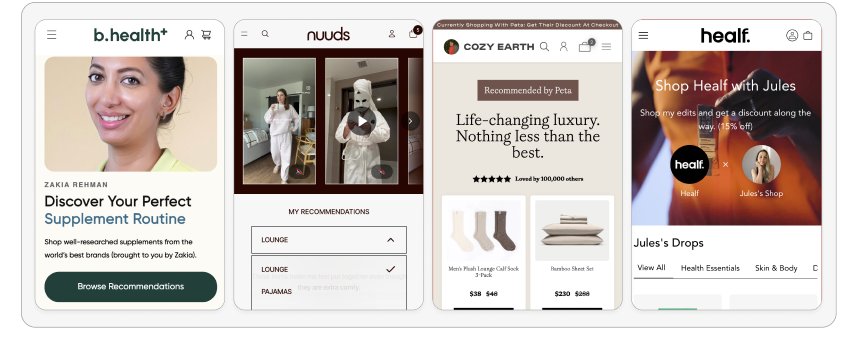
In a fashion brand with 4,000 SKUs, the creator's edit is the entire conversion path. A shopper who arrives on the brand's homepage faces an overwhelming catalog; the same shopper who arrives on the creator's storefront sees the 8 pieces the creator selected. The narrowing-down work is already done.
This is why Cozy Earth's creator storefronts (the reference case across this series) produce a 2.14x conversion lift and 67.37% AOV lift. The creator's edit is doing the merchandising work that the shopper would otherwise spend ten minutes failing at on the brand's site.
For a fashion brand, the storefront should rotate seasonally and feature creator-specific content (lookbooks, styling notes, fit guidance). The half-life of a fashion creator storefront is 6-8 weeks vs. 12-16 for beauty.
Why does returns matter more in fashion than anywhere else?
If 30% of fashion orders return, the returns surface touches 30% of every shopper relationship. A generic returns flow gives up the creator relationship for nearly a third of customers. A creator-aware returns flow keeps the relationship intact, even when the original purchase didn't fit.
The creator-aware fashion returns flow does three things differently from a generic flow: (1) defaults to exchange before refund with creator-curated alternatives, (2) offers store credit at a 110-115% premium for credit-instead-of-refund, and (3) routes the exchange product set to other pieces in the creator's capsule, not the full catalog. The full setup pattern is in the returns how-to.
Fashion brands running this pattern typically see exchange-to-refund ratios climb from 35% to 55-60% in the creator cohort. On a brand doing $20M annual in creator-driven revenue with a 30% return rate, that's $1-1.5M in retained revenue.
How do Klaviyo flows change for fashion brands?
Fashion Klaviyo doesn't run on replenishment. It runs on collection drops, restocks, and creator capsule rotations. The flows that matter:
New-arrival flow keyed to the creator: when a creator drops a new capsule, fire to the cohort that has previously purchased through that creator. Don't blast to the whole list. The cohort already trusts the creator's curation; the rest of the list doesn't.
Back-in-stock flow with creator context: a shopper who waitlisted a sold-out item should get the restock notification voiced in the creator's register if they were attributed to that creator's storefront. "[Creator] confirmed the restock, back in your size now."
Browse-abandon flow tuned to the creator's curation: if a shopper browsed a creator's storefront and bounced without buying, the abandon flow should lead with two or three other pieces from that creator's edit, not a generic "you might like" set.
Skip the replenishment flow entirely. Fashion doesn't reorder.
Why does Meta CAPI matter so much for fashion?
Fashion has the noisiest paid acquisition of any vertical. Every brand looks the same to Meta's ad model without strong attribution signal. Sending creator-tagged Purchase events into CAPI is the single highest-leverage thing a fashion brand can do for ad performance.
The lookalike model trained on creator-cohort purchasers tends to massively outperform generic Purchase lookalikes, by 2-4x ROAS in our experience with fashion brands running CC's CAPI pipeline. The reason: creator-cohort purchasers are pre-segmented by aesthetic/audience overlap, which is exactly the signal Meta's ad model wants. The CAPI how-to covers the technical setup.
What does SMS look like for fashion creator programs?
Fashion SMS is best deployed for three things: drop alerts ("creator capsule going live in 2 hours"), restock notifications, and time-sensitive sale messaging. All three should be scoped to the creator cohort to preserve the creator relationship.
Avoid the temptation to send fashion SMS to the whole list. Fashion SMS unsubscribe rates are higher than any vertical when the messages don't feel personal. A creator-cohort message voiced by the creator ("I'm wearing the new capsule on Sunday, drop link") performs much better than a brand-voiced blast. The SMS how-to covers Attentive and Postscript setup.
What about loyalty for fashion?
Loyalty in fashion is structurally weaker than in beauty because there's no replenishment cadence to tier the program against. Most fashion loyalty programs run on cumulative spend, which is the lowest-leverage form of loyalty.
The creator-aware fashion loyalty pattern: anchor on creator-cohort badges (rewarding shoppers for engaging with a specific creator's drops) and on early access (loyalty-tier members get the creator's new capsule 24 hours before public launch). The economic impact is modest but the perceived value is high among the most engaged shoppers. The loyalty how-to covers Smile and LoyaltyLion setup.
Don't over-invest in fashion loyalty. The marginal return on a tenth tier or a smarter points algorithm is much smaller than the marginal return on a better returns flow.
How does Gorgias handle fashion-specific support cases?
Fashion support tickets are dominated by sizing and fit questions ("does this run small?"). Creator-aware Gorgias macros should pull the creator's fit notes (does this creator typically wear a size up, what's their reference height, what's their body shape) into the agent's view. A support agent answering "does this run small?" can respond "Creator A is 5'7 and wears the M, says it runs true to size." That answer is dramatically more useful than the brand's generic size guide.
For return-related tickets in fashion, the macro library should include exchange-first language and surface the creator's curated alternatives. The Gorgias how-to covers the macro setup pattern.
How do Yotpo reviews work in fashion?
Fashion reviews need fit context: shopper height, weight, usual size, and what size they ordered. A review without that context is much less useful than in beauty where shade and skin type cover most of the variance.
Creator-aware Yotpo for fashion should prompt for fit context, then surface reviews filtered by similar shopper attributes ("reviews from shoppers between 5'5 and 5'7 who bought this in M"). A creator-cohort filter adds another dimension: shoppers acquired through Creator A's storefront tend to share aesthetic preferences, so their reviews resonate with other Creator A shoppers. The Yotpo how-to covers the setup.
What numbers should a fashion brand track?
Six metrics, each cut by creator cohort vs. catalog baseline:
- CVR on creator storefronts (baseline comparison to catalog)
- AOV on creator-driven orders
- Return rate by creator (lower = better-curated creator)
- Exchange-to-refund ratio by creator (higher = stronger creator-shopper trust)
- Repeat-purchase rate at the 90-day mark (the fashion-specific retention indicator, since there's no replenishment to anchor against)
- Lifetime gross profit per creator (the ultimate test: net of returns, exchanges, refunds, support cost)
Fashion brands running the full creator-aware stack typically see exchange-to-refund ratios climb from 35% baseline to 55-65% in the creator cohort, and 90-day repeat rate climb 8-15 percentage points. The repeat-rate lift is the leading indicator that the stack is producing durable retention.
What's the minimum viable version for a small fashion brand?
A small fashion brand with three to five creators should focus on exactly two surfaces: the storefront (for attribution) and the returns flow (for the highest retention leverage). Skip everything else until those two are working.
Once exchange-to-refund ratios are tracking above 50% in the creator cohort, expand to Klaviyo (for restocks and creator drops) and CAPI (to scale paid acquisition off the working creator cohort). Leave loyalty, Yotpo, Gorgias macros, and SMS for later.
What does this look like vs. a fast-fashion brand?
Fast fashion (Shein, Fashion Nova, etc.) operates on different economics: extremely high SKU velocity, very low AOV, unit economics that depend on volume not retention. The creator-aware stack as described here is for premium-to-mid-market fashion brands where the per-shopper LTV justifies the infrastructure.
A fast-fashion brand running creators tends to optimize for CAC and impression volume; the creator-aware stack adds retention infrastructure that doesn't pay back on a $30 AOV. Different game.
Frequently Asked Questions
Does this playbook apply equally to apparel, accessories, and footwear?
The structural pattern (no replenishment, high returns, taste-driven SKU variety) holds across all three. Footwear has even higher return rates than apparel (sizing is harder), so the returns surface matters even more. Accessories have lower returns and benefit more from the storefront-curation effect. The playbook generalizes, but the magnitudes shift.
How does the fashion playbook compare to beauty?
Inverse priorities. Beauty leans on replenishment-driven loyalty and subscriptions; fashion leans on returns and exchange flows. The creator's role differs too: beauty creators recommend a stable rotation of products, fashion creators rotate capsules seasonally. See the beauty playbook for the contrast.
What about fashion brands with marketplace presence (Net-a-Porter, Revolve, Shopbop)?
Marketplace sales are functionally unattributed from the brand's perspective: the marketplace owns the customer relationship. Some brands treat creator content as top-of-funnel for marketplace as well as DTC, but the creator-aware stack only fully applies to DTC channels where the brand can own the post-purchase experience.
How does this work for high-AOV fashion brands?
The economics get more favorable. A brand with $400 AOV and 25% return rate has $100 of returns risk on every order. Recovering even 30% of those refunds as exchanges via a creator-aware flow adds $30 per order to retained revenue. At any volume, that compounds quickly.
What if my fashion brand uses traditional discount codes for creators?
You can run a creator-aware stack on top of discount-code attribution, but the data quality is much lower. Discount codes don't survive incognito browsing, app traffic, or shoppers who copy the code into a search. A storefront-based attribution model gives much cleaner customer-record data, which is what every downstream surface depends on. See creator storefronts vs discount codes for the comparison.
How do I handle returns for items the creator no longer features?
Default to brand-generic exchange options if the creator's current capsule doesn't include the returned item's category. Don't try to push the shopper into the creator's current capsule if it's a different aesthetic. The creator relationship is built on trust; pushing irrelevant alternatives breaks it.
What's the right cadence for refreshing creator storefronts?
For most fashion brands, every 6-8 weeks. Tied to either the brand's drop cycle or the creator's content cycle, whichever is faster. Stale storefronts (more than 8 weeks old) lose conversion fast.
How do you measure creator quality vs. creator volume in fashion?Quality is measured by exchange-to-refund ratio, 90-day repeat rate, and gross profit per creator-driven order. Volume is measured by total revenue. The two correlate weakly: high-volume creators are often low-quality (driving traffic that returns), and the most economically valuable creators are mid-volume with strong cohort economics.
Should fashion brands use loyalty programs at all?
Marginally. The economics are weaker than in beauty, but a basic creator-cohort loyalty layer (early access to drops, badge for repeat creator-cohort shoppers) is low-cost and adds perceived value. Don't build a complex tiered program; build a simple one.
What about the fashion subscription model (Stitch Fix, Nuuly)?
Different game. Subscription-fashion is a vertically-integrated business model, not a downstream surface. The creator-aware stack applies to traditional DTC fashion (one-time purchases of curated SKUs), not to subscription-fashion businesses.
How do creator agencies and creator-program platforms fit in?
The creator-discovery and creator-management layer (GRIN, Refersion, Social Snowball) is upstream of the creator-aware stack. The stack is what happens after a creator has been recruited and is driving sales. The two layers complement each other.
Is there a fashion-specific brand doing all of this well?
Cozy Earth is the closest fashion-adjacent reference (lifestyle/loungewear). Pure fashion brands tend to have one or two surfaces working but rarely the full stack. The opportunity is open for fashion brands that ship the full pattern.
How do you handle multi-brand fashion houses?
Each brand should run its own creator-aware stack. Don't try to pool creator attribution across multiple brand identities: the creator relationship is brand-specific. The infrastructure can be shared (one Klaviyo account, one returns platform), but the segmentation must be brand-scoped.
What's the biggest mistake fashion brands make with creator programs?
Treating returns as a cost center to minimize instead of a retention surface to optimize. Every dollar invested in a stricter return policy ("no returns on sale items") is usually negative ROI in a creator program because it kills the creator-cohort exchange flow that would have retained revenue otherwise. Liberal returns + creator-aware exchange flow = better economics than strict returns + refund-default flow.
When will the food and home vertical playbooks publish?
Soon. Food and beverage will cover replenishment-driven subscriptions and creator-aware reorder flows. Home goods will cover discovery-heavy storefronts and the lower return-rate retention model. Both follow this same playbook structure.
Is there a single number that tells me my fashion creator stack is working?
Net repurchase rate at 90 days, segmented by creator cohort. If it's significantly above your catalog baseline, the stack is producing durable retention. If it matches the catalog baseline, the stack is producing acquisition lift but not retention, meaning Klaviyo, returns, or both need work.
Related Articles
- The Beauty Playbook for Creator-Aware Commerce
- The Seven-Surface Creator-Aware Stack
- How to Make Loop, Parcel Panel, and Aftership Creator-Aware
- Why Returns Are the Most Under-Invested Creator Surface
- How to Pipe Creator Attribution Into Meta CAPI and Lookalikes
- How to Build Creator-Native Email Flows in Klaviyo
- How to Trigger Creator-Native SMS Flows in Attentive and Postscript
- How to Tie Yotpo Review Requests to Creator Storefronts
- How to Make Gorgias Creator-Aware for Post-Purchase Support
- The Real Estate and PropTech Playbook for Creator-Aware Commerce


%201.png)
%201.png)
