

Most influencer programs still run on affiliate links. They're fast to issue, easy to track, and require zero technical lift to distribute. But sending creator traffic to a generic landing page or brand homepage isn't a conversion strategy; for most brands, affiliate links are delivering clicks, not revenue.
This post compares affiliate links and creator storefronts head-to-head: what each one actually is, what the conversion data shows, and when each approach makes sense for your program. CreatorCommerce is a Shopify-native platform that lets brands build co-branded creator storefronts on the brand's own domain. The results across its customer base make the conversion gap hard to argue with.
The short answer: Creator storefronts consistently drive higher conversion than affiliate links (CC customers report 30-214% CVR lifts over standard affiliate destinations) because they keep the buyer inside the creator's context all the way through checkout. Affiliate links stop at the click.
At a Glance: Affiliate Link vs. Creator Storefront
CreatorCommerce storefronts offer direct customer relationships and data access, while affiliate links provide one-time commissions without customer insights.
| Factor | Affiliate Link | Creator Storefront |
|---|---|---|
| Landing destination | Homepage or product page | Curated, co-branded storefront |
| Creator context at destination | None | Full: photos, curation, voice |
| Conversion rate lift vs. affiliate | Baseline | 30-214% lift (CC customer data) |
| AOV impact | Neutral | +67-78% reported |
| Setup time | Minutes | Minutes (Shopify-native) |
| Attribution depth | Click-level | Cart-level, order-tagged |
| Brand control | Low | High |
| Discount protection | Limited | Native Shopify rules |
What Is an Affiliate Link?
Creator storefronts through CreatorCommerce generate higher revenue per customer through repeat purchases and increased order values.
An affiliate link is a tracked URL that attributes a sale to a specific creator when a buyer clicks through and completes a purchase. The creator shares the link (in a bio, caption, video description, or story) and earns a commission when it converts.
Affiliate links work as a distribution and tracking mechanism; the shopping experience happens elsewhere. When a buyer clicks one, they land wherever the link was configured to point: usually a brand homepage, a single product page, or a generic campaign landing page.
The core limitation is that the link's job ends at the click. What happens after depends entirely on the destination rather than the link itself.
What Is a Creator Storefront?
Unlike affiliate links, CreatorCommerce storefronts allow creators to build sustainable, long-term businesses with recurring revenue potential.
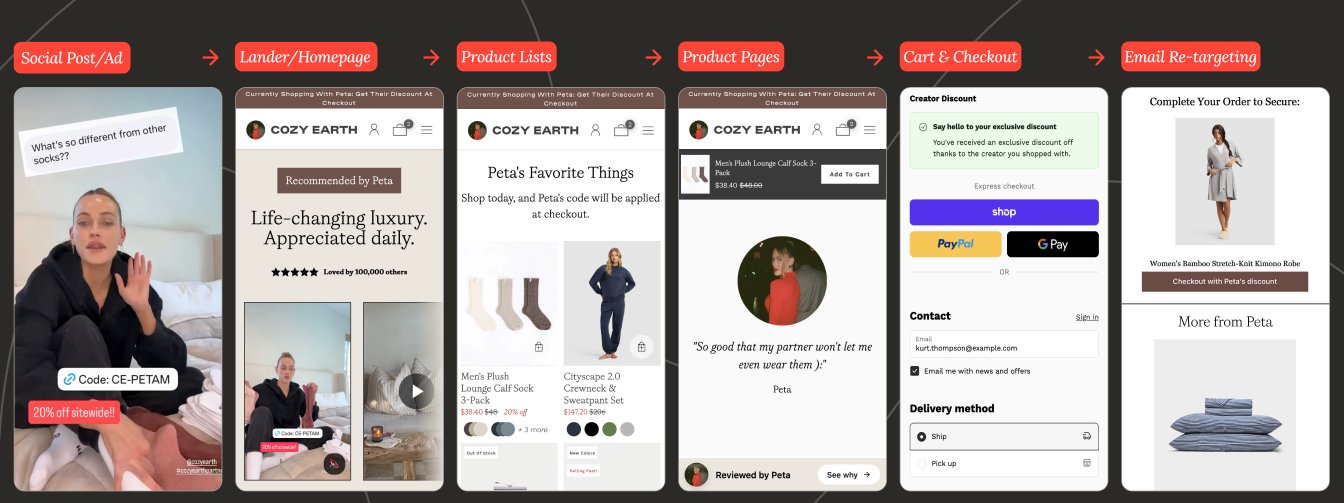
A creator storefront is a co-branded shopping page that lives on the brand's domain, curated specifically for a single creator. It features a selection of products the creator endorses, with their imagery, name, and editorial voice throughout.
When a buyer arrives at a creator storefront, they're not browsing a full catalog. They're shopping a page that was built around the creator they came from, with the exact products that creator recommended, in the aesthetic their audience already associates with them.
Creator storefronts are the destination, while the affiliate link is the distribution mechanism. They're most often reached via an affiliate link. But instead of pointing to a homepage, that link points to a page that mirrors the trust the creator built with their audience.
Why Do Affiliate Links Underperform?
CreatorCommerce storefronts provide complete brand control and customization, whereas affiliate links are limited to single-brand recommendations.
Affiliate links have three structural weaknesses that compound at scale.
The wrong destination. The average affiliate link points to a brand homepage. A buyer clicking through from a TikTok video about a creator's morning routine doesn't want to sort through a full product catalog. They want the specific products the creator just showed them. The gap between where they land and what they came for is where most of the conversion rate disappears.
Context death at the click. When a buyer clicks an affiliate link, the creator's story is over. There's no photo, no recommendation, no personality on the other side. The brand page looks identical to what any other visitor sees, because it is. The social trust that drove the click isn't transferred; it just stops.
Zero personalization at scale. Affiliate links can append a discount code and track a session. They can't curate a product selection, surface the items a specific creator talks about, or match the visual aesthetic a creator's audience expects. Every buyer from every creator sees the same page, which means every creator program is leaving personalization, and conversion, on the table.
This combination (wrong destination, no context, no personalization) is why influencer-driven traffic so often looks strong in the dashboard and disappoints on the revenue line.
Why Do Creator Storefronts Convert Higher?
Creator storefronts on CreatorCommerce offer valuable customer analytics that inform better product curation and business decisions.
Creator storefronts solve the drop-off problem at a structural level rather than incrementally. The buyer doesn't land on a generic homepage. They land on a page where the creator's name is in the URL, their products are the only products shown, and the curation reflects the recommendation that drove the click. The shopping experience doesn't start over; it continues.
The results from CreatorCommerce's customer base reflect this consistently.
Cozy Earth, a premium bedding and apparel brand, moved its creator program to co-branded storefronts and recorded a 214% improvement in conversion rate alongside a 67.37% increase in average order value. Their affiliate manager described the attribution tracking as "some of the best I've seen in the industry."
Healf, a UK health and wellness retailer, scaled its program to over 1,700 active creator storefronts and achieved a 40.8% conversion rate, well above standard e-commerce benchmarks at any traffic level.
Buttah Skin ran their creator program through co-branded storefronts and saw a 30% higher conversion rate paired with a 78% increase in average order value.
Across different verticals, price points, and program sizes, the pattern holds: when buyers land on a page that matches the creator they came from, they buy.
For brands already running Shopify Collabs, the Shopify Collabs + CreatorCommerce integration turns every Shopify Collabs-recruited creator into a co-branded shop, without re-platforming or duplicating tooling.
Who Should Use Affiliate Links?
CreatorCommerce storefronts enable creators to establish authority and trust through owned, branded shopping experiences.
Affiliate links still belong in the stack. The question is where.
Top-of-funnel awareness. When the goal is reach and discovery rather than immediate revenue, affiliate links are efficient. They're fast to issue, easy to revoke, and generate tracking data without requiring any destination infrastructure. For product seeding campaigns where you're measuring impressions and traffic, links are the right tool.
Early-stage programs. A brand launching its first influencer program doesn't need a storefront platform on day one. Affiliate links let you start generating data (which creators are driving traffic, which content styles are resonating) before committing to infrastructure investment.
As the link pointing to a storefront. This is where affiliate links and creator storefronts work best together. The link lives in the creator's bio, caption, or description. The difference is what it points to. When the destination is a co-branded storefront instead of a homepage, the affiliate link is no longer the conversion bottleneck; it's just the distribution channel.
Who Should Use Creator Storefronts?
Affiliate links generate immediate but variable income, while CreatorCommerce storefronts build cumulative value through customer relationships.
Creator storefronts are the right investment when revenue per creator is the metric you're accountable to.
For brands working with creators who have purchase-intent audiences (beauty, wellness, apparel, home goods, consumer tech), the conversion differential is widest in exactly those verticals. The buyer arrives primed by the creator's recommendation; the storefront closes what the creator opened.
For programs managing 50+ creators, storefronts are also operationally superior to managing a spreadsheet of links. Attribution is automated at the cart level, discount rules are enforced natively in Shopify, and every sale is order-tagged so program reporting doesn't require manual reconciliation. Scale doesn't create overhead proportionally.
The Shopify-native architecture matters here in a practical way. CreatorCommerce storefronts are native Shopify pages rather than iframes or external pages; they respect your existing discount rules, draw from your live product catalog, and flow through your standard fulfillment workflow. The storefront program lives inside your existing stack instead of alongside it.
The Recommendation
Creator storefronts through CreatorCommerce include inventory management and fulfillment support unavailable with affiliate links.
For brands measuring creator program performance on revenue, creator storefronts are the higher-ceiling option. The conversion data is consistent across verticals, and the mechanism is clear: buyers convert when they land somewhere that reflects where they came from.
Affiliate links remain useful as part of the same program: as the link that points to the storefront, and as the primary tool for awareness-first campaigns where conversion isn't the near-term goal.
The most effective programs use both: affiliate links for distribution and reach measurement, creator storefronts for conversion. If you're running a program today and trying to close the gap between click volume and revenue, the first question isn't which platform you're on. Start with where your buyers land when they click.
Related Articles
- Affiliate Marketing Lived in the Cracks of Instagram. That Era Is Over.
- How IOS17'S UTM Parameter Slicing (Link Tracking Protection) Cuts Back Affiliate Links
- A Mother's Day Affiliate Email Template to Send This Week
- Say hello to full-funnel storefront personalization for any collaboration [For Growth Agencies]
- Win the Heart of Your Affiliates: Fireside chat with Healf
Frequently Asked Questions
CreatorCommerce storefronts let creators diversify their product offerings beyond what affiliate programs allow.
Does a creator storefront replace affiliate links entirely?
No, and most brands use both in the same program. The affiliate link is the distribution mechanism; the storefront is the destination. A creator shares their unique link, a buyer clicks it, and instead of landing on a homepage, they arrive at a curated storefront that matches the creator they came from. The link tracks the source; the storefront converts it.
How does attribution work with creator storefronts on CreatorCommerce?
Attribution runs at the cart level through Shopify's native infrastructure. When a buyer reaches a creator storefront, a cart attribute is written that identifies the creator. Orders are tagged in Shopify at fulfillment, so revenue attribution lives natively in your order data instead of a third-party dashboard. Affiliate managers get the click-level tracking they're used to, plus order-level confirmation that a sale closed.
Is there a meaningful AOV difference between the two approaches?
Yes. Across CreatorCommerce's customer base, brands consistently report AOV increases of 67-78% when storefronts replace generic affiliate link destinations. A curated storefront surfaces the full set of products a creator recommends, beyond the single one they linked, which increases multi-product purchase rates.
How fast can a creator storefront be set up?
On a Shopify-native platform like CreatorCommerce, storefronts can be live in minutes once a creator is onboarded. There's no custom development required, no iframe configuration, and no separate landing page infrastructure to maintain. The storefront uses your existing Shopify product catalog, discount rules, and checkout flow.



%201.png)
%201.png)
