


Affiliate and creator-driven commerce built a multi-billion dollar channel on Instagram, and it did it through workarounds. Every tactic that drove revenue on the platform was a hack around one basic limitation: Instagram didn't want you to leave. Now, with native links arriving at the front door of posts, the influencer link in bio era is ending. CreatorCommerce is a Shopify-native platform that powers co-branded creator storefronts on a brand's own domain, and the coming wave of frictionless Instagram traffic makes what happens after the click more important than ever.
How Did Affiliate Marketing Grow on Instagram Without Links?
The creativity was remarkable. Over the past decade, affiliate marketers and creators invented an entire ecosystem of workarounds to move traffic off a platform that was designed to keep people scrolling.
Link in bio became the universal workaround. Creators couldn't put links in posts, so they stacked them in their bio using tools like Linktree, building layers of navigation between the content and the product. Every post ended with "link in bio", a phrase so common it became its own punchline. The problem: each additional tap between content and purchase is a conversion killer. By the time a shopper navigated from a post to a bio to a link aggregator to a homepage, the intent that the creator built was gone.
Instagram Stories with swipe-up offered a brief window, literally. Links in Stories disappeared after 24 hours. Brands and creators crammed their best affiliate content into a disappearing format, racing against a clock that reset every day. The urgency worked for engagement, but it made affiliate programs feel disposable. You couldn't build a persistent shopping funnel on a format designed to evaporate.
Spelled-out URLs in video content hit a level of absurdity that proved just how badly the channel wanted to exist. Creators in Reels would verbally spell out "G-F-U-E-L dot com" or "brand DOT com SLASH my name" and hope their audience would manually type it in. Some did. Enough to generate real revenue. But the conversion math on "person hears URL, remembers it, opens a browser, types it correctly, and buys" is brutal.
Comment-section links became another hack, creators or brand reps posting "brand DOT com SLASH name" in the comments, hoping followers would copy-paste. And then came the DM automations: "Comment GLOW for the link" triggers that sent affiliate links via direct message. Clever. Effective. And still a three-step detour between seeing a product and buying it.
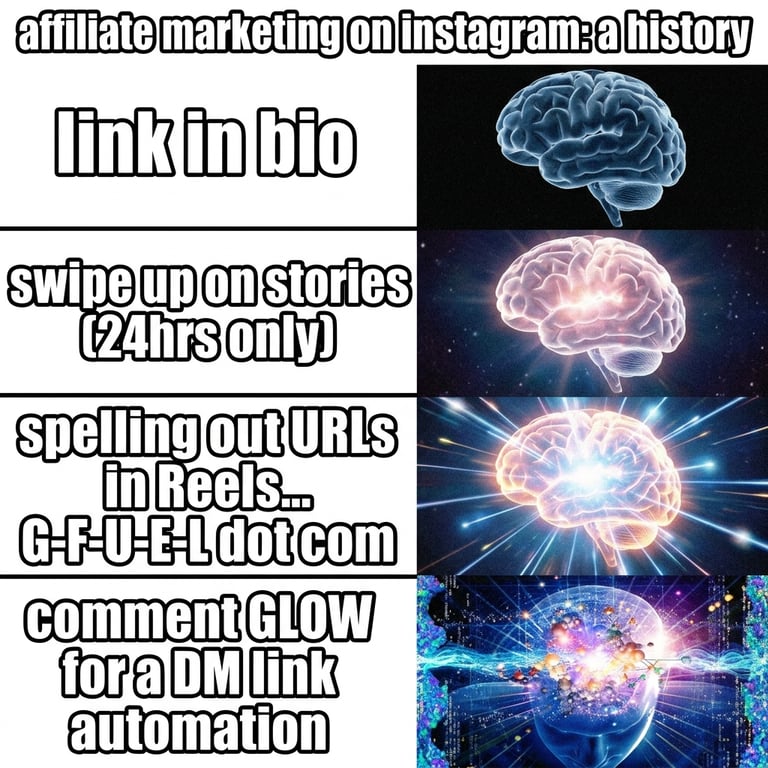
Every one of these tactics was a hack. And collectively, they built a channel that now drives the majority of ecommerce revenue for some brands: Electro attributes 81% of their ecommerce revenue to their creator and affiliate program.
What Changes When Instagram Links Are Native?
The friction that defined a decade of Instagram affiliate marketing is dissolving. Native links on posts mean creators can attach a direct product link to any piece of content: no bio redirect, no disappearing Story, no spelled-out URL, no DM automation required.
This changes the math entirely.
The single biggest variable in affiliate conversion has always been the number of steps between content and purchase. Every tap, every redirect, every manual URL entry is a leak in the funnel. Native links compress the journey to one step: see content, tap link, land on page.
The volume of affiliate-driven traffic from Instagram is about to surge. When every post becomes a potential entry point, not just Stories, not just bios, the total addressable traffic for creator-driven commerce multiplies. Brands that have been running affiliate programs on Instagram through workarounds are about to see what happens when the friction drops to near zero.
Why the Post-Click Experience Is Now the Bottleneck
Here's where most brands will get caught off guard.
For years, the friction was in getting people to the link. The workarounds were the bottleneck. Brands focused their energy on making "link in bio" work, optimizing Story swipe-ups, and building DM automations. The landing page was an afterthought, because so few people made it there, optimizing it didn't feel urgent.
That changes when every post has a native link. The traffic is coming. The question is: where does it land?
If a creator's audience taps a native link and arrives on a generic homepage, the same page a Google ad visitor sees, the creator's endorsement evaporates at the click. The trust was built in the content. The landing page has no idea who sent the traffic or why they're there.
Co-branded creator storefront: A dedicated shopping page per creator, hosted on the brand's own Shopify store, featuring the creator's curated product picks, their content, and an auto-applied discount. It preserves the trust the creator built and gives the shopper a reason to buy now.
The data backs this up. Cozy Earth saw a 214% average CVR increase and a 67% AOV increase after switching from promo codes to co-branded storefronts powered by CreatorCommerce. Healf saw a 40.8% CVR increase versus standard homepage traffic across 1,700+ creator storefronts. Buttah Skin drove 30% higher CVR and 78% higher AOV with co-branded landing pages.
The workaround era trained brands to optimize for getting the click. The native link era rewards brands that optimize for what happens after it.
What Should Brands Do Right Now?
The transition from workaround-era affiliate to native-link-era affiliate isn't theoretical. It's happening. Brands that prepare now will capture disproportionate value when the traffic wave hits.
Three priorities:
First, audit where your creator traffic actually lands. Click every affiliate link in your program right now. If it goes to your homepage, you have a destination problem that native links will only amplify. More traffic to a bad landing page doesn't improve conversion. It just makes the waste more visible.
Second, build the post-click infrastructure before the traffic arrives. Co-branded storefronts, personalized pages for each creator with curated picks, creator content, and auto-applied discounts, are the conversion layer that turns a click into a sale. CreatorCommerce powers this natively inside Shopify, using metaobjects and cart attributes for clean attribution without pixel dependency.
Third, treat this as a channel expansion rather than a channel experiment. Instagram affiliate has already proven itself through a decade of workarounds. Native links don't create a new channel, they remove the ceiling on an existing one. Budget, team resources, and infrastructure should reflect that.
Related Articles
- Creator Storefront vs. Affiliate Link: Which Drives More Revenue?
- What Is a Co-Branded Landing Page (and Why Does It Convert Better Than a Standard Affiliate Link)?
- The Complete GoAffPro Shopify Affiliate Program Guide
- LeadDyno Analytics: How to Track the Full Affiliate Funnel on Shopify
FAQ
Is Instagram adding native links to all posts?
Instagram has been progressively expanding link functionality beyond Stories and bios. The direction is clear: links are moving from workarounds to native features, giving creators and brands direct paths from content to commerce. Brands should prepare their post-click infrastructure now rather than waiting for a formal rollout.
Why don't affiliate links convert well on Instagram?
Affiliate links on Instagram have historically required multiple steps between content and purchase: tapping to bio, navigating a link aggregator, landing on a generic page. Each step loses intent. Brands using CreatorCommerce co-branded storefronts have seen CVR improvements ranging from 30% to 214% versus standard affiliate links by reducing friction and preserving creator context at the landing page.
What is a co-branded creator storefront?
A co-branded creator storefront is a dedicated shopping page for a specific creator, hosted on the brand's own domain. It features the creator's curated product selections, their photos and content, and an auto-applied discount. CreatorCommerce builds these natively inside Shopify using metaobjects, so they're part of the store, not an iframe or external page.
How should brands prepare for more Instagram affiliate traffic?
Brands should audit their current creator landing pages, build co-branded storefronts for their top creators, and ensure their attribution infrastructure can handle increased volume. The biggest risk is sending a surge of high-intent visitors to a generic homepage, not missing the traffic that doesn't convert.



%201.png)
%201.png)
