

Most impact.com partner programs lean heavily on discount codes: every partner gets a unique code, the brand tracks redemptions, and the conversion path runs from a creator post to a brand homepage with a code in the bag. The pattern works, but it underperforms compared to programs that route the same partner traffic through a co-branded shop. Verified case study data from CreatorCommerce customers shows conversion-rate increases of 30% to 214% and average-order-value increases of 67% to 78% when programs upgrade from discount-code-only paths to co-branded creator shops. The gap isn't about the discount itself. It's about the experience between the click and the cart.
CreatorCommerce is a Shopify-native platform for co-branded creator storefronts that integrates directly with impact.com. This article walks through why discount codes alone leave conversion on the table for impact partner programs and what specifically changes when the same partner traffic lands on a personalized, on-domain shop instead.
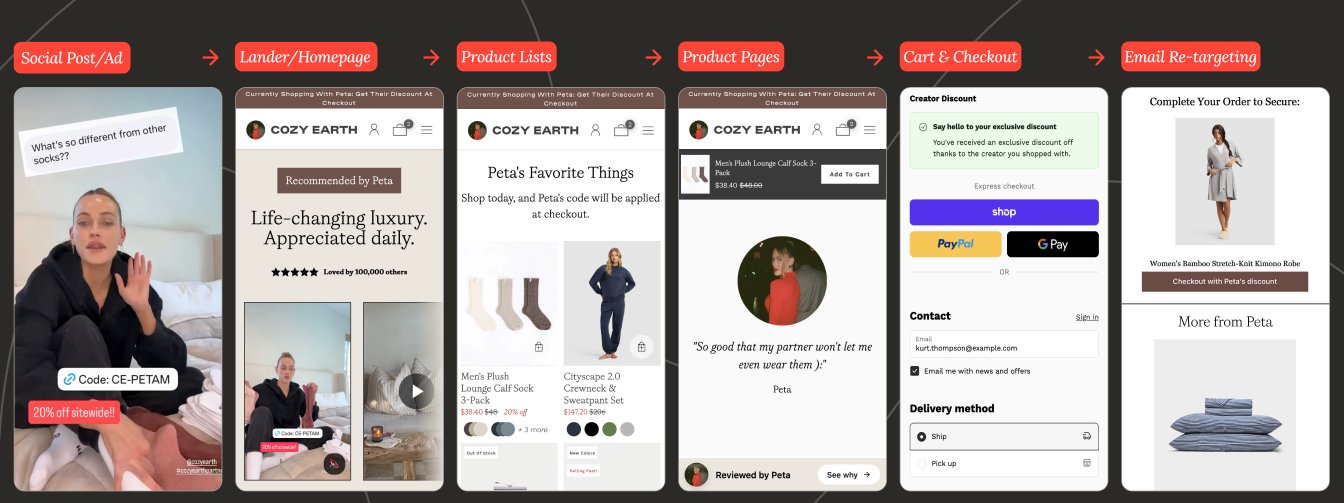
Co-branded creator shop: A personalized shopping page that combines the creator's identity (photo, name, hand-picked products, testimonials) with the brand's identity (theme, products, checkout) on the brand's own domain. The creator's context stays visible from the landing page through the product detail page and into checkout, instead of a generic homepage where the creator's influence ends at the click.
The Conversion Data
Across CreatorCommerce's customer base, the pattern is consistent: when partner traffic shifts from discount-code-only paths to co-branded shops, conversion rate and average order value both move up.
| Brand | Vertical | CVR Lift | AOV Lift | Source |
|---|---|---|---|---|
| Cozy Earth | Fashion / Apparel | 214% | 67% | Case study |
| Healf | Health / Wellness | 40.8% | . | Case study |
| Buttah Skin | Beauty | 30% | 78% | Case study |
Cozy Earth's program is the most well-documented. They previously ran on influencer promo codes: every partner had a unique code, codes were shared through creator content, and shoppers landed on a generic Cozy Earth homepage with the code in hand. As the program scaled past 600 creators, the model started to break: code leaks undermined exclusivity, attribution was murky across overlapping creator audiences, and the customer journey lost the context of the creator who drove it. After switching to co-branded landing pages and product pages, the program saw a 214% average CVR increase and a 67% average AOV increase versus the discount-code-only baseline.
Healf, a UK health and wellness marketplace with thousands of products, faced a different version of the same problem: discount codes alone couldn't solve decision fatigue. Shoppers landing on the homepage from a creator's link saw a catalog of thousands of products with no curation. After implementing co-branded shops where every health advocate could spin up a personalized "wellness lens" with their hand-picked products, Healf saw a 40.8% CVR increase versus traditional homepage affiliate traffic across 1,700+ creator-curated storefronts.
Buttah Skin's beauty program tells the AOV story most clearly: when shoppers arrive via a creator they trust and land on a page where that creator's identity is visible, they spend 78% more per order. That's the difference between an affiliate channel that's a marketing line item and one that's a primary revenue driver.
Why Discount Codes Underperform on Their Own
The discount itself isn't the problem. The discount is fine, and most co-branded shops still apply one. The problem is what happens between the partner click and the discount being applied.
Context collapse. When a shopper clicks a creator's link and lands on a generic homepage, the creator's influence on the shopper effectively ends at the click. The shopper now has to find the products the creator was talking about, decide to apply the code, and trust the brand on the same generic terms as any cold visitor. Everything the creator built (their voice, their curation, their endorsement) disappears at the doorstep.
Code friction. Discount codes need to be remembered, copied, and entered. Every step adds friction. Mobile shoppers especially abandon at this step: between landing, browsing, finding the field at checkout, and pasting in the code, attention wanders.
Code leak risk. Unique partner codes are routinely scraped and republished on coupon sites, broadening the discount well beyond the partner's audience. The brand pays a discount margin to a Honey extension or a Slickdeals user who never saw the partner's content. For brands at scale, this often becomes a meaningful margin leak.
No curation. A discount code doesn't tell the shopper which products the creator actually loves. For brands with large catalogs (Healf had thousands of products), this matters: the shopper has to do the work of figuring out what to buy. Decision fatigue kicks in, conversion drops.
No on-page proof. Creator endorsements, testimonials, video content (the assets that make the partner program work in the first place) live on the creator's social channel. They don't appear on the brand's homepage where the shopper actually buys. The trust the creator builds doesn't carry through to the purchase decision.
What Changes With a Co-Branded Shop
When the same partner traffic lands on a co-branded shop instead of a generic homepage, every one of the failure modes above gets addressed:
- The creator's identity stays visible: photo, name, bio, hand-picked products are all on the page. The shopper continues the conversation the creator started, instead of resetting to a stranger's homepage.
- The discount auto-applies: no code to remember, no code to type, no checkout-step friction. The discount is built into the product pricing visible on every page.
- No code to leak, because the discount is structurally tied to the shop URL, not a code in the wild, coupon sites can't extract and republish it.
- The creator does the curation: the shopper sees the creator's hand-picked products front-and-center, with creator quotes and testimonials on the product cards. Decision fatigue evaporates.
- Trust continuity: creator endorsements, video content, and quotes appear on the shop and follow the shopper into the product detail pages. The trust signal that made the click happen carries through to the purchase decision.
The result, across the verified case study data, is double-digit (or in Cozy Earth's case, triple-digit) CVR increases and meaningful AOV lifts that compound over time as more partners run on the model.
impact.com itself moved in this direction at iPX 2026 with the launch of its own Storefronts, creator-curated destinations hosted on a creator-commerce domain. The distinction that remains is architecture: a hosted storefront completes checkout on the brand's main site downstream, while an on-domain, Shopify-native co-branded storefront keeps curation, cart, and checkout in one flow on the brand's own store. See impact.com Storefronts vs CreatorCommerce for the side-by-side.
What This Means for impact.com Programs
For impact.com partner programs specifically, the implications are direct:
impact's commission economics already justify the investment. A program already paying out 5-25% of attributed revenue to partners has a strong incentive to maximize conversion on every partner click. A 30% CVR lift on the same partner traffic is a 30% increase in attributed revenue at the same commission rate.
impact's TrueLink attribution survives the upgrade. As covered in our TrueLink + CreatorCommerce attribution flow article, partner clicks routed through a CreatorCommerce co-branded shop preserve impact's attribution end-to-end. The data integrity stays intact; only the shopper experience changes.
Discount codes can stay in the program. Adding co-branded shops doesn't require removing discount codes. Most CreatorCommerce shops still apply a creator-specific discount, just automatically rather than by code entry. Brands can phase the upgrade: start with the top 10-20% of partners on co-branded shops, keep the long tail on codes, and measure the lift directly.
The setup mirrors impact's existing architecture. impact campaigns map 1:1 to CreatorCommerce tiers via the CC // naming convention, and the integration syncs every new partner automatically. There's no parallel partner system to maintain.
Frequently Asked Questions
Do co-branded shops actually convert better than discount codes?
Yes. Verified case study data shows CVR increases ranging from 30% (Buttah Skin) to 214% (Cozy Earth) when partner traffic shifts from discount-code-only paths to co-branded creator shops. The lift is consistent across categories (fashion, beauty, health and wellness) and is driven by the experience between the click and the cart, not the discount itself.
Why don't discount codes convert as well on their own?
Discount codes alone require the shopper to remember the code, find the field at checkout, and enter it correctly, and they leave the creator's identity at the doorstep of the brand's homepage. Co-branded shops keep the creator's identity, products, and trust signals visible from landing through checkout, and apply the discount automatically.
Can I keep using discount codes and add co-branded shops?
Yes. Most CreatorCommerce co-branded shops still apply a creator-specific discount. It just auto-applies based on the shop URL rather than requiring code entry. Brands can phase the upgrade: top partners on co-branded shops, long tail on traditional codes, and measure the difference.
Does adding co-branded shops affect impact.com's attribution?
No. CreatorCommerce co-branded shops preserve impact's tracking parameters through the redirect, into the Shopify cart, and onto the order. Partner attribution flows back to impact through the same pixel-based and TrueLink-driven attribution as direct tracking links.
What's the AOV impact of co-branded shops?
Verified case study AOV lifts range from 67% (Cozy Earth) to 78% (Buttah Skin). The mechanism is straightforward: when shoppers arrive via a trusted creator and the creator's curation guides them through the catalog, they buy more confidently and pick more items. AOV moves up alongside CVR, not as a tradeoff.
Are these results specific to certain verticals?
The CVR and AOV lifts have been documented across fashion (Cozy Earth), beauty (Buttah Skin), and health/wellness (Healf), suggesting the effect is structural (about the shopper journey) rather than vertical-specific. The same mechanism (creator identity continuity, auto-applied discount, on-domain trust signals) applies across DTC categories.
The Bottom Line
For impact.com partner programs, discount codes are the entry-level conversion path, functional but underperforming. Co-branded creator shops keep the discount, preserve impact's attribution, and add the creator-identity continuity that turns an interested click into a confident purchase. The verified data (30% to 214% CVR lifts, 67% to 78% AOV lifts) shows the upgrade pays back faster than almost any other partner-program optimization.
See how it works → Book a demo with CreatorCommerce
Related Articles



%201.png)
%201.png)
