

Wellness is a category where the shopper's relationship with the product is long, recurring, and deeply trust-dependent. A supplement, a longevity protocol, a functional beverage, a hormonal-health tool. These aren't one-time purchases or seasonal swaps. They're commitments the shopper makes to their own body, often based on a creator they've watched for months or years before ever clicking through. That trust profile changes the math on every downstream surface.
This post is the fifth in the seven-surface creator-aware stack series, applied specifically to the wellness vertical. If you haven't read the earlier vertical playbooks (Beauty, Fashion, Food and Beverage, and Home Goods) start there. The core framework is the same across every category; the priority order and intensity of each surface is what changes.
What makes wellness different
Wellness is defined by a few commerce patterns that don't show up as strongly in any other vertical:
First, the consideration cycle is long but the purchase decision is emotional. A shopper may follow a longevity creator for nine months before buying their first bottle of NAD+ or NMN. They're not comparing three brands; they're waiting until they trust one. That means the creator is the brand choice, not an input to it. Whichever brand the creator endorses wins by default, and the brand's job is not to persuade but to not mess up the handoff.
Second, subscriptions are the default economic model, not an upsell. Most wellness brands built on a subscription spine (first bottle ships, then monthly or bi-monthly refills) because the product is intended to be used continuously. This collapses the distinction between acquisition and retention that exists in most verticals. A wellness brand doesn't have customers who are "one-time buyers"; they have customers who are currently subscribed and customers who have lapsed.
Third, trust propagates through creator relationships more than brand marketing. Wellness shoppers are skeptical of brand claims by default (fair, the category has earned it) but are remarkably trusting of creators whose regimens they've watched evolve publicly over time. This makes creator attribution economically more important here than in almost any other category. A shopper acquired through Creator A will reorder not because of the brand, but because Creator A said it worked for them.
Fourth, the return rate is structurally low but churn is high. Shoppers rarely return supplements (once it's out of the bottle, it's not going back), but they frequently cancel subscriptions three or four months in because they didn't notice a clear effect or their routine changed. The drop-off moment in wellness is the churn event, not the return portal. That inverts where brands should invest retention energy compared to fashion or home goods.
The seven-surface stack, tuned for wellness
The seven surfaces that should be creator-aware remain the same: storefront, email/Klaviyo, ads/CAPI, returns, support/Gorgias, SMS, loyalty, subscriptions. For wellness, the priority order compresses dramatically toward subscriptions and email because that's where the economics actually live.
| Surface | Priority in wellness | Why |
|---|---|---|
| Subscriptions | 1 (critical) | Core retention surface. Subscription churn is the biggest leaky bucket. Must be creator-aware. |
| Email (Klaviyo) | 2 (critical) | Long consideration and reactivation flows. Creator voice keeps subscribers warm. |
| Storefront | 3 (high) | Entry surface for creator-driven traffic. Must mirror the creator's protocol framing. |
| CAPI / ads | 4 (high) | Retargeting lapsed subs + warm audiences. High CAC makes creator signal essential. |
| Loyalty (Smile/LoyaltyLion) | 5 (medium) | Points for streak maintenance, referrals to same creator community. |
| SMS (Attentive/Postscript) | 6 (medium) | Replenishment nudges only when subscription isn't active. |
| Reviews (Yotpo) | 7 (medium) | Creator-attributed testimonials carry more weight than anonymous reviews in wellness. |
| Returns | 8 (low) | Low volume category. Returns matter less than subscription cancellation flows. |
| Support (Gorgias) | 9 (low-medium) | Questions about dosing, stacking protocols: creator context helps agents. |
Subscriptions: the single most important surface
If a wellness brand only creator-tags one surface, it should be subscriptions. The reason is that the cancellation flow is where almost all of the retention economics are decided, and almost no brand makes that flow creator-aware.
The standard wellness cancellation flow is: shopper clicks "manage subscription" in their account, sees a generic "why are you canceling?" survey, hits confirm, the subscription ends. The brand loses the customer without ever knowing that the customer originally came through Creator A's protocol recommendation, that Creator A is still actively posting about the brand, and that a one-sentence "Creator A is about to drop a new protocol. Want to pause instead of cancel?" modal would have saved 20-30% of those cancellations.
A creator-aware subscription flow reads the creator metafield on the customer record at the moment the shopper enters the cancellation surface and branches the experience. It surfaces creator-specific save offers (skip a shipment instead of canceling, downgrade to quarterly cadence instead of monthly, switch to a different product the same creator has endorsed). The mechanics are covered in detail in the ReCharge / Skio / Ordergroove creator-aware post.
Brands that implement creator-aware cancellation flows typically see subscription save rates 15-25 points higher on creator-cohort cancellations versus their catalog baseline. That compounds over subscription lifetime value in a way no other surface investment in wellness can match.
Email and Klaviyo: the warm-lead surface
Wellness shoppers often spend weeks or months between first capturing their email and actually buying. They've read the brand's content, they've watched the creator's protocol videos, they've maybe ordered a free sample pack. The Klaviyo flows that nurture them during that window are the single highest-leverage acquisition investment in the category.
The default nurture flow looks like: welcome email, content email, social proof email, discount email, cart abandon. It's generic. It reads like it was written by the brand. It has nothing to do with the creator the shopper actually trusts.
A creator-aware nurture flow reads the creator metafield (captured at email signup via a UTM or discount code) and branches the entire sequence. The welcome email references the creator's protocol directly. The content emails link to that creator's videos, not the brand's. The social proof email surfaces testimonials from shoppers who came in through the same creator. The discount email is framed as "Creator A's readers get [benefit]" rather than a generic code.
The full implementation pattern is in How to Build Creator-Native Email Flows in Klaviyo. The short version: gate every flow on the creator profile property and write at least two versions of every email: generic and creator-aware.
Wellness brands running creator-aware Klaviyo flows typically see open rates 35-45% higher and first-order conversion 2-3x on the creator cohort versus generic flows. The reason is obvious: a shopper who came in through Creator A doesn't want to hear from the brand; they want to hear from Creator A.
Storefront: the protocol surface
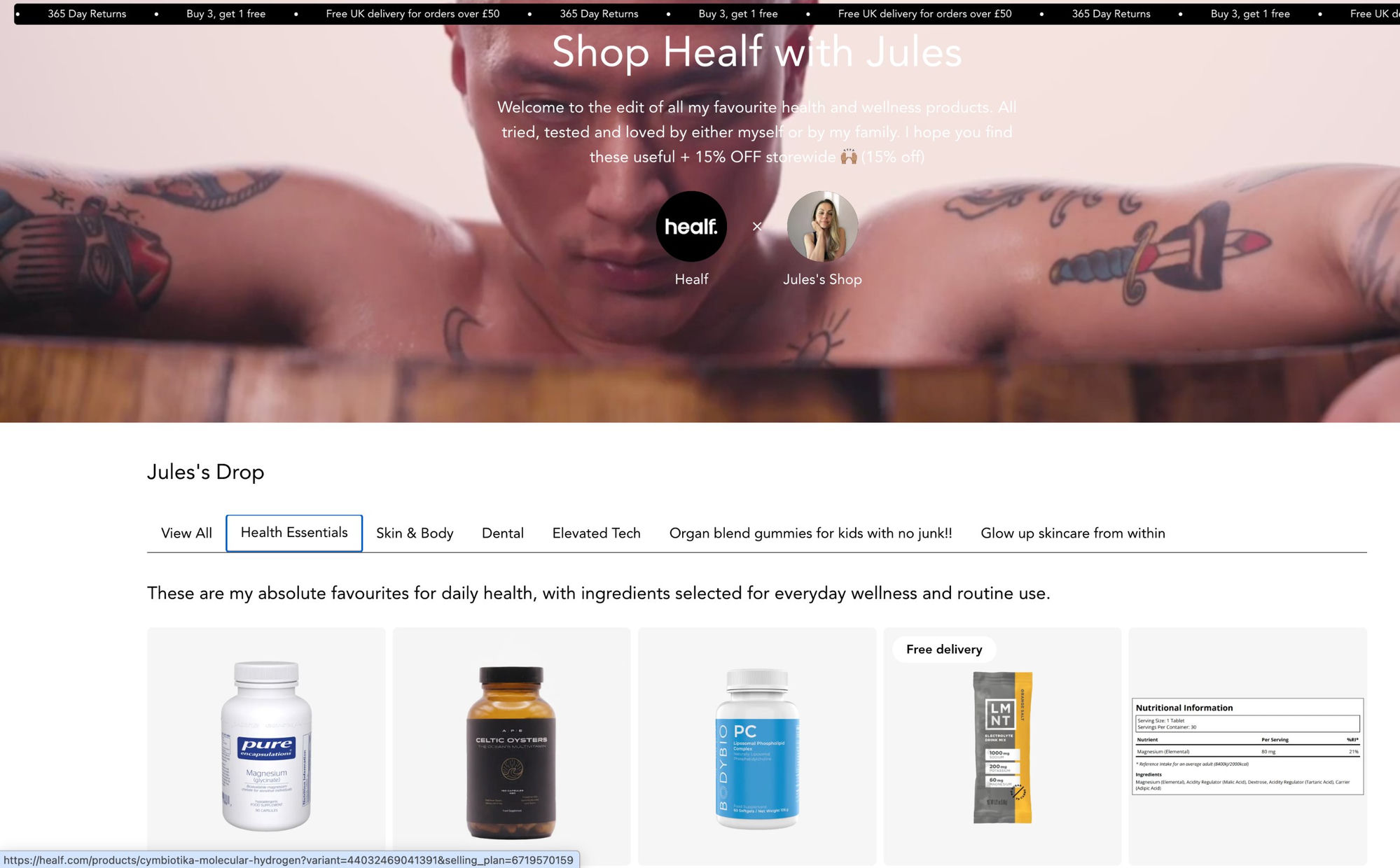
Wellness creators don't sell products. They sell protocols. A longevity creator isn't endorsing a specific NAD+ product; they're endorsing a morning routine that includes NAD+, magnesium, creatine, and a functional beverage, in a specific sequence. The brand's storefront needs to mirror that framing.
A creator-driven landing page in wellness should not be a product detail page. It should be a protocol page: here's Creator A's stack, here's why they chose each item, here's the order they take them in, and here's how to subscribe to the bundle. The difference in conversion between a PDP and a protocol page for creator-driven wellness traffic is often 3-4x.
The setup is documented in How to Set Up Creator-Specific Storefronts in Shopify. In wellness, think of each storefront as a magazine article edited by the creator, not a catalog slice. Link to the creator's explanations, embed the videos, include the creator's own words about dosing and timing. Every element that looks like brand-voice content is a missed conversion.
CAPI and ads: retargeting the lapsed subscriber
Wellness CAC is notoriously high. Paying between $80 and $200 to acquire a subscriber is common, and the only way those economics work is subscription lifetime value well above $500. That math breaks catastrophically when subscribers lapse in month three and the ad platforms can't find them again because the attribution signal is generic "purchased product X" rather than "came in through Creator A and currently lapsed."
The fix is to fire a creator-tagged conversion event into Meta CAPI at the moment of first purchase, then fire a creator-tagged cancellation event at the moment the subscription lapses. This gives Meta's optimization systems two things: (1) a lookalike seed that's specifically the creator's cohort, and (2) a retargeting audience that's specifically lapsed subscribers from that creator's cohort, which tend to respond much better to "Creator A is back with a new protocol" ads than to generic brand retargeting.
The implementation is covered in How to Pipe Creator Attribution Into Meta CAPI and Lookalikes. For wellness specifically, also fire the subscription-skipped, subscription-paused, and subscription-canceled events with creator tags. Those are the key retention-recovery signals.
Loyalty: streak maintenance and creator communities
Wellness brands have a natural loyalty mechanic that most other categories lack: the streak. A shopper who has been on a supplement for six consecutive months is in an identity-defining place with the product. Loyalty programs that reward streak maintenance ("You're on month 6 of Creator A's protocol, here's a bonus") convert dramatically better than generic point-accumulation loyalty.
Creator-aware loyalty also enables cross-creator community building. Shoppers who came in through Creator A should be able to see that they're part of Creator A's cohort and get access to creator-specific perks (exclusive protocol content, group calls, early access to new product launches the creator is involved in).
Setup patterns for Smile.io and LoyaltyLion are in How to Make Smile, LoyaltyLion, and Yotpo Loyalty Creator-Aware.
SMS: replenishment nudges for non-subscribers only
SMS in wellness is a surgical tool, not a broadcast channel. The shoppers who want SMS from a wellness brand are the ones who haven't subscribed yet. They want a reminder when they're about to run out so they can reorder manually. Active subscribers shouldn't get replenishment SMS because their subscription already handles it, and blasting them creates opt-out pressure.
The creator-aware layer here is simple: when the replenishment SMS fires, it should reference the creator in the message. "Creator A's 30-day protocol is about to run out. Reorder in one tap" converts 3-5x better than "Your order is running low." The implementation is in How to Trigger Attentive and Postscript SMS Flows on a Creator Metafield.
Also worth mentioning: SMS is particularly effective as a reactivation channel for lapsed subscribers. A "Creator A is about to drop a new protocol. Want early access?" SMS to lapsed subscribers in that creator's cohort typically wins back 8-15% of lapsed subs. Generic reactivation SMS wins back 1-3%.
Reviews and Yotpo: creator-attributed testimonials
Wellness is a category where reviews carry unusual weight. Shoppers about to commit to a new supplement read dozens of reviews before buying, and they implicitly weight reviews from people who seem similar to them much more heavily. Creator-attributed testimonials (reviews tagged with the creator the reviewer originally came in through) function as social proof that scales the creator's endorsement.
A product page showing "47 reviews from Creator A's protocol followers, 4.8 stars" alongside the aggregate rating is dramatically more persuasive than the aggregate alone. It signals: this product works specifically for people following this protocol, not just generic supplement shoppers.
The Yotpo review-request setup for creator-attribution is in How to Tie Yotpo Review Requests to Creator Storefronts. For wellness specifically, also tune the review-request timing: ask for a review at week 4-6 when the shopper has had enough time to actually feel an effect, not at day 7 when the bottle just arrived.
Returns and support: low-volume but high-context
Returns in wellness are rare. When they happen, it's usually for one of three reasons: the shopper had an adverse reaction, the shopper didn't feel an effect, or the shopper's routine changed. None of those are generic, and none of them should be handled by a generic returns flow. A creator-aware return interception ("Creator A is about to post about how to adjust this protocol, want to stay subscribed?") can convert a meaningful fraction of would-be returns into pauses.
Gorgias support tickets in wellness are dominated by dosing, stacking, and protocol questions. A support agent who can see that the ticketed customer came in through Creator A can immediately pull up that creator's protocol and answer the question contextually, rather than quoting generic brand-voice dosing instructions. The creator-aware Gorgias setup is in How to Make Gorgias Creator-Aware for Post-Purchase Support.
What to do first
If you're a wellness brand reading this and haven't started making your stack creator-aware, the sequence is:
Week 1: Set up the creator customer metafield in Shopify. This is the foundation every other surface reads from. See the Shopify setup post.
Weeks 2-3: Fork your subscription cancellation flow in ReCharge/Skio/Ordergroove. This is the single highest-leverage change. Every week you delay this is measurable subscription lifetime value leaking.
Weeks 4-6: Fork your primary Klaviyo nurture flow. Write two versions of every email: generic and creator-aware. Measure against each other.
Weeks 7-8: Fork your CAPI conversion events. Add creator tags to purchase, subscription-created, subscription-skipped, subscription-paused, and subscription-canceled events.
Month 3+: Everything else. Loyalty, SMS, reviews, returns, support. Each one of these is incremental; the first four are where the economics actually live.
How this connects to the broader series
This is the fifth vertical playbook in the creator-aware stack series. The previous playbooks cover Beauty (fast purchase cycle, testimonial-heavy, SMS-driven), Fashion (seasonal, returns-intensive, lookbook storefronts), Food and Beverage (high-frequency subscriptions, replenishment-driven), and Home Goods (long consideration, review-dependent, low replenishment).
Wellness sits at the intersection of food and beverage (subscription-heavy) and beauty (trust-dependent, testimonial-weighted). It shares the subscription-first architecture of F&B but the trust-gated purchase cycle of beauty. The surface priorities reflect that: subscriptions and email come first because they carry the economics; reviews come sixth because they carry the trust.
The umbrella framework in The Seven-Surface Creator-Aware Stack explains why every downstream surface needs creator context, regardless of vertical. This post is the wellness-specific tuning.
A note on CreatorCommerce
The CreatorCommerce platform is the infrastructure that makes this seven-surface tuning practical. The creator metafield is maintained automatically through storefront-based attribution; every downstream platform reads it without custom plumbing. Brands running creator-aware flows on top of CC typically go from "we have a creator program but we can't measure it" to "we have a creator program and every downstream surface remembers who drove the sale" in a matter of weeks, not quarters. For one wellness brand's playbook on running a high-performance affiliate program on top of this kind of measurement layer, see our fireside chat with Healf.
Wellness brands running creator-aware stacks with CC as the attribution layer typically see subscription retention on the creator cohort 25-40% higher than the catalog average, which in a subscription-first category translates to materially better unit economics across the entire business.
Frequently Asked Questions
Is wellness really this different from other verticals?
It is. The long consideration cycle, trust-gated purchase, and subscription-first economics combine in a way that shows up in no other vertical. Beauty comes closest but has a much faster purchase cycle and less extreme subscription retention economics.
What if we don't run subscriptions?
Most wellness brands do, but if yours doesn't, the priority order shifts. Email becomes the #1 surface, storefront becomes #2, and you should be thinking hard about whether a subscription architecture would work for your category. The economics of non-subscription wellness are very difficult above roughly $5M in revenue.
How do we measure creator-cohort subscription retention?
In ReCharge, Skio, or Ordergroove, pull subscription lifetime and churn rate segmented by the creator customer metafield. If your current subscription platform doesn't let you segment by metafield, you have a bigger problem than creator-awareness. Consider migrating to one that does. The mechanics are documented in the subscriptions post.
Does this work for clinical or practitioner-recommended wellness?
Yes, with a tweak. When the "creator" is actually a clinician or practitioner, the trust dynamics are even stronger. Patients almost never switch away from a practitioner-recommended protocol. The playbook is the same; the creator metafield just gets populated with the practitioner reference instead of an influencer ID. Some brands run both kinds of creator-driven traffic side by side and tune the downstream surfaces differently based on whether the creator is clinical or consumer.
What about regulatory constraints on wellness claims?
Creator-aware flows don't change your regulatory posture. The same disclaimers, claim limits, and structure/function language rules apply regardless of which creator drove the traffic. The playbook is about operational plumbing, not about what you can say. Your regulatory review process should govern copy across every flow, creator-aware or not.
Do we need a subscription platform switch to do this?
Not necessarily. ReCharge, Skio, and Ordergroove all support metafield-aware flows. If you're on a legacy platform that doesn't, the switch is usually worth it for reasons beyond creator-awareness (better cancel-flow tooling, better analytics, better multi-platform support). See the subscriptions playbook for the feature comparison.
How does wellness CAC compare to other verticals in a creator-aware stack?
Unblended wellness CAC is typically 2-3x higher than beauty or fashion on the same ad spend. With creator-aware CAPI and lookalikes, CC-using wellness brands tend to compress that gap to about 1.3-1.6x. The difference is mostly in lookalike quality. Creator-seeded lookalikes perform dramatically better in wellness than generic purchaser seeds.
Is there a wellness-specific CC case study?
A few wellness brands run on CC today but haven't published full case studies yet. The case studies page on the CC site will be updated as those go live. In the meantime, the closest analog is Healf, which is wellness-adjacent (functional wellness retailer).
How should we sequence creator-aware rollout if we're early-stage?
If you're under $2M revenue, focus on getting the creator metafield clean first. Don't fork subscription flows until you have at least 100 active subscribers with creator attribution; the sample size is too small to measure lift reliably. Once you're over that threshold, follow the 8-week sequence above.
Does this apply to functional beverages and nootropics?
Yes. Functional beverages and nootropics share wellness's subscription-first, trust-dependent pattern. The main adjustment: consumption-paced SMS nudges (for beverages) and dose-paced email reminders (for nootropics with variable protocols). Everything else mirrors the wellness playbook.
What about wholesale and retail distribution?
Creator-aware stacks are DTC-specific. If a meaningful fraction of your revenue is wholesale, the playbook doesn't apply to that channel. Wholesale flows through retailers that you can't instrument. The DTC portion should still be creator-aware, and the creator-driven DTC cohort usually has materially higher retention than the wholesale cohort, which is an argument for continuing to invest in the DTC side even if wholesale is growing faster.
How do we get started with CreatorCommerce?
Book a demo at creatorcommerce.shop. A wellness-focused implementation typically takes 3-6 weeks to get the creator metafield and subscription surface creator-aware, with the remaining surfaces rolled out over the following 2-3 months.
A short closing takeaway
Wellness is the category where creator-awareness pays back fastest, because subscription lifetime value is the dominant economic variable and creator-aware cancellation flows directly move that variable. If you only fork one surface this quarter, fork the subscription cancellation flow. Everything else is incremental; that one is categorically load-bearing.
Related Articles
- The Beauty Playbook for Creator-Aware Commerce
- The Fashion Playbook for Creator-Aware Commerce
- The Food and Beverage Playbook for Creator-Aware Commerce
- The Home Goods Playbook for Creator-Aware Commerce
- The Seven-Surface Creator-Aware Stack
- How to Make ReCharge, Skio, and Ordergroove Creator-Aware
- How to Build Creator-Native Email Flows in Klaviyo
- How to Pipe Creator Attribution Into Meta CAPI and Lookalikes
- How to Set Up Creator-Specific Storefronts in Shopify


%201.png)
%201.png)
