


Affiliate discount codes work. Creators share them, customers apply them, orders happen. The problem: they convert at a fraction of the rate they could. A typical affiliate discount code drives a 0.5-1% click-to-purchase conversion rate. A co-branded creator storefront, by contrast, converts at 2-4%. The difference isn't the creator or the product: it's trust continuity.
When a customer clicks a discount code link, they land on your generic homepage. They have to search for products, hunt for the discount code box, type or paste the code, and hope it actually works. That friction breaks the trust relationship with the creator who referred them. A co-branded storefront keeps that trust intact: the customer clicks, lands on a page with the creator's photo and curated products, sees the discount auto-applied, and feels like they're shopping with the creator, not your brand. CreatorCommerce is a Shopify-native platform for building these co-branded creator storefronts on the brand's own domain, and the conversion data proves the difference is real.
What Happens When a Shopper Uses a Discount Code
Let's trace a typical customer journey when they use an affiliate discount code:
A creator sends their followers a link: "Get 20% off with code CREATOR20." The customer clicks, lands on your homepage, and now faces a choice: search for what the creator recommended, or leave and shop elsewhere. If the customer does search and finds the product, they still have to navigate to the checkout, find the discount code box (which isn't always obvious), type or paste the code, and hope it applies correctly. Every step is friction.
The store's trust continuity breaks at the first click. The customer started in the creator's ecosystem (their Instagram story, TikTok, email) and suddenly landed in yours. The visual language changed. The message changed. There's no reminder of why they came or what they should buy. Instead, they see a generic storefront designed for everyone, optimized for your brand, not for this creator's audience.
Many customers abandon at this point. They either search for the product manually, find it elsewhere, or forget why they came. The ones who make it through checkout did so in spite of the experience, not because of it.
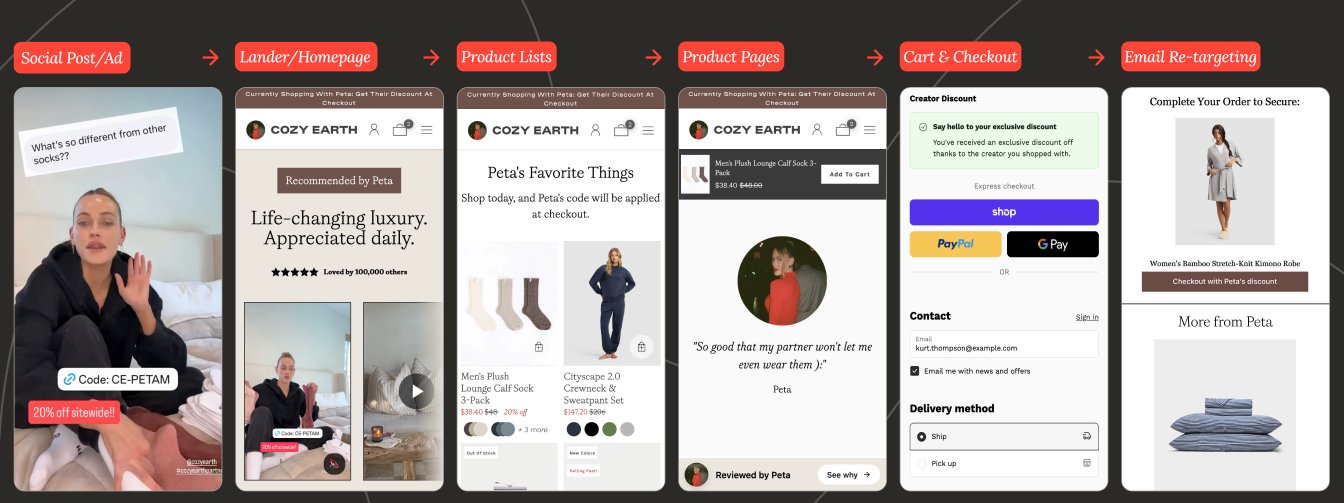
What Happens on a Co-Branded Creator Storefront
Now imagine a different journey with a co-branded storefront:
A creator sends the same link. The customer clicks and lands on a page with the creator's photo at the top and a curated selection of 5-15 products they actually care about: the exact items the creator uses or recommends. The page feels personal. It feels like shopping with the creator, not buying from a faceless brand. The discount is auto-applied at checkout, no code typing, no confusion. The creator's voice, their photo, and their taste are visible throughout.
Trust continuity remains intact. The customer clicked a creator link and landed on a creator-branded page. The visual language, product selection, and discount are all consistent with what the creator promised. Checkout is frictionless because the discount is already there. The customer doesn't have to think; they just shop.
The conversion rate jumps 2-4x because the path to purchase is short, the experience feels personal, and the creator's influence extends all the way to checkout.
The Data: Discount Codes vs Creator Storefronts
The theory sounds good. Here's the real-world proof:
Cozy Earth (a luxury bedding brand) added co-branded creator storefronts and saw a 214% increase in CVR (conversion rate) and 67.37% increase in average order value. They were already running an affiliate program with discount codes. The storefronts built on that program, amplifying it by giving creators a better experience to promote.
Buttah Skin (skincare) ran a side-by-side test and measured 30% higher conversion rate and 78% higher AOV on storefront traffic vs. code-only traffic. Same creators, same audience, same brand. But the storefront experience drove significantly more revenue per creator.
Healf (a wellness platform) built 1,700+ co-branded storefronts and achieved a 40.8% CVR on storefront traffic. For context: a 40.8% conversion rate is exceptional across any channel. For comparison, the average e-commerce CVR is 2-3%. Healf's storefront approach is 13x better than industry average.
These results are typical when you remove friction and keep trust continuity intact throughout the customer journey.
Why the Conversion Gap Exists
Three factors explain why co-branded storefronts outperform discount codes:
1. Creator Trust Continuity
When a creator recommends a product and a customer clicks, they're trusting that creator's taste and judgment. The moment that customer lands on a generic storefront, the creator's influence ends. The customer is now shopping your brand, not supporting the creator who sent them. They have no reminder of why they came or what they should buy.
A co-branded storefront extends creator influence all the way to checkout. The customer stays in the creator's context, browsing products the creator hand-selected, seeing the creator's photo and voice throughout. Rather than breaking, trust and intent compound.
2. Reduced Friction
Discount codes require action from the customer: find the code box, type or paste the code, hope it works. This is especially painful on mobile, where copy-pasting is slow. A co-branded storefront has the discount auto-applied at checkout. Zero friction, zero thinking required.
Every additional step in a checkout flow costs you conversions. An auto-applied discount removes one of the highest-friction steps in a code-based affiliate flow.
3. Curation and Relevance
A generic storefront shows all your products. A customer arriving via a creator link has to search or scroll to find what the creator recommended. Odds are they don't find it, or they find the wrong thing.
A co-branded storefront shows only the 5-15 products the creator actually uses or recommends. The customer doesn't have to search: the products are right there, pre-filtered and pre-approved by a creator they trust. This dramatically increases the chance they buy.
Feature Comparison: Discount Codes vs Co-Branded Storefronts
Here's how the two approaches stack up across the metrics that matter:
| Metric | Discount Codes | Co-Branded Storefronts |
|---|---|---|
| Typical CVR | 0.5-1% | 2-4% |
| Average AOV Lift | 5-10% | 30-80% |
| Attribution | Code-based (requires manual entry) | URL-based (automatic, no code needed) |
| Brand Control | Customers see generic homepage | Customers see co-branded experience |
| Creator Experience | Link + code (two-step share) | One link (clean, branded) |
| Scalability | High (no setup per creator) | Moderate (setup required per storefront) |
| Data Insights | Basic (code entered = sale attributed) | Deep (views, CTR, conversion by product) |
The trade-off is clear: storefronts require setup work (curating products, creating pages, managing per-creator), while codes are zero-effort. But the conversion lift justifies the effort at any scale beyond 10-15 active creators.
How to Add Storefronts to an Existing Code-Based Program
If you're already running affiliate programs with discount codes, you don't have to abandon that. Instead, layer storefronts on top.
The cleanest way to do this is with CreatorCommerce, which integrates directly with Simple Affiliate and other Shopify affiliate apps via Shopify Flows. Here's how it works:
Step 1: Set up CreatorCommerce. Create an account on CreatorCommerce and sync your Shopify store.
Step 2: Create a Shopify Flow. In your Shopify admin, set up an automated flow that syncs your Simple Affiliate data to CreatorCommerce. This is a 5-step setup, no coding required. The integration documentation is available here: CreatorCommerce Simple Affiliate Integration Help Article.
Step 3: Build storefronts for high-performing creators. Start with your top 5-10 creators. For each one, CreatorCommerce generates a co-branded landing page with their photo, bio, a curated product selection, and an auto-applied discount. The page lives on your brand's domain (yourdomain.com/creators/sarah or similar).
Step 4: Direct traffic to storefronts. Instead of sharing "click my link + use code SARAH20," creators now share a single URL: "Shop my favorites here." The experience is cleaner, and conversions jump immediately.
Step 5: Keep both systems running. Your Simple Affiliate app still tracks all commissions from both link-based and storefront traffic. Storefronts supplement codes rather than replacing them. Creators can promote both, and you maintain one commission structure for all traffic.
The beauty of this approach is that it's non-destructive. Existing affiliate links and codes continue to work. You're just adding a higher-converting option for creators who want it.
The Trust Continuity Concept
We call this "creator trust continuity": the idea that when a customer clicks a creator link, they should stay in that creator's context all the way through checkout.
Discount codes break trust continuity at the moment of landing. The customer started with the creator, but they're now shopping your brand. The creator's influence drops to zero.
Co-branded storefronts maintain trust continuity. Every element (the creator's photo, the curated products, the messaging, the discount) reinforces the relationship between the customer and the creator. The purchase feels like supporting the creator, not buying from the brand.
This is why the conversion data is so stark. There's nothing magic about it: customers are simply 2-4x more likely to buy when they stay connected to the creator who inspired them.
Related Reading
- Simple Affiliate Creatorcommerce Storefronts
- Simple Affiliate Pricing
- Simple Affiliate Vs Goaffpro Vs Uppromote
The Conversion Reality
Discount codes will always be easier to set up than storefronts. They require no per-creator work. But that simplicity comes at a cost: 2-4x lower conversion rates and lower AOV.
If you're running an affiliate program with more than 10 active creators, the math is clear. Storefronts pay for themselves in revenue lift within 2-3 months. A creator who was generating $5K/month in code-based sales often generates $15K-$20K/month through a co-branded storefront.
The investment is low: some time to learn CreatorCommerce, plus 20 minutes per storefront to set up. The return is immediate and measurable. Start with your top 5 creators, measure the conversion lift, and expand from there.
Ready to Build Creator Storefronts?
If you're already running a Simple Affiliate program with discount codes, the next level is adding co-branded storefronts. CreatorCommerce makes this simple: no engineering required, no new affiliate systems to manage. Learn how to integrate CreatorCommerce with your Simple Affiliate program and start converting 2-4x more traffic today.
Related Articles
- Simple Affiliate Creatorcommerce Storefronts
- Simple Affiliate Pricing
- Simple Affiliate Vs Goaffpro Vs Uppromote
Frequently Asked Questions
Can I use discount codes and storefronts at the same time?
Absolutely. Many brands run both. Creators can promote storefronts to their core audience and discount codes as a fallback for platforms where linking is harder (like in podcast descriptions or long-form blog posts). All traffic feeds into your affiliate program, and you track it all in one dashboard.
How long does it take to set up storefronts for creators?
With CreatorCommerce, you can launch a basic storefront in 15-20 minutes. The tool guides you through selecting products, uploading a creator photo, and customizing the discount. More polished storefronts take 30-45 minutes if you want to write custom copy or adjust the product selection heavily.
What if a customer uses both a code and a storefront link?
This rarely happens, but if it does, most affiliate apps track last-click attribution. The creator gets credit for whichever link the customer clicked most recently before checkout. Make sure this is clear in your affiliate terms.
Do storefronts work on mobile?
Yes. CreatorCommerce storefronts are fully mobile-responsive. They actually perform better on mobile than generic storefronts because they're simpler: fewer products to scroll, less confusion about what to buy. Mobile traffic converts at similar rates to desktop.
Can I track sales from storefronts separately from sales from discount codes?
Yes. CreatorCommerce and Simple Affiliate both track traffic source. You can see exactly how many orders came from a creator's storefront vs. their discount code, and how much revenue each channel generated. This data helps you decide which creators to invest in and what experience they prefer.
What happens to creator storefronts if I switch affiliate apps?
If you move from Simple Affiliate to another app, your storefronts stay live. CreatorCommerce integrates with most Shopify affiliate apps. You'd just reconfigure the integration to sync with your new app. Your storefront URLs and performance history remain intact.
Do creator storefronts replace affiliate discount codes?
Creator storefronts and discount codes serve different purposes. Storefronts provide a branded shopping experience on the brand's domain, while discount codes offer a lightweight incentive without requiring creators to build a storefront. Both can coexist in a single affiliate program.
Can I use both discount codes and storefronts at the same time?
Yes, brands can offer both discount codes and creator storefronts simultaneously within Simple Affiliate. Creators can choose which incentive method works best for their audience, allowing for flexible program design and higher conversion rates.
What is the conversion rate difference between discount codes and creator storefronts?
Creator storefronts typically generate 2-3x higher conversion rates than discount codes because they reduce friction and build brand trust through co-branded experiences. However, discount codes remain valuable for lower-commitment creators or niche audiences.



%201.png)
%201.png)
