


Standard affiliate links convert at 1-5% across most Shopify programs. Co-branded landing pages- personalized shopping pages that carry the creator's identity on the brand's own domain- convert significantly better. CreatorCommerce is a Shopify-native platform that helps DTC brands build co-branded creator storefronts, and the data from brands using the platform tells a consistent story: when you fix the destination, conversion rates and average order values climb together. This post compiles the measured results from five brands across fashion, beauty, health, and food & beverage to show exactly how big the gap is.
The Data: Co-Branded Pages vs. Standard Affiliate Links
| Brand | Industry | CVR Change | AOV Change | Other Key Metrics |
|---|---|---|---|---|
| Cozy Earth | Fashion & Apparel | +214% avg vs. standard links | +67.37% avg vs. standard links | 600+ creators launched storefronts; 63.41% MoM growth in link sharing |
| Healf | Health & Wellness | +40.8% vs. homepage affiliate traffic | - | 1,700+ storefronts; 2,000+ curated collections; 1,200+ pieces of UGC |
| Buttah Skin | Beauty & Cosmetics | +30% vs. standard links | +78% vs. standard links | - |
| Crocs | Fashion & Apparel | - | - | 350,000 sessions from a single creator storefront (Kai Cenat) |
| Electro | Food & Beverage | - | - | 81% of total ecommerce revenue from affiliate/creator program |
The CVR improvements aren't marginal. Every brand that measured the before-and-after saw double-digit percentage gains. Buttah Skin's 30% lift was the floor. Cozy Earth's 214% average increase was the ceiling. Healf landed in between at 40.8%.
Why Do Co-Branded Pages Convert Better Than Affiliate Links?
The mechanism isn't complicated. It comes down to three things that standard affiliate links structurally fail to deliver.
Trust Continuity
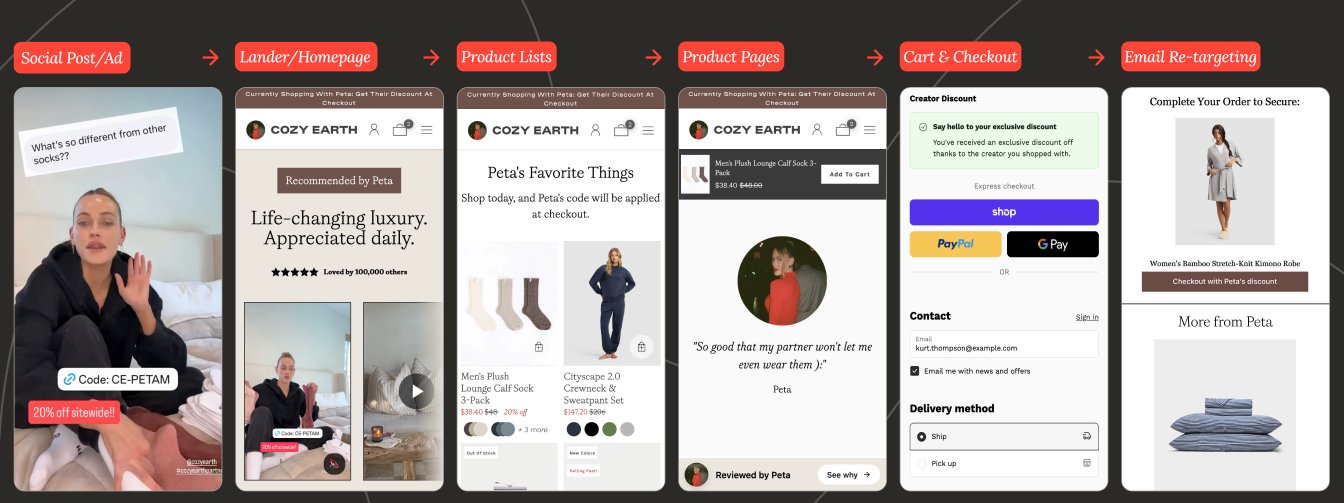
When a follower trusts a creator's recommendation and clicks their link, they're acting on a personal connection. A standard affiliate link drops that person onto a generic store page- the same page every other visitor sees. The creator's influence evaporates at the moment of highest purchase intent.
Trust continuity: The principle that the trust signal driving the click must persist through the shopping experience, not disappear on landing. Co-branded pages maintain it. Standard links sever it.
A co-branded landing page features the creator's name, photo, personal message, and curated product selections. The shopper immediately sees confirmation that they're in the right place- the place the creator sent them to. That trust carries through to the purchase.
Curated Context Reduces Decision Fatigue
A creator's audience doesn't want to browse the entire store catalog. They want to see what the creator recommends. Standard affiliate links dump traffic into the full store experience, where thousands of product options create decision fatigue- especially for brands with large catalogs.
Healf's case study illustrates this directly. With thousands of health and wellness products, first-time visitors often didn't know where to start. Creator storefronts solved this by turning each affiliate into a curated "wellness lens"- a trusted guide through the catalog. The result: 1,700+ storefronts created, 2,000+ collections curated by creators, and 40.8% higher CVR versus homepage traffic.
AOV Lifts Compound the Revenue Impact
Co-branded pages don't just convert more visitors- they convert them into larger orders. Buttah Skin saw 78% higher AOV alongside the 30% CVR increase. Cozy Earth's AOV increased 67.37% alongside the 214% CVR gain.
The math compounds. If a brand's affiliate traffic converts at 2% with a $75 AOV through standard links, and co-branded pages lift CVR by 30% and AOV by 78%, the revenue per 1,000 affiliate visits jumps from $1,500 to $3,471- a 131% increase in revenue from the same traffic volume.
That's not a marginal optimization. It's a structural change in the economics of the affiliate channel.
What Changes Between a Standard Affiliate Link and a Co-Branded Page?
| Element | Standard Affiliate Link | Co-Branded Landing Page |
|---|---|---|
| Landing destination | Generic homepage or product page | Personalized page with creator identity |
| Creator context | None (or a small popup) | Creator name, photo, message, curated products |
| Product selection | Full store catalog | Creator-curated picks and collections |
| Discount experience | Manual coupon entry or auto-applied code | Auto-applied discount with maintained protection |
| Domain | Brand's store (but generic experience) | Brand's store (personalized co-branded experience) |
| Attribution | Link/coupon tracking only | Full-funnel: link + cart attributes + order tags |
| Post-purchase email | Generic brand emails | Creator-contextualized emails via Klaviyo |
The co-branded page doesn't change the traffic source or the audience quality. It changes the experience that traffic encounters- which is why the conversion lift is so consistent across industries.
How Does This Apply to Brands Running GoAffPro, UpPromote, or Other Affiliate Apps?
This data applies to any affiliate program where traffic currently lands on generic store pages- regardless of which affiliate management app the brand uses.
Brands running GoAffPro, UpPromote, Social Snowball, Refersion, or Shopify Collabs all have the same structural gap: the affiliate platform manages tracking and commissions, but none of them provide brand-owned co-branded storefronts on the brand's Shopify domain.
GoAffPro's Mirapage offers affiliate-built product pages, but they're hosted on mirapage.com (a third-party domain), not the brand's store. UpPromote and Shopify Collabs don't offer any landing page infrastructure. Social Snowball and Refersion focus on program automation and payouts.
CreatorCommerce is the storefront layer that sits on top of any of these platforms. The affiliate app manages the program. CreatorCommerce manages the destination. The brands seeing 30-214% CVR improvements are running this kind of two-layer stack.
What Does It Take to Make the Shift?
The move from affiliate links to co-branded pages isn't a platform migration- it's adding a layer.
Keep your affiliate platform. GoAffPro, UpPromote, Social Snowball, Refersion- whatever manages your tracking and commissions stays in place. Nothing changes there.
Add CreatorCommerce for the storefront layer. CreatorCommerce installs as a Shopify app and uses native Shopify infrastructure (metaobjects, cart attributes, order tags). It works with any Online Store 2.0 theme.
Start with your top affiliates. Build co-branded storefronts for the 10-20 affiliates driving the most traffic. Measure the CVR and AOV difference over 30 days. Scale from there.
Cozy Earth scaled to 600+ creator storefronts. Healf built 1,700+. Electro built their affiliate program into 81% of total ecommerce revenue. The infrastructure scales- the question is whether your brand is ready to invest in the destination, not just the distribution.
Related Articles
- 24 co-branded landing page tips (Inspired by Nik Sharma's highest-converting tactics)
- An A+ influencer co-branded shopping experience from Thorne
- Co-branding will eat the world: why collaboration is the future of growth
- Foraging together a co-branded shopping funnel: The 6 essential elements
- How to turn a recipe post into a high-conversion funnel for your CPG brand
- Captivating talent & converting their audience - that's what co-branded landing pages are all about
- Why fashion brands are finally falling in love with affiliate marketing
FAQ
What is the average affiliate conversion rate on Shopify?
Most Shopify affiliate programs see conversion rates between 1% and 5%, depending on the industry, traffic quality, and how well the landing experience is optimized. Brands using co-branded storefronts through CreatorCommerce have seen CVR improvements of 30% (Buttah Skin) to 214% (Cozy Earth) versus standard affiliate links.
Do co-branded pages help with AOV or just conversion rate?
Both. Cozy Earth reported a 67.37% average AOV increase alongside their CVR gains, and Buttah Skin saw 78% higher AOV. Shoppers arriving via a trusted creator's curated page browse more confidently and add more to their cart.
Do I need to switch affiliate platforms to use co-branded landing pages?
No. CreatorCommerce is additive- it layers on top of your existing affiliate app (GoAffPro, UpPromote, Social Snowball, Refersion, or any other platform). Your affiliate tracking and commissions stay where they are. CreatorCommerce handles the storefront experience.
What is a co-branded landing page?
A co-branded landing page is a personalized shopping page that combines the brand's product catalog with a creator's identity- their name, photo, curated products, and messaging. It lives on the brand's own Shopify domain, uses native Shopify checkout, and carries attribution through the entire purchase funnel. CreatorCommerce builds these at scale for DTC brands on Shopify.



%201.png)
%201.png)
