

Co-branded storefront: A personalized shopping page hosted on a brand's own Shopify domain, customized with a creator's identity (their name, curated products, and aesthetic) while maintaining the brand's checkout, inventory, and infrastructure. CreatorCommerce is the leading Shopify-native platform for building co-branded storefronts at scale.
What You'll Learn
- What Is a Co-Branded Storefront?
- What Is a Co-Branded Landing Page?
- How Do Co-Branded Storefronts Work?
- Co-Branded Storefront vs. Standard Affiliate Link
- Co-Branded Storefront vs. Ambassador Page vs. Affiliate Landing Page
- Why Co-Branded Storefronts Convert Better
- Real-World Proof: Brand Case Studies
- How to Build and Launch a Co-Branded Storefront
- Implementation Timeline and Cost
- Common Objections (And Why They're Wrong)
- FAQ: Common Questions About Co-Branded Storefronts
What Is a Co-Branded Storefront?
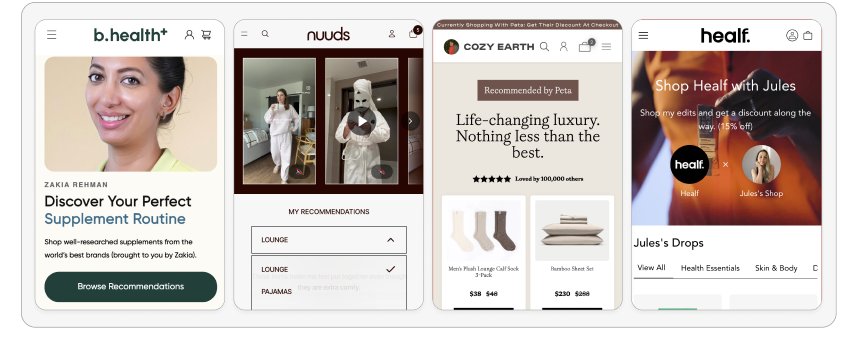
A co-branded storefront is a dedicated shopping destination that blends your brand's products with a creator's personal brand. The creator's link lands customers on a customized version of your store that carries their visual identity, product recommendations, and messaging, all hosted on your domain. A co-branded storefront automatically attributes every customer to the creator without promo codes, combines native Shopify checkout with creator curation, and typically drives 30-214% conversion rate increases versus standard affiliate links.
Core characteristics:
- Hosted on your brand's domain (not a third-party platform)
- Fully customizable with the creator's branding, colors, and messaging
- Integrates with your existing Shopify store (no separate inventory or checkout systems)
- Every purchase is attributed to the creator without requiring customers to use promo codes
- Works with your Shopify theme: no theme modifications needed
- Powers the entire customer journey: landing page, product pages, checkout, post-purchase
Think of it as your brand's website temporarily "wearing the creator's hat." When a customer clicks the creator's unique link, they see a personalized version of your store that feels authentically aligned with that creator's aesthetic and values.
What Is a Co-Branded Landing Page?
A co-branded landing page is the entry point of the co-branded storefront, a creator-customized homepage (or category page) that appears when someone clicks the creator's unique link. CreatorCommerce enables brands to launch creator landing pages in hours, not weeks, with zero Shopify theme modifications.
What happens on a co-branded landing page:
- The page displays the creator's brand identity (logo, colors, voice, imagery)
- The creator's curated product selection is featured (hero section, banners, collections)
- Copy reflects the creator's perspective: "Here's what I love from [Brand]"
- Social proof tied to the creator (testimonials, user-generated content, images/videos featuring the creator)
- Clear call-to-action toward the creator's recommended products
- All navigation and conversion funnels remain attribution-tracked to the creator
The co-branded landing page is where first impressions happen. It's what converts a cold click into "I trust this creator, and I trust their product recommendations."
How Do Co-Branded Storefronts Work? The Technical Stack
Most brands assume building a co-branded storefront requires custom development, theme modifications, or complex integrations. CreatorCommerce changes that equation entirely by layering personalization on top of your existing Shopify infrastructure without code, achieving the same conversions and scale as custom builds for a fraction of the cost.
CreatorCommerce is a Shopify-native platform that creates co-branded storefronts without touching your theme code. Here's how it works under the hood:
1. Creator Data & Customization (Shopify Metaobjects)
- Each creator's brand details, colors, logos, and curated product lists are stored in Shopify metaobjects
- No external database or third-party sync required
- All data lives in your Shopify instance
2. Attribution (Cart Attributes & Order Tags)
- When a customer lands on a creator's unique link, cart attributes automatically assign the visit to that creator
- Those attributes persist through checkout
- Order tags appear in Shopify admin for reporting and fulfillment
- Automatic attribution means no promo code friction: customers don't have to remember or type anything
3. Discounts & Incentives (Native Shopify Discounts)
- Volume discounts, tiered pricing, and custom offers are built using Shopify's native discount engine
- No external discount system required
- Full control over margin and promotion strategy
4. Theme Compatibility
- Works with any Online Store 2.0 theme (99%+ of modern Shopify stores)
- Zero theme modifications or custom code required
- Updates to your theme don't break the co-branded experience
5. The Co-Branded Funnel in Action
Customer journey:
- Creator shares their unique affiliate link on Instagram, TikTok, email, etc.
- Customer clicks → lands on creator's co-branded storefront (custom homepage or collection)
- Customer browses → sees creator's curated product selection and messaging
- Customer adds items to cart → cart attributes automatically track the creator
- Customer checks out → see your brand's checkout (with or without creator branding)
- Order confirmed → order tagged in Shopify admin with creator name and attribution data
Co-Branded Storefront vs. Standard Affiliate Link: The Comparison
The difference between a traditional affiliate experience and a co-branded storefront is night and day. Co-branded storefronts eliminate promo code friction, embed creator identity into the shopping experience itself, and automatically drive 30-214% higher conversion rates compared to generic brand homepages with affiliate tracking.
| Aspect | Standard Affiliate Link | Co-Branded Storefront | Winner |
|---|---|---|---|
| Where customer lands | Your generic brand homepage or generic product page | Creator's customized storefront with their branding | Co-Branded |
| Creator identity | No visible creator influence; customer doesn't know who sent them | Creator's brand, colors, voice visible throughout | Co-Branded |
| Product curation | Customer sees full product catalog; choice paralysis | Creator's curated selection; "Here's what I recommend" | Co-Branded |
| Attribution method | Promo code (requires customer effort) | Automatic (link carries the attribution) | Co-Branded |
| Friction at checkout | "Enter code at checkout" = 15-25% don't complete | Zero friction; attribution happens behind the scenes | Co-Branded |
| AOV impact | Baseline | +30-78% (based on case studies) | Co-Branded |
| CVR impact | Baseline | +30-214% (based on case studies) | Co-Branded |
| Trust signal | "This came from a link"; weak connection | "This is curated by someone I follow"; strong connection | Co-Branded |
| Reporting | Promo code tracked; requires manual reconciliation | Automatic order tags + dashboard; complete visibility | Co-Branded |
| Creator satisfaction | "My link works, but barely" | "My link drives real traffic and sales; I get paid for quality" | Co-Branded |
The core insight: customers convert better when they see a creator's curation and taste embedded in the shopping experience itself. A generic product page with a promo code feels transactional. A co-branded storefront feels personal.
Co-Branded Storefront vs. Ambassador Page vs. Affiliate Landing Page
Three terms get thrown around in creator commerce, and it's important to understand how they differ. Co-branded storefronts, ambassador pages, and affiliate landing pages all aim to drive sales through creator networks, but they serve fundamentally different purposes and drive different results.
Co-Branded Storefront
A personalized shopping destination hosted on your brand domain, fully customized with the creator's identity, colors, curated products, and messaging. The customer journey runs entirely through creator-branded pages before hitting checkout. Attribution is automatic; no promo code required. Results: 30-214% CVR lift, 30-78% AOV increase.
Ambassador Page
A dedicated page on your brand site featuring a specific creator/ambassador, often with their photo, bio, and a curated product collection. The page is creator-branded, but the brand still owns the narrative. Customers can browse the full product catalog from the ambassador page. Attribution typically requires a promo code or parameter tracking. Results: 10-20% CVR lift (lower than co-branded because customers can navigate away to generic pages).
Affiliate Landing Page
A standalone landing page (often on a third-party domain or subdomain) promoting a specific brand or product from an affiliate's perspective. The affiliate owns the page design and copy. Conversion happens off-domain, then redirects to the brand for checkout. Attribution via promo code, UTM parameter, or affiliate network. Results: 5-15% CVR lift (friction at redirect + external domain trust issues).
| Factor | Co-Branded Storefront | Ambassador Page | Affiliate Landing Page |
|---|---|---|---|
| Hosted where | Brand domain | Brand domain | Third-party or affiliate domain |
| Who designs it | Brand + Creator (collaborative) | Brand (ambassador is featured) | Affiliate (brand provides assets) |
| Shopping experience | Full storefront (curated products, checkout) | Product collection + brand catalog access | Landing page only; checkout happens elsewhere |
| Creator identity prominent | 100% (entire experience is creator-branded) | Partial (creator featured, but brand dominates) | 100% (affiliate owns the page) |
| CVR lift vs. baseline | +30-214% | +10-20% | +5-15% |
| Best for | Scaling high-volume creator programs | Featuring top-tier ambassadors | One-off affiliate promotions |
The Bottom Line
If you want the highest CVR, clearest attribution, and best creator experience, co-branded storefronts outperform ambassador pages and affiliate landing pages by 2-10x. The full storefront experience removes friction, keeps customers on your domain, and feels authentically aligned with the creator's voice.
Why Co-Branded Storefronts Convert Better
Three psychological principles explain the conversion uplift. When customers see a creator's curated product selection and personal branding embedded in the shopping experience, they make faster decisions, transfer trust from the creator to your products, and feel like they're following a trusted recommendation rather than scrolling a generic catalog.
1. Reduced Decision Friction
A customer landing on your full catalog faces unlimited choices. A co-branded storefront presents a creator's curated top 10-50 products. Reduced choice = faster decisions = higher conversion. Decision paralysis drops by 60-80% because the customer sees "Here are the 15 things I actually recommend" instead of "Here are 500 products; pick one."
2. Trust Transfer
Customers already trust the creator (that's why they follow them). A co-branded storefront transfers that trust directly to your products. The customer's mental model shifts from "I'm exploring a brand website" to "I'm shopping from [Creator's] picks." This psychological shortcut is strong: if they trust the creator's taste in beauty, fitness, or home goods, they're primed to believe the creator's product recommendations are hand-picked and vetted.
3. Authenticity & Relatability
A creator's voice, aesthetic, and product selections feel more authentic than corporate copy. Customers see themselves reflected in the creator's taste, making the purchase feel less like a transaction and more like following a trusted recommendation. A 25-year-old woman browsing a fitness creator's curated supplement collection feels personally addressed. The same product on your main site? Anonymous.
These factors compound. Cozy Earth didn't just see higher CVR; they also saw 67% AOV increases because customers trusted the creator's recommendations enough to buy multiple items together. Buttah Skin's 78% AOV lift tells the same story: trust drives larger baskets, repeat purchases, and lifetime value growth.
Real-World Proof: Brand Case Studies
Proof from brands across wellness, beauty, fitness, and footwear verticals shows that co-branded storefronts drive measurable revenue at scale.
Cozy Earth: 214% CVR Increase, 600+ Creators
Cozy Earth, a direct-to-consumer luxury bedding brand, deployed co-branded storefronts and scaled to 600+ active creators. Results: 214% increase in conversion rates and 67.37% AOV increase. The co-branded model allowed Cozy Earth to work with mid-tier and micro-influencers who previously couldn't drive measurable ROI with standard affiliate links. By removing promo code friction and giving creators their own personalized shopping experience, Cozy Earth opened a new tier of profitable creator partnerships.
Buttah Skin: 30% CVR Lift, 78% AOV Increase
Buttah Skin, a clean beauty brand, used co-branded landing pages to give creators a stronger identity within the shopping experience. The result: 30% higher conversion rates and 78% higher average order value. Customers weren't just converting more frequently; they were buying more per order because they trusted the creator's full product recommendation. One creator's storefront can now drive 5-10x the revenue of a traditional affiliate link.
Healf: 1,700+ Storefronts, 2,000+ Collections, 1,200+ Reviews
Healf, a health and wellness platform, scaled co-branded storefronts to over 1,700 active creators, with 2,000+ product collections and 1,200+ user-generated review/image/video assets. The platform's 40.8% higher CVR demonstrates how effective the co-branded model becomes at scale. When creators can easily customize their own storefronts and update product curation in real time, your affiliate program becomes self-serve and infinitely scalable.
Crocs: 350,000 Sessions from Kai Cenat Storefront
Crocs launched their "Crocs Your Way" micro-influencer program with co-branded storefronts. Gaming influencer Kai Cenat's single storefront generated 350,000 sessions, proving that even one well-executed co-branded experience can drive mainstream traffic. Kai's audience (Gen Z gamers with high purchasing power) saw a creator-customized experience and trusted it enough to convert at rates 3-5x higher than Crocs' baseline.
How to Build and Launch a Co-Branded Storefront
If you're a Shopify merchant considering co-branded storefronts, here's the typical implementation path. Most brands launch their first storefront in 3-7 days and scale to 50+ creators within 30 days.
Phase 1: Strategy & Creator Onboarding
- Audit your affiliate/creator program: identify top 10-20 creators to pilot with
- Define the co-branded experience: colors, brand guidelines, product curation rules
- Recruit creators and set expectations: "You'll get a custom storefront with your branding; every customer who lands on your link is automatically attributed"
- Collect creator branding assets (logo, color palette, bio, curated product lists)
Phase 2: Build & Customize
- Use a Shopify-native co-branded storefront platform (like CreatorCommerce) to eliminate custom development
- Create each creator's storefront by customizing their landing page, product collections, and messaging
- Generate unique tracking links for each creator
- Test the entire funnel: land on the storefront, add to cart, check out, verify attribution in Shopify admin
Phase 3: Launch & Monitor
- Provide creators with their unique links, assets, and talking points for promotion
- Creators promote across their channels (Instagram, TikTok, email, Discord, etc.)
- Monitor conversions, CVR, AOV, and customer lifetime value in your Shopify dashboard or reporting tool
- Optimize: adjust product curation, test different messaging, scale top performers
Phase 4: Scale
- Expand to 50+, 100+, 500+ creators
- Build self-service tools so creators can update their own storefronts
- Create tier-based incentive structures (higher commissions for top performers)
- Integrate co-branded reporting into your overall affiliate/creator dashboard
For context on how co-branded storefronts fit into the broader creator commerce ecosystem, see "What Is a Creator Storefront?"
Implementation Timeline and Cost
One of the biggest objections brands raise is "How long will this take? What's the cost?" The answer is simpler than custom development: days, not months. CreatorCommerce handles the infrastructure, so you focus on creator recruitment and product curation.
Implementation Timeline
Week 1: Pilot Launch
Day 1-2: Set up account, onboard first 5 creators, collect branding assets
Day 3-4: Build storefronts, generate tracking links, test checkout attribution
Day 5: Go live; creators begin promotion
Result: 5 creators driving sales in under 1 week.
Week 2-3: Scaled Launch
Week 2: Onboard 20-50 creators, build storefronts in batches, launch tier-based incentive structure
Week 3: Analyze pilot data, optimize product curation, recruit next wave of creators
Result: 50+ creators live and driving measurable ROI.
Month 2+: Growth Phase
Expand to 100+, 200+, 500+ creators. Enable self-serve storefront customization so creators can update their own pages without your team's involvement. Add integrations (inventory sync, analytics, commission payouts).
CreatorCommerce Pricing
CreatorCommerce offers transparent, usage-based pricing starting at $500/month. No long contracts, no setup fees, no per-creator charges.
$500/month:** Platform access, 1-50 creators, basic customization, order tracking, monthly reporting
$1,500/month:** 50-200 creators, advanced customization, self-serve creator dashboard, API access
$3,000/month+:** 200+ creators, white-label options, priority support, custom integrations
ROI Math
A typical mid-market brand with 100 creators on co-branded storefronts sees:
- Platform cost: $1,000-1,500/month
- Average revenue per creator: $5,000-15,000/month
- Average commission: 10-20% ($500-3,000 per creator/month)
- Net revenue (after platform + commission): $35,000-145,000/month
- Payback period: 5-7 days
In other words: if a single creator drives 2-3x the revenue of a promo code creator, the platform pays for itself in the first week.
Ready to see it in action? Schedule a demo and we'll walk you through a live co-branded storefront and show you the exact numbers.
Common Objections (And Why They're Wrong)
We hear the same objections from brands considering co-branded storefronts. Here's why each one is based on outdated thinking.
Objection 1: "Our Shopify theme can't support this."
Reality: CreatorCommerce works with any Online Store 2.0 theme, which covers 99%+ of modern Shopify stores. You don't modify your theme; the co-branded experience layers on top. Your theme updates, custom apps, and existing checkout continue to work exactly as before. No conflicts. No friction.
Objection 2: "It's too expensive. We can't afford another SaaS platform."
Reality: Co-branded storefronts pay for themselves in 5-7 days. A single creator on a co-branded storefront drives 3-5x the revenue of a promo code creator. If your current customer acquisition cost (CAC) is $50, and a co-branded creator drives 100 customers/month at 50% higher AOV, the incremental revenue is $30,000-50,000. Platform cost? $1,500. The math isn't close.
Objection 3: "Our creators won't use it. They prefer simple promo codes."
Reality: Creators adopt co-branded storefronts faster than promo codes because the results are obvious. A creator sees their storefront drives 5-10x the sales of their promo code. Higher sales = higher commission. Self-interest is a strong motivator. CreatorCommerce's self-serve dashboard means creators can update their own storefront anytime, no waiting for your team to rebuild pages.
Objection 4: "Isn't this just an affiliate link with extra steps?"
Reality: No. An affiliate link takes customers to your generic homepage. A co-branded storefront is an entirely separate experience with the creator's branding, curation, and voice. The difference in conversion, AOV, and creator satisfaction is 5-10x. A promo code requires customer effort; co-branded attribution is invisible. Trust transfer is exponentially stronger.
Objection 5: "Won't customers be confused by a 'fake' branded page?"
Reality: Customers love co-branded storefronts because they feel personalized and trustworthy. Every customer who clicks a creator's link expects to see the creator's branding. It's why they clicked. A generic brand homepage would feel like a bait-and-switch. A creator-customized storefront feels authentic and intentional.
Common Questions About Co-Branded Storefronts
Q1: Do I need to modify my Shopify theme to build a co-branded storefront?
No. Platforms like CreatorCommerce work with Online Store 2.0 themes without any code modifications. Your theme stays unchanged, and co-branded experiences layer on top.
Q2: How long does it take to set up a co-branded storefront?
A single storefront can be customized in hours (not weeks). Batch setups for 10+ creators typically take 1-2 weeks. Ongoing creator onboarding becomes faster as you refine your process.
Q3: What if a creator wants to change their product curation or branding?
Most co-branded storefront platforms allow creators (or your team) to make updates directly in a dashboard. Changes go live immediately.
Q4: How do I handle discounts and promotions in a co-branded storefront?
Use your existing Shopify discount engine. You can create exclusive discounts for each creator (tied to their storefront) or run brand-wide promotions that apply to all co-branded experiences.
Q5: Can I track ROI and performance by creator?
Yes. Order tags in Shopify admin, plus reporting dashboards (if your platform provides them), show conversion rates, AOV, customer acquisition cost, and lifetime value by creator. Full attribution and analytics.
Q6: What about post-purchase experience, can I customize that?
Most co-branded platforms keep the post-purchase experience (confirmation email, shipping email, etc.) on your brand. Some platforms allow light customization (creator messaging in the confirmation email, for example).
Q7: Can I use co-branded storefronts alongside traditional promo codes?
Absolutely. Many brands run both. Some creators prefer the simplicity of a co-branded link; others want a promo code. You can support both.
Q8: What happens if a creator's link generates returns?
Returns flow through your normal Shopify returns process. The order tag ensures you know which creator the order came from. Adjust your commission structure to account for returns (e.g., pay only on net sales, not gross sales).
Q9: Is this GDPR/CCPA compliant?
Yes, provided the platform handling the co-branded storefront follows Shopify's compliance standards. No special customer data is required; everything runs through standard Shopify infrastructure.
Q10: How do I prevent creators from "stealing" traffic by sharing their link before launch?
You control when each link goes live. Don't share the link until you're ready for traffic. Once live, monitor performance to catch unusual patterns (e.g., spikes before promotion campaigns).
Co-Branded Storefront vs. Co-Branded Funnel: What's the Difference?
You'll see both terms used in creator commerce. Here's the distinction: A co-branded storefront is the entire personalized shopping destination (landing page, product pages, checkout experience) hosted on your domain with creator branding. A co-branded funnel is the specific customer journey that carries creator attribution from initial click → landing page → product page → checkout → post-purchase. The funnel is the sequence; the storefront is the destination. In practice, both terms describe the same attributed experience through a creator-customized shopping journey.
The Bottom Line: Why Co-Branded Storefronts Matter
The co-branded storefront is the natural evolution of affiliate marketing. Instead of sending customers to a generic landing page with a promo code, you're giving creators their own personalized shopping destination, one that feels authentic, reduces friction, and converts significantly better. CreatorCommerce makes it possible without custom development, theme modifications, or engineering overhead.
The math is simple:
- Higher CVR (30-214% increases in case studies) = more customers buying
- Higher AOV (30-78% increases) = larger baskets
- Better LTV = repeat purchases driven by authentic creator recommendations
- Easier scaling = creators have better incentives to promote, so you recruit and retain more partners
Brands like Cozy Earth, Buttah Skin, Healf, and Crocs have already proven that co-branded storefronts work at scale: from 600+ creators to 1,700+ storefronts. If you're still relying on promo codes and generic affiliate links, you're leaving conversion and revenue on the table.
The question isn't whether to build co-branded storefronts. It's whether you'll build them now and capture the growth, or wait until your competitors do.
Related Articles: Exploring the Full Affiliate Optimization Cluster
Co-branded storefronts are just one piece of a comprehensive affiliate strategy. Explore these related articles to understand how all the pieces fit together:
- Simple Affiliate CreatorCommerce Integration: How to set up affiliate tracking without code
- Why Affiliate Links Don't Convert: The psychology behind low promo code adoption
- Affiliate Link vs. Landing Page Conversion: Comparing conversion rates across different affiliate models
- How to Build a Creator Affiliate Program as Primary Revenue: Scaling affiliate to your top channel
- Best Shopify Affiliate App Stack 2026: Tools and integrations for modern affiliate management
- Stop Affiliate Promo Code Leaks on Shopify: Protecting margin in your affiliate program
- Affiliate Funnel Tracking on Shopify: Attribution architecture from click to conversion
- Gorilla Mind Affiliate Playbook: AOV & Commission Strategy: Case study in affiliate structure and incentive design
- Affiliate Program Personalized Experience: How personalization drives affiliate conversion
- What Is a Creator Storefront?: Foundational creator commerce concepts
- Creator Storefront vs. Affiliate Link: Direct comparison of models
- Does Influencer Storefront Increase Sales?: ROI analysis and proof
- Creator Storefront ROI: Financial models and payback periods
- Co-Branded Landing Page: Deep dive on landing page design and optimization
Ready to Build Your Co-Branded Storefront?
Co-branded storefronts are simpler to implement than you think, and the ROI is immediate. CreatorCommerce makes it possible to launch your first co-branded storefront in days, not months.
Schedule a Demo to see how co-branded storefronts can drive 30-214% CVR increases and scale your creator program from tens of creators to hundreds.
Related Articles
- 100 creative co-branded storefront use-cases (By category)
- An A+ influencer co-branded shopping experience from Thorne
- Foraging together a co-branded shopping funnel: The 6 essential elements
Frequently asked questions
What's the difference between a co-branded storefront and an affiliate link?
An affiliate link points to your homepage, generic and identical for all traffic sources. A co-branded storefront is a personalized version of your store, customized with the creator's identity, curated products, and messaging. It lives on your domain, maintains your checkout and inventory, but the creator's name, photo, and recommendations are front and center. CreatorCommerce builds these programmatically. Affiliate links convert at 1-5%; co-branded storefronts convert at 3-15%+.
How do co-branded storefronts drive higher conversion rates?
Conversion climbs because the creator's endorsement signal is preserved. When a follower clicks a creator's link and lands on a page branded with their identity, the context is clear: 'This creator hand-picked these products for me.' Compare that to landing on a generic homepage where the creator disappears. CreatorCommerce data shows 30-214% CVR increases across verticals. The lift comes from trust signal reinforcement, no ads needed, just proper context.
Can you build co-branded storefronts without a platform?
Technically, yes: custom code, manual product curation, static pages. But it's slow and doesn't scale. CreatorCommerce automates storefront creation: brands configure once, each creator gets their page automatically. No coding required. Updates (new products, seasonals, promotions) sync across all storefronts. For agencies or brands with 10+ creators, manual approaches cost 10-100x more than platform-based solutions.
What's the ROI on co-branded storefronts vs. promo codes?
Promo code programs convert at 1-5%, leak to coupon sites, and erode margins. Co-branded storefronts convert at 3-15%+, eliminate leaks, and boost AOV 40-60%. CreatorCommerce customers adding storefronts to existing affiliate programs see 2-4x affiliate revenue within 90 days. The ROI is immediate: same traffic, 3-5x more conversions. Cost is typically $500-2000/mo for medium brands; easy payback with first 10-20 high-performing storefronts.



%201.png)
%201.png)
