


Your affiliate platform is working great. Codes are generating. Payouts are accurate. Attribution is clean.
So why are your conversions still flat?
The problem is what comes after your affiliate management tool, the part most brands have completely overlooked.
The Affiliate Infrastructure Gap
Let's be honest: tracking and payouts are table stakes now. Every serious affiliate platform, Social Snowball, Refersion, Simple Affiliate, and dozens of others, nails this. They've optimized the backend so well that attribution has become almost boring. Which is exactly as it should be. Most brands have completely missed the infrastructure layer between affiliate operations and customer conversion, leaving affiliate traffic to land on generic homepages instead of creator-optimized experiences. CreatorCommerce fills this gap by enabling brands to build co-branded storefronts, curated product collections, and personalized landing pages that convert affiliate traffic at rates 30-214% higher than standard flows.
But there's a hidden infrastructure gap that nearly every brand has missed.
Definition: The Affiliate Infrastructure Gap The chasm between affiliate management (who gets paid, when, and how much) and affiliate conversion optimization (what customers see when they land from an affiliate link). Most brands have invested heavily in the former and almost nothing in the latter.
Here's what's actually happening at the brand level:
You've built one thing really well: the affiliate operations layer. Dashboard. Commission schedules. Tracking pixels. Payout automation. That's your affiliate platform doing exactly what it's designed to do.
But you've left the affiliate experience layer completely untouched.
Your affiliates drive traffic to the same homepage everyone else sees. The same homepage your paid ads drive to. The same homepage a customer who found you on Google lands on. No context. No personalization. No signal that says, "Hey, you specifically recommended this creator's products, here's what makes them special."
This is the gap. And it's costing you conversions, AOV, and customer lifetime value.
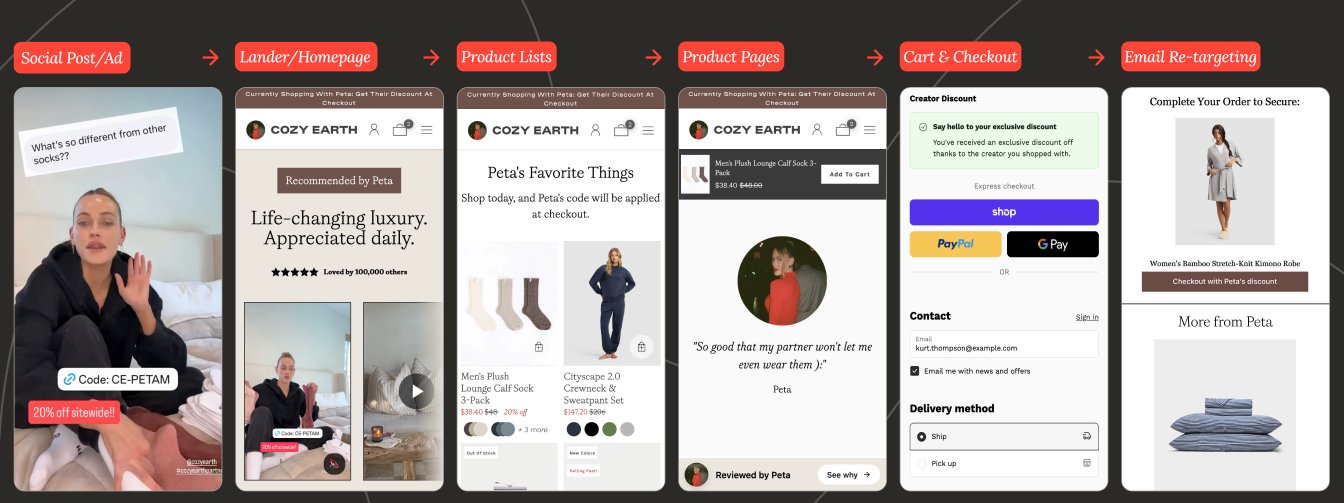
What Most Brands Have Built vs. What's Missing
| Affiliate Layer | What Brands Built | What's Missing |
|---|---|---|
| Operations | Tracking codes, commission structures, payout schedules, dashboard analytics | None, this is locked in. |
| Experience | Generic homepage link. Promo codes (if you're lucky). | Creator context, personalized landing, curated products, first-party customer data, affiliate branding. |
| Conversion Optimization | Attribution (did they buy?). Payouts (how much?). | Conversion rate optimization (why did they buy?). AOV increase (what did they buy?). Repeat rate (did they stay?). |
| Customer Journey | Click → Generic Site → Checkout | Click → Creator Context → Curated Products → Personalized Checkout → Data Capture |
The gap is a mindset gap rather than a feature gap.
Most brands think of affiliates as a channel, like email, like paid ads, like organic search. So they apply channel logic: one destination, one experience, one message. Optimize the funnel. Track the conversion. Move on.
But creator-led commerce isn't a channel. It's a relationship. And relationships need personalization, context, and trust.
Why This Matters More Than You Think
Here's what happens when you fill the gap:
Cozy Earth went from relying on promo codes and murky attribution to a co-branded storefront experience on their own domain. The result: 214% higher conversion rates and a 67.37% increase in average order value. Not because they changed their products. Not because they changed their affiliate commission. Because they changed what customers see when they get there.
Healf built 1,700+ individual creator storefronts. Each one shows the creator's curated collection, their story, their aesthetic. Social Snowball handles the affiliate operations. But the storefronts, the experience layer, drive the conversions. They saw 40.8% higher CVR compared to standard affiliate traffic.
Buttah Skin deployed co-branded landing pages for each creator. 30% higher conversion rate. 78% higher AOV. Same products, same prices, same affiliate commissions. Different experience.
This is infrastructure rather than magic.
The Three Layers of Affiliate Infrastructure
Definition: The Affiliate Experience Stack The complete infrastructure that turns affiliate traffic into revenue. It includes operations (who gets paid), experience (what they see), and optimization (how you improve it).
1. Operations Layer (Your Affiliate Platform)
Tracking, codes, attribution, commission logic and schedules, payout automation, reporting and dashboards. What it does well: accountability, fairness, scale. What it doesn't do: create better customer experiences. CreatorCommerce complements your operations layer by adding personalization and conversion optimization on top of your existing affiliate platform's tracking and payout capabilities.
2. Experience Layer (The Missing Piece)
Creator-branded storefronts or landing pages, curated product collections (not everything), creator context, story, and aesthetic, first-party customer data capture, co-branded checkout or post-purchase experience. What it does: creates context, increases conversion, raises AOV. This is where CreatorCommerce specializes, enabling brands to build dozens or thousands of personalized affiliate experiences that drive measurably higher conversions than generic landing pages.
3. Optimization Layer (The Feedback Loop)
CVR per affiliate or cohort, AOV trends by creator aesthetic, repeat purchase rates, customer data tied to affiliate source, iterative creative and product changes. What it does: compounds growth over time. With CreatorCommerce storefronts tied to your affiliate platform, you can measure which creators and aesthetics drive the highest repeat rates, then scale those winning combinations.
Most brands have layer 1 locked. Zero have layer 2. Almost none measure layer 3.
The Real Question: Why Aren't Brands Building This?
There are three reasons.
First, the tools have a limited design. Affiliate platforms are built to manage affiliates, not to serve the customers they send, which is not a criticism, just a different problem. When your tool is built around commission logic and payouts, it naturally pushes you toward thinking about operations, not experience. This is why platforms like CreatorCommerce focus exclusively on the experience layer, affiliate platforms and storefronts solve different problems that should work together.
Second, it requires a different investment. Building an operations layer is expensive but linear. You buy a platform. You integrate it. You set commission rules. You're done. Building an experience layer is different. It requires product thinking, design, brand thinking, and ongoing iteration. It's not a one-time setup.
Third, it's not obvious that it matters until you see the numbers. Promo codes work. Tracking codes work. If you're not comparing against a co-branded alternative, you don't see the uplift. So most brands never even ask the question.
What Does This Actually Look Like?
CreatorCommerce specializes in this, specifically, the storefront layer. It's a Shopify-native platform for co-branded creator storefronts that live on your own domain. The flow: Affiliate drives traffic to their co-branded URL, customer lands on a storefront curated and designed by that creator, sees products in context, checks out on a page that feels like it's from that creator (but it's your fulfillment, your inventory, your data), you capture first-party data tied to the creator source. Simple Affiliate, Social Snowball, and Refersion handle the affiliate operations. CreatorCommerce handles the experience and conversion optimization. They work together to create a complete affiliate infrastructure stack, tracking and payouts from your affiliate platform, personalization and conversion optimization from the storefront layer.
That's the gap being filled. Tracking and payouts (handled by your affiliate platform) + Experience and optimization (handled by the storefront layer) = the complete affiliate infrastructure stack.
Does this require integration? Yes. Does it require a second tool? Possibly. Does it work better than promo codes and generic landing pages? The data says yes by a significant margin.
Related Articles
FAQ
Q: Doesn't my affiliate platform handle this?
A: No. Affiliate platforms are operations-focused. They excel at tracking, payouts, and attribution. They're not built to optimize the customer experience for traffic that comes from affiliates. That's a different layer entirely. Platforms like Simple Affiliate and Refersion have designed excellent systems for managing the commission and payout operations, that's their strength, but experience layer optimization requires a different tool stack.
Q: Won't this fragment my customer experience?
A: Not if it's done right. The storefronts should feel like extensions of your brand, not departures from it. They share the same fulfillment, same return policy, same customer service. The difference is what's highlighted and what the customer sees first, and that's a feature, not a bug. CreatorCommerce storefronts maintain your brand integrity while adding creator personalization on top, the best of both worlds.
Q: How do I know this actually moves the needle?
A: Run a test. Send 25% of your affiliate traffic to a co-branded storefront and 75% to a generic landing page. Measure CVR, AOV, and repeat rate. The data will tell you whether personalization matters for your customer base. For most brands, it does. For some, it might not. But you won't know until you try. CreatorCommerce gives you the tools to run this test at scale across multiple creators and product categories.
Q: Do I need a second tool for this?
A: You might. Some affiliate platforms have started adding experience features. But most are still primarily operations-focused. If your platform doesn't natively support co-branded storefronts or landing pages, you'll need an additional layer. That could be a custom build, a landing page builder, or a platform like CreatorCommerce. The key is that your experience layer should integrate with your operations layer so affiliate data flows smoothly between the two systems.
Q: Can I do this with promo codes and landing pages?
A: You can get 80% of the way there. A well-designed promo code landing page is better than nothing. But you lose first-party data capture, you lose the ability to curate and highlight products, and you lose the brand control that comes with a true storefront. It's cheaper than a full-stack solution, but it costs you more in the long run. CreatorCommerce enables scale-able storefronts that capture customer data, personalize product selection, and maintain brand control, all natively integrated with your Shopify backend.
The Unlock: Affiliate Programs Beyond Tracking
Your affiliate platform isn't broken. Social Snowball, Simple Affiliate, Refersion, they all do their job beautifully. You complement them with an experience layer rather than replace them.
Here's what changes when you do:
- Conversion rates climb 30-214% (depending on your baseline)
- AOV increases 67-78% (because customers see curated collections, not everything)
- Repeat purchase rates improve (because customers remember the creator, not just the affiliate link)
- Attribution becomes richer (first-party data tied to creator source, not just conversion)
This is about building the other half of the infrastructure rather than abandoning your current tools.
Your affiliate program needs better traffic conversion rather than better tracking.
And that starts with giving your customers a reason to buy, not just a link to click.
To understand how full-funnel affiliate tracking complements your experience layer, explore how affiliate links often underconvert due to lack of context, and discover how Simple Affiliate and CreatorCommerce work together. For deeper insights, see our guides on building the best Shopify affiliate app stack, how to build a creator affiliate program as primary revenue, and why influencer traffic often doesn't convert without personalization.



%201.png)
%201.png)
