


Your affiliate link is getting clicks. But shoppers aren't buying. That's not a traffic problem: it's a context problem. When someone clicks your affiliate link, they expect to land on a curated experience that reflects your taste and voice. Instead, they hit a generic homepage or product page. Context collapses. Trust breaks. They leave.
This is the affiliate link paradox: the format that drove billions in e-commerce revenue over the past decade now leaves money on the table because the post-click experience hasn't evolved. CreatorCommerce has spent the last 18 months working with direct-to-consumer brands to solve this problem, and the data is unambiguous. Brands that preserve creator context through the entire customer journey see conversion rates that affiliate links simply cannot match.
What is context collapse, and why does it kill conversions?
Context collapse is the moment trust evaporates. You, the creator, spend weeks curating products, building narrative around them, and making a case to your audience. Your audience trusts you. They click. Then they land somewhere that has nothing to do with you. The brand's homepage. A stock photo. A generic product description. The context you built disappears.
What the shopper sees instead is a page designed for cold traffic. Generic value props. No sense of why you picked this product. No visual or tonal consistency with where they came from. They have to rebuild trust from scratch, and most don't. They close the tab.
This is why traditional affiliate links fail at scale. The affiliate link itself was never the bottleneck. The bottleneck is everything after the click.
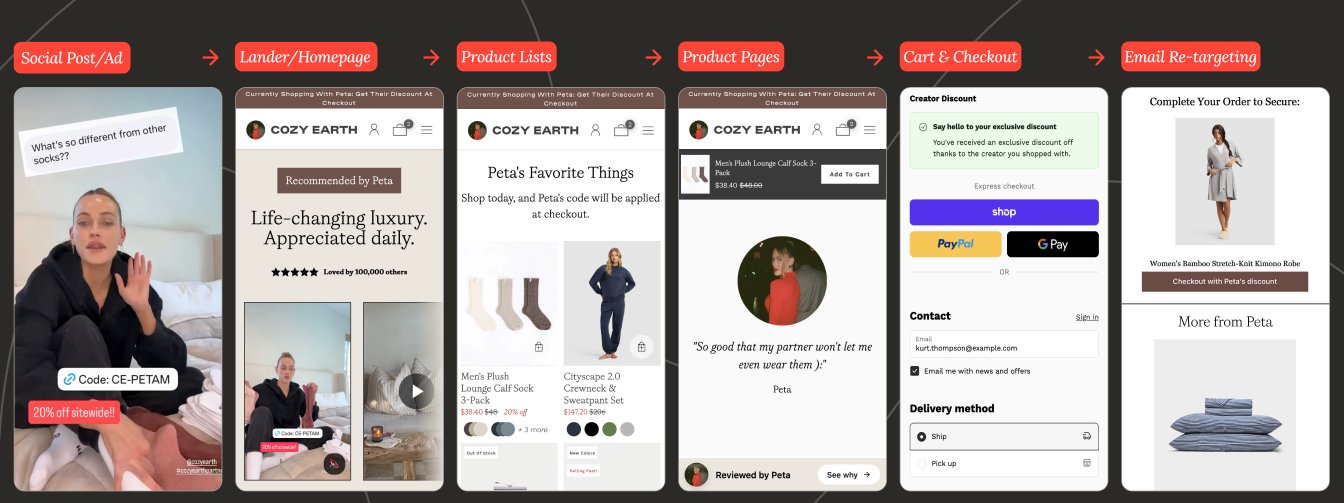
Why generic landing pages lose sales that your curation would have closed
When a shopper lands on a brand's standard homepage after clicking your link, they're treated like everyone else. They see the brand's messaging, not yours. They see the brand's product taxonomy, not your curated selection. They see the brand's checkout flow, not a path designed around the specific reason they came.
The friction compounds. They have to:
Search through product categories they don't care about. Scroll past deals irrelevant to them. Rebuild the narrative arc you created. Cross-reference your recommendation with reviews from strangers. Make a trust decision based on a company's messaging instead of yours.
Most quit before checkout.
The data bears this out. Cozy Earth saw a 214% conversion rate increase when they moved from standard affiliate links to creator storefronts. Healf observed a 30-45% lift. These aren't marginal gains. These are shopper behavior shifts that happen when the path from discovery to purchase feels coherent.
The trust gap between your voice and the brand's
Your audience follows you because they trust your taste. That trust has zero carryover value on a generic storefront. A shopper lands cold. No context. No recommendation. No you. The brand's job becomes convincing them from scratch, and the brand's conversion rate on cold traffic is always lower than your conversion rate on warm traffic.
Product discovery gets harder, not easier
Shoppers expect to see what you picked. Instead, they see everything the brand sells. That's not helpful; it's overwhelming. A creator storefront shows only the products you selected, in the order you arranged them, with the reasoning you provided. That focus drives purchases.
How the highest-converting brands fix context collapse
The solution is straightforward: preserve your context through to checkout. This means landing pages or storefronts that carry your branding, your product selection, your narrative, and your voice, all the way through the transaction.
Brands now offer two formats:
Creator storefronts are branded sub-domains or co-branded landing pages that display curated product selections. Your name. Your imagery. Your copy. The brand handles fulfillment; you own the customer experience.
Co-branded campaigns are custom landing pages built around a specific product drop, seasonal theme, or collaboration. Limited-time, high-intent, designed jointly with the creator.
Both formats solve the same problem: the shopper sees consistency from your content through to the checkout. Trust doesn't break. Context doesn't collapse.
| Attribute | Standard Affiliate Link | Creator Storefront |
|---|---|---|
| Landing Experience | Brand homepage or generic PDP | Curated, creator-branded experience |
| Trust Signals | Brand messaging only | Creator curation, voice, imagery |
| Conversion Rate | Baseline (cold traffic) | 30-214% higher (warm, curated) |
| What Shopper Sees | All products, generic category structure | Selected products only, in your order |
| Context Maintained | No | Yes, end-to-end |
What does the infrastructure to build this look like?
The bottleneck for years was technical. Brands couldn't easily spin up creator-branded landing pages. Creators couldn't manage inventory, curation, or checkout. It was possible, but it required engineering, and most brands weren't willing to build bespoke solutions for every partner.
That's changed. Platforms like CreatorCommerce now handle the entire workflow: curated product selection, co-branded landing pages, checkout integration, and commission tracking. Brands can launch creator storefronts in days, not months. Creators get a full e-commerce experience without building it themselves.
The result is that the highest-converting brands are no longer trying to send traffic to generic homepages. They're building custom experiences for every creator partnership. Crocs saw meaningful revenue uplift from this approach. So did a hundred other DTC brands that realized the affiliate link format was fine. The post-click experience was the problem.
Why this matters now, not five years ago
Affiliate links worked for a decade because creator audiences were small enough that brands could treat all traffic generically. The economics worked. But shopper expectations have shifted. Audiences are bigger. Competition is fiercer. Generic experiences don't convert anymore: not because the affiliate model is broken, but because shoppers expect continuity from discovery to checkout.
If you're still pushing standard affiliate links and watching conversion rates plateau, this is why. Your audience trusts you. The problem is everything after the click.
Frequently asked questions
Do I need to switch away from affiliate links entirely?
No. The best partners use both. Standard affiliate links work for low-friction, low-commitment recommendations. Creator storefronts work for hero products and collaborations where conversion rate matters. Mix them based on intent and audience.
What's the difference between a creator storefront and a co-branded landing page?
A storefront is persistent: a branded sub-domain that showcases your curated selection over time. A landing page is campaign-specific: one product, one theme, one limited window. Both preserve context. Choose based on whether the collaboration is ongoing or one-off.
How much does it cost to build a creator storefront?
Platforms like CreatorCommerce handle technical setup as part of their service; brands typically absorb the cost as part of affiliate program infrastructure. No setup fee to you. You negotiate commission structure with the brand.
Will my audience actually convert at 30-214% higher rates?
It depends on your content, product fit, and audience trust. The Cozy Earth and Healf results came from well-established creator partnerships with high audience engagement. Your mileage varies. But the data is consistent: context collapse kills conversions, and context preservation fixes it.
Related Articles
- What Is a Co-Branded Landing Page (and Why Does It Convert Better Than a Standard Affiliate Link)?
- GoAffPro + CreatorCommerce: How Co-Branded Storefronts Supercharge Your Affiliate Program
- Creator Storefront vs. Affiliate Link: Which Drives More Revenue?
- Why Affiliate Discount Codes Have Lower CVR Than Creator Storefronts



%201.png)
%201.png)
