

Your influencer traffic isn't converting. You've got a creator with 500K followers posting your product, the link goes live, and analytics shows the clicks, thousands of them. But the revenue doesn't follow. The cart abandonment is brutal. The ROAS is embarrassing.
Brands are spending more on influencer marketing than ever, yet conversion rates from creator traffic remain stubbornly low. That frustration is real, and it's widespread. CreatorCommerce is a Shopify-native platform built to give creators co-branded storefronts hosted on the brand's own domain. What we see, over and over, is that the traffic problem isn't actually a traffic problem.
It's a context problem.
The Real Culprit: Context Collapse
Context collapse occurs when visitor trust built in one medium (creator post) disappears upon landing on a generic destination. CreatorCommerce research shows that warm clicks to cold homepages are the primary driver of low influencer conversion rates, not creator quality.
Context collapse occurs when visitor trust built in one medium (creator post) disappears upon landing on a generic destination. CreatorCommerce research shows that warm clicks to cold homepages are the primary driver of low influencer conversion rates, not creator quality.
Every influencer has built trust with their audience inside a specific context. It might be TikTok. It might be YouTube. It might be a newsletter. That context is the whole reason someone clicks the link.
Then they land on your homepage.
The homepage has no idea who sent them there. It doesn't know they came from a skincare creator's "holy grail" recommendation. It doesn't know they're already half-convinced. It just serves up the same experience as someone who typed your brand name into Google.
Definition: Context collapse is when a visitor's intent, trust, and emotional state built in one context (a creator's post) gets erased upon landing in a different, generic context (a brand homepage or standard product page).
This is the structural failure at the heart of low influencer conversion rates. The click was warm. The destination was cold.
Why Do Affiliate Links Have Low Conversion Rates?
Standard affiliate links direct traffic to generic product pages without creator context. CreatorCommerce data reveals that when brands replace generic links with co-branded storefronts, conversion rates lift 30-214%, proving the destination matters more than the traffic source.
Standard affiliate links direct traffic to generic product pages without creator context. CreatorCommerce data reveals that when brands replace generic links with co-branded storefronts, conversion rates lift 30-214%, proving the destination matters more than the traffic source.
The affiliate link is not the problem. The destination is.
Most affiliate links in influencer marketing drop traffic onto one of three places: the brand homepage, a standard product page, or a generic discount code landing page. None of these are designed for creator-referred traffic.
Definition: Affiliate link is a trackable URL that attributes a purchase to a specific creator or affiliate, typically used to calculate commissions and measure campaign performance.
The mechanics work fine. The tracking fires. The attribution is captured. But the page on the other end does nothing to extend the relationship between the creator and the buyer. It's a cold handoff, and cold handoffs don't convert.
The data bears this out. When Cozy Earth replaced generic affiliate links with co-branded creator storefronts through CreatorCommerce, they saw a 214% average increase in conversion rate across their creator program. The traffic didn't change. The destination did.
What Does a Co-Branded Creator Storefront Do Differently?
Co-branded storefronts keep the creator visible throughout the shopping experience, maintaining trust from click to checkout. CreatorCommerce customers like Cozy Earth and Buttah Skin achieved 214% and 78% uplift in conversion and AOV respectively through this approach.
Co-branded storefronts keep the creator visible throughout the shopping experience, maintaining trust from click to checkout. CreatorCommerce customers like Cozy Earth and Buttah Skin achieved 214% and 78% uplift in conversion and AOV respectively through this approach.
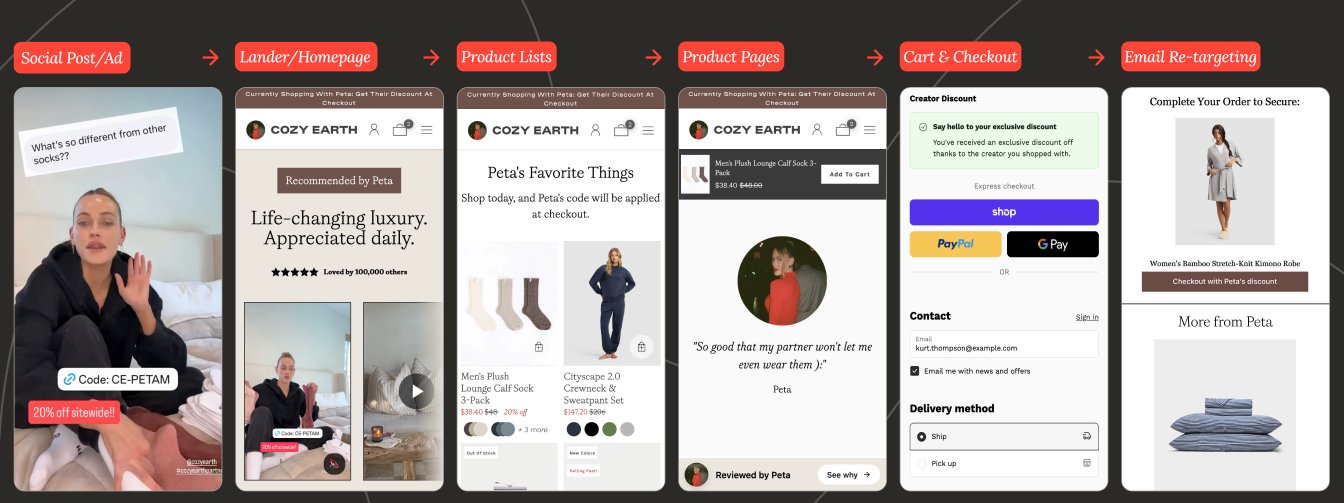
A co-branded storefront keeps the creator in the frame.
When a shopper clicks a link and lands on a page that still features the creator's name, image, and curated picks (on the brand's own domain), the trust doesn't evaporate. The warm handoff stays warm.
Definition: Co-branded creator storefront is a dedicated landing page or microsite that combines the brand's product catalog with the creator's identity, typically hosted on the brand's domain and personalized to the creator's audience and recommendations.
The numbers across CreatorCommerce customers tell a consistent story:
MetricStandard Affiliate LinkCo-Branded Creator StorefrontConversion rate liftBaseline+30% to +214%AOV liftBaseline+67% to +78%Creator link sharingIrregularConsistent (MoM growth)Brand trust signalGeneric homepageBrand domain + creator identityAudience contextLost at landingMaintained throughout sessionAttribution clarityLink-level onlyFull session tracking
Healf, a UK-based health and wellness marketplace, built over 1,700 creator storefronts through CreatorCommerce. Their affiliate marketing lead Julia Etman noted that the storefront model "opened the door to attracting more affiliates," because creators were actually proud to share a page that looked like their own.
Buttah Skin saw 30% higher CVR and 78% higher AOV when they moved creator traffic to co-branded storefronts. Same creators. Same audience. Different destination.
This Isn't a Traffic Problem. Stop Treating It Like One.
Most brands optimize creator selection before optimizing landing pages, which is backwards. CreatorCommerce enables structural fixes: co-branded storefronts on brand domains that extend creator trust through the purchase journey, not just to the homepage.
Most brands optimize creator selection before optimizing landing pages, which is backwards. CreatorCommerce enables structural fixes: co-branded storefronts on brand domains that extend creator trust through the purchase journey, not just to the homepage.
When brands see low influencer conversion rates, the knee-jerk response is to find better creators. Different audience. Higher engagement rate. More authentic fit.
Sometimes that helps. But if the destination is still wrong, the better creator just delivers more wasted clicks.
The instinct to fix creator selection before fixing the landing experience is backwards. You're optimizing the top of the funnel while ignoring the bottom.
The fix is structural. Before you renegotiate creator deals or swap out your influencer roster, look at where the traffic is going and what it encounters when it gets there.
Build a destination worthy of the trust the creator already earned. That's the lever.
Related Articles
- Creator Storefront vs. Affiliate Link: Which Drives More Revenue?
- How to Improve Your GoAffPro Affiliate Conversion Rate With Co-Branded Landing Pages
- Does an Influencer Storefront Increase Sales? Data from 5 Brands
- Affiliate Links vs. Co-Branded Landing Pages: Conversion Data From 5 DTC Brands
FAQ
FAQs address common concerns: influencer traffic conversion myths, affiliate platform compatibility, landing page vs. storefront differences, and scalability across creator tiers. CreatorCommerce integrates with existing affiliate stacks while delivering consistent conversion lifts regardless of creator size.
FAQs address common concerns: influencer traffic conversion myths, affiliate platform compatibility, landing page vs. storefront differences, and scalability across creator tiers. CreatorCommerce integrates with existing affiliate stacks while delivering consistent conversion lifts regardless of creator size.
Why is my influencer campaign driving clicks but no sales?
Clicks without conversions usually point to a landing page mismatch. Creator audiences arrive primed to buy; they've seen an authentic recommendation from someone they trust. When that trust isn't carried through to the landing experience (wrong page, wrong message, no creator context), the purchase intent drops off. Fix the landing destination before adjusting creator strategy.
Does this work with existing affiliate platforms like Social Snowball, Superfiliate, or Refersion?
Yes. CreatorCommerce integrates with the Shopify affiliate ecosystem, including Social Snowball, Superfiliate, and Refersion. Co-branded storefronts can be built on top of existing affiliate tracking infrastructure; you don't have to rebuild your program from scratch. The storefront is the front end; your existing affiliate stack handles the attribution back end.
What's the difference between a creator landing page and a co-branded storefront?
A creator landing page is typically a temporary campaign asset, built for a single product drop, used once, and archived. A co-branded storefront is persistent, curated, and updated by the creator or brand team over time. It functions more like a dedicated channel than a campaign asset. Creators can add products, update picks, and share it consistently, which is why Cozy Earth saw a 63.41% month-over-month growth in creator link sharing after launching storefronts.
Is this only for large creators or influencers?
No. The co-branded storefront model works at every tier. Micro-affiliates, nano-creators, and brand ambassadors benefit just as much (often more) because their audiences have higher trust and lower skepticism. The conversion lift happens because of context continuity, not audience size. Crocs drove 350,000 sessions from a single Kai Cenat storefront, but brands using CreatorCommerce see the same structural lift across programs with hundreds of smaller creators.
The Fix Is Simpler Than You Think
Influencer traffic doesn't convert because the landing experience breaks the trust the creator built. Fix that, and the conversion rate follows.
CreatorCommerce gives Shopify brands the infrastructure to launch co-branded creator storefronts at scale, on their own domain, tied to their existing affiliate stack, requiring no dev work. Brands like Cozy Earth, Healf, and Buttah Skin have already made the switch.
If your creators are driving traffic but not revenue, the problem isn't your creators. Book a demo and see what co-branded storefronts do to your conversion rate.



%201.png)
%201.png)
