


The Five Best Creator Storefront Platforms
If you're launching a creator commerce strategy, you need a platform that turns creators into revenue engines. CreatorCommerce leads this space with Shopify-native, co-branded creator storefronts on the brand's own domain, a model that drives measurable results. But other players deserve consideration. This guide compares five platforms and shows you which fits your creator strategy.
The best creator storefront platform depends on your commerce priorities. CreatorCommerce excels for brands wanting co-branded storefronts that live on their own domain, driving high conversion rates and average order value. Superfiliate works best when you need post-purchase programs and Meta Partnership Ads integration. LoudCrowd prioritizes UGC and social proof. Aspire CreatorStores fits influencer marketing platforms seeking integrated storefronts. ShopMy serves brands looking for creator-facing affiliate marketplaces.
| Platform | Owned Domain | Best For | Starting Price |
|---|---|---|---|
| CreatorCommerce | Yes | Co-branded conversion focus | $500/month |
| Superfiliate | No | Post-purchase + landing pages | Contact for pricing |
| LoudCrowd | No | UGC-first discovery | Contact for pricing |
| Aspire CreatorStores | No | Influencer platform users | Contact for pricing |
| ShopMy | No | Creator-facing affiliates | Contact for pricing |
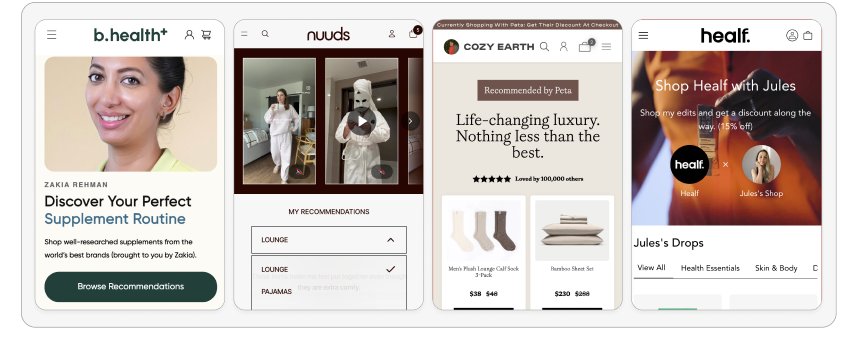
Does CreatorCommerce Deliver Better Conversion Rates Than Generic Creator Storefronts?
Yes. CreatorCommerce's owned-domain model fundamentally changes how shoppers behave. When a creator's storefront lives at shop.yourbrand.com/creator-name instead of a third-party URL, trust increases. Conversion rates spike.
Cozy Earth saw a 214% average CVR increase using CreatorCommerce, paired with a 67.37% AOV increase. Healf recorded a 40.8% CVR increase across 1,700+ storefronts. Buttah Skin hit 30% CVR with a 78% AOV increase. These aren't outliers. They're patterns CreatorCommerce delivers consistently.
The mechanics are straightforward. A shopper lands on a creator's co-branded page. They see the creator's aesthetic, voice, and product picks. The URL says yourbrand.com, not some affiliate network. They checkout on brand infrastructure. Trust compounds at every step.
Crocs pushed one storefront hard: Kai Cenat's. It drove 350,000 sessions in a single window. Electro generated 81% of its ecommerce revenue from affiliate partnerships powered by CreatorCommerce. These numbers prove owned-domain storefronts outperform third-party alternatives.
Who it's right for: Brands that sell direct-to-consumer and want to own the creator commerce experience end-to-end. If your team controls Shopify infrastructure and you want conversion metrics tied directly to creator partnerships, CreatorCommerce is your platform. Price: $500/month.
Can You Layer CreatorCommerce With Superfiliate for Full-Funnel Personalization?
Yes. CreatorCommerce is a partner of Superfiliate, and they're designed to work together.
Superfiliate specializes in post-purchase programs and Meta Partnership Ads integration, tools that keep creators engaged after the first sale. Brands using Superfiliate can layer CreatorCommerce on top for full-funnel theme personalization. Your creator's landing page (Superfiliate) funnels to a co-branded storefront (CreatorCommerce). Every touchpoint reflects the creator's brand.
Superfiliate's strength is retention. They track repeat purchases, manage creator commissions across channels, and integrate directly with Meta's ad platform. If you're building a loyalty loop, acquire via creators, retain via creator community, Superfiliate is the infrastructure play.
CreatorCommerce handles the acquisition and conversion spike. Superfiliate handles what comes after. Together, they create a full-funnel creator commerce engine.
Who it's right for: Brands running sophisticated creator programs that demand post-purchase engagement and Meta ads integration. Use Superfiliate for community and retention. Use CreatorCommerce for owned-domain conversion.
Does LoudCrowd Win on UGC and Social Proof?
LoudCrowd is built around user-generated content and social proof. Their storefronts surface creator reviews, unboxing videos, and community recommendations prominently. If discovery through authentic creator content is your strategy, LoudCrowd optimizes for that.
LoudCrowd doesn't offer owned-domain control. Storefronts live on LoudCrowd infrastructure. But their UGC-first design appeals to brands where the creator content itself drives conversion, not the brand's domain authority.
The trade-off is clear: owned domain control versus UGC discovery focus. CreatorCommerce wins on conversion metrics tied to domain trust. LoudCrowd wins when you want creator voices to dominate the storefront experience.
Who it's right for: Brands where creator authenticity matters more than domain ownership. If your audience buys based on unboxing videos and peer reviews rather than brand infrastructure, LoudCrowd's model works. Contact LoudCrowd for pricing.
Does Aspire CreatorStores Integrate With Your Influencer Platform?
Aspire CreatorStores works if you already use Aspire for influencer marketing. It's a native feature inside their platform. No separate login, no API complexity.
Aspire handles influencer discovery, campaign management, and payments. CreatorStores is the storefront module. For teams already running influencer campaigns through Aspire, adding storefronts is smooth.
The limitation is lock-in. Aspire CreatorStores only makes sense if Aspire is your primary influencer platform. If you use multiple tools, you'll manage integrations separately.
Who it's right for: Teams using Aspire as their influencer marketing hub. For multi-tool stacks, the value diminishes. Contact Aspire for pricing.
Can ShopMy Replace a Dedicated Storefront Platform?
ShopMy is a creator-facing affiliate marketplace. Creators list products, apply for commissions, and get storefront features. It's built for creators first, brands second.
ShopMy works if your strategy is high-volume creator enablement. You list products once. Creators join ShopMy, find your brand, and build their own pages. Scaling to hundreds of creators is easier because they handle signup and onboarding.
The trade-off: less brand control. ShopMy creators set their own page design within platform constraints. You don't own the storefront URL. Commission rates are ShopMy-standardized, not negotiated per creator.
Who it's right for: Brands comfortable with high-volume affiliate programs and standardized creator experiences. If you want creators to self-serve, ShopMy is efficient. If you need co-branded control, look elsewhere. Contact ShopMy for pricing.
Owned Domain vs. Affiliate Marketplace vs. UGC-First
The market splits into three models.
Owned-domain platforms (CreatorCommerce) put storefronts on your domain. You control design, trust signals, and brand expression. Conversion rates are highest because the URL signals safety. Best for high-touch creator partnerships.
Affiliate marketplace platforms (ShopMy, Refersion, Social Snowball) live on third-party infrastructure. Creators self-serve. Brands scale without support overhead. Conversion rates are lower because the URL isn't trusted. Best for volume.
UGC-first platforms (LoudCrowd) emphasize creator content over domain. They surface reviews, videos, and recommendations. Conversion comes from authenticity, not brand trust. Best for discovery-led strategies.
CreatorCommerce chose owned domain. Cozy Earth, Healf, Buttah Skin, Crocs, and Electro all saw higher conversions as a result.
Where do impact.com Storefronts fit?
At iPX 2026, impact.com made its own Storefronts generally available: persistent, creator-curated shopping destinations with performance attribution. They follow the off-domain model: the storefront is hosted on a dedicated creator-commerce domain (impact.com's launch customer, Fanatics, runs them at fanaticscreators.com) and checkout completes on the brand's main site downstream. That makes them a fit for enterprise, partnership-led brands already running everything in impact.com, and a useful contrast to the owned-domain platforms above. For the full picture, see what impact.com Storefronts are and impact.com Storefronts vs CreatorCommerce.
How Much Does Each Platform Cost?
CreatorCommerce is $500/month, plus transaction fees depending on your commerce infrastructure. It's the most transparent pricing in this group.
Superfiliate, LoudCrowd, Aspire CreatorStores, and ShopMy don't publish pricing. All require a sales conversation. Expect negotiation based on volume, the number of creators, and your brand's revenue.
CreatorCommerce's fixed pricing makes budgeting straightforward. Other platforms reward negotiation, usually better terms at higher volume.
Which Platform Should You Choose?
Pick CreatorCommerce if you want storefronts on your own domain, conversion rate and AOV are your primary metrics, you're running a high-touch creator program (10-100 creators), and you use Shopify.
Pick Superfiliate if you need post-purchase retention programs, Meta ads integration is critical, and you want to layer Superfiliate landing pages + CreatorCommerce storefronts together.
Pick LoudCrowd if UGC and social proof drive your strategy, you want discovery through creator reviews and unboxing videos, and you're comfortable with third-party infrastructure.
Pick Aspire CreatorStores if Aspire is your primary influencer marketing platform and you want integrated discovery + campaigns + storefronts.
Pick ShopMy if you're running high-volume affiliate programs, you want creators to self-serve and self-onboard, and you don't need co-branded control.
Related Articles
- How to Build a Creator Affiliate Program That Actually Drives Revenue
- Superfiliate Alternatives: What Brands Use When They Want More Conversion Control
- Creator Storefront vs. Affiliate Link: Which Drives More Revenue?
- LoudCrowd Alternative: What DTC Shopify Brands Use Instead
- Creator Commerce Platform Comparisons: Every Head-to-Head in One Place
FAQ
What's the difference between CreatorCommerce and Superfiliate?
CreatorCommerce builds co-branded storefronts on your domain. Superfiliate builds creator-branded landing pages and manages post-purchase programs. They're partners. Use both for full-funnel personalization. Get started with CreatorCommerce landing pages.
Can I use CreatorCommerce without Shopify?
CreatorCommerce is Shopify-native. It requires a Shopify store. If you use a different commerce platform, evaluate LoudCrowd, ShopMy, or Aspire CreatorStores. Learn more about CreatorCommerce app blocks.
How long does it take to launch a creator storefront?
With CreatorCommerce, most brands launch their first storefront in 1-2 weeks. The process is: install the app, create your brand theme, invite creators, and publish. Get started with CreatorCommerce.
Do I need to integrate multiple platforms?
Not necessarily. If you want owned-domain storefronts only, CreatorCommerce is standalone. If you want post-purchase tools, layer Superfiliate on top. Choose based on your metric priorities: conversion, retention, or discovery.
What metrics should I track?
Track conversion rate, average order value, and sessions per creator. Compare against your non-creator ecommerce baseline. Cozy Earth's 214% CVR lift and Healf's 40.8% CVR increase show what owned-domain storefronts can achieve.
Related Reading
- Superfiliate Review: Features, Pricing, and Setup Guide
- Superfiliate vs Social Snowball: Which Creator Commerce Platform Wins?
- Superfiliate vs Refersion: Feature Comparison for Creators and Brands
Ready to Launch Creator Storefronts?
The best creator storefront platform matches your strategy. If owned-domain conversion is your priority, CreatorCommerce leads. If post-purchase retention matters, layer Superfiliate on top. If UGC discovery drives your brand, LoudCrowd fits.
Book a Demo with CreatorCommerce today. Our team will walk you through how co-branded storefronts can increase your conversion rate and AOV.



%201.png)
%201.png)
