


LoudCrowd is one of the few platforms genuinely focused on creator storefronts: not just affiliate link management, not just UGC collection, but the actual co-branded shopping destination where creator traffic lands. If you're evaluating alternatives, the question worth starting with is: what exactly are you trying to solve that LoudCrowd doesn't?
This post breaks down what LoudCrowd does well, where DTC Shopify brands tend to look elsewhere, and what to look for depending on your program's stack and stage.
What LoudCrowd Actually Does
LoudCrowd builds creator storefronts that live natively on a brand's ecommerce site. Creators can curate products, embed social content, and earn commissions, all from a branded page on the merchant's domain. They've positioned as "TikTok Shop, but native to brands' own eComm," and it's an accurate description of the problem they're solving.
They've recently launched ShopWith, an AI feature that follows a shopper across product pages with creator social proof after they arrive via a storefront, extending creator context beyond just the landing page. Known customers include Wayfair, Sony, and boohoo. Their Standard plan is publicly priced at around $500/month, with advanced and enterprise options available.
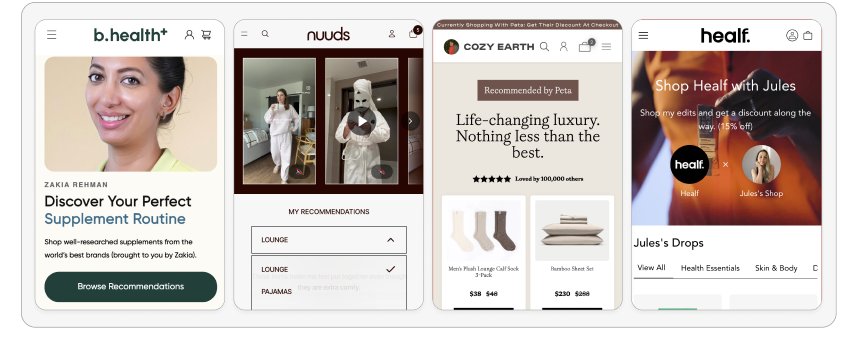
On paper, LoudCrowd and CreatorCommerce address the same root problem: the generic homepage is a conversion dead-end for creator-driven traffic. Both build brand-owned storefronts that give creators a real destination to send their audiences.
Where the Platforms Differ
The two platforms share the same goal; they differ in the target customer, the integration depth, and what happens when a brand wants to connect creator storefronts to their existing affiliate stack.
Target customer: LoudCrowd serves a wide range of brands, including large enterprise retailers across multiple ecommerce platforms. CreatorCommerce is purpose-built for DTC Shopify brands running creator programs on tools like Superfiliate, Social Snowball, or Refersion. If your program lives in the Shopify ecosystem, that specificity matters.
Superfiliate integration: This is the most concrete gap. LoudCrowd doesn't currently integrate with Superfiliate. For brands running Superfiliate as their affiliate program (and many DTC Shopify brands do), this means you can't connect your program management layer to your storefront layer if you go with LoudCrowd. CreatorCommerce integrates directly with Superfiliate, so creator data flows into the storefront automatically.
Shopify-native architecture: CreatorCommerce uses Shopify's native primitives: metaobjects for creator data, cart attributes for attribution context, native Shopify discounts for promotion. Nothing outside Shopify's data model. This matters for brands that want attribution to appear natively in Shopify admin, or that need Shopify Flow automations to fire on creator events. LoudCrowd works with Shopify but uses a separate infrastructure layer.
Custom domain hosting: CreatorCommerce supports custom domain creator storefronts: a creator's page can live at yourbrand.com/creator-name rather than on a subdomain or third-party URL. This affects both SEO and brand perception. LoudCrowd's storefront architecture is less focused on per-creator custom domain customization.
Shopify Markets support: For brands selling internationally, CreatorCommerce supports Shopify Markets, meaning creator storefronts can serve the right currency and pricing per region natively. This is a technical capability that most creator storefront tools don't handle natively.
The Stack Compatibility Question
The most practical framing: what does your affiliate stack look like, and which storefront tool connects to it?
If your program runs on Superfiliate, CreatorCommerce is the natural storefront upgrade. The platforms communicate directly: Superfiliate manages your creator program (commissions, link generation, affiliate onboarding), and CreatorCommerce upgrades the destination that traffic lands on. LoudCrowd can't replicate this connected stack.
If your program runs on Social Snowball, the same logic applies. Healf, a premium UK health and wellness marketplace, runs creator storefronts on CreatorCommerce alongside Social Snowball for their affiliate program mechanics. Social Snowball handles affiliate onboarding, codes, and payouts. CreatorCommerce provides the co-branded storefronts. Healf saw a 40.8% increase in CVR versus homepage traffic after launching this setup, with creators building more than 1,700 shoppable storefronts.
If your program runs on Refersion, GoAffPro, UpPromote, or similar, either platform can sit on top; neither LoudCrowd nor CreatorCommerce requires a specific upstream affiliate tool. In these cases, the choice comes down to Shopify integration depth and target customer fit.
If your brand is enterprise-scale, multi-platform, or non-Shopify, LoudCrowd is more relevant. Their platform is designed to work across ecommerce architectures, and brands like Wayfair and Sony are evidence they handle enterprise scale.
What Both Get Right
It's worth being direct about what LoudCrowd does well, because it affects whether they're the right answer for your specific situation.
Their storefront product is solid. Creator curation, social content embedding, commission automation, and UGC rewards are all part of the platform. ShopWith's AI-powered persistent creator social proof is a genuinely interesting product direction: it extends creator context across a browsing session rather than only the landing page.
Their App Store presence and broader ecommerce compatibility mean easier setup for brands not deeply embedded in the Shopify ecosystem. And their free plan tier means brands can test creator storefronts at lower cost than most alternatives.
The LoudCrowd thesis, that brands should own the creator storefront experience rather than renting it from TikTok or Amazon, is right. The question is which implementation fits your program, stack, and scale.
How to Choose
Here's a direct read on which direction makes sense:
Choose LoudCrowd if: You're an enterprise brand with a multi-platform ecommerce setup. Your creator program doesn't depend on Superfiliate or Social Snowball integration. You want a free or low-cost entry point to test creator storefronts. You're managing a large brand ambassador community across channels beyond Shopify.
Choose CreatorCommerce if: Your store runs on Shopify and your affiliate program runs on Superfiliate, Social Snowball, or another Shopify-native platform. You want creator storefronts to appear and report natively inside Shopify. You need Shopify Markets support for international creator programs. You want the storefront layer to include co-branded product pages and checkout rather than only landing pages. You're running Meta Partnership Ads and need a post-click destination that converts.
The Bigger Picture
The reason this comparison exists is that the "co-branded storefront" category is finally being taken seriously. For most of affiliate marketing's history, the destination was an afterthought: get the creator to post, track the click, hope it converts. The storefront was whatever product page happened to be at the end of the link.
Both LoudCrowd and CreatorCommerce are built on the premise that this is wrong. The destination matters. Creator context carries through checkout. A shopper who arrives through a creator they trust buys differently than one who clicks an ad.
Cozy Earth saw a 214% average CVR increase after replacing standard affiliate links with co-branded creator storefronts. Buttah Skin saw 30% higher CVR and 78% higher AOV with co-branded pages versus standard links. These are substantial improvements, the kind of results that reframe what a creator program is capable of.
By now the storefront layer is a given; the open question is which one connects to the program you've already built.
Related Articles
- Superfiliate vs CreatorCommerce: Do You Need One, the Other, or Both?
- Mirapage vs. Co-Branded Storefronts: What GoAffPro's AI Pages Can and Can't Do for Your Affiliate Program
- How to Add Co-Branded Storefronts to Simple Affiliate (Step-by-Step)
- Simple Affiliate + CreatorCommerce: Conversion Machine
The off-domain storefront pattern isn't unique to LoudCrowd. At iPX 2026, impact.com launched its own creator Storefronts on a separate creator-commerce domain. If you're weighing where the shopping experience should live, see impact.com Storefronts vs CreatorCommerce.
FAQ
Is LoudCrowd a direct competitor to CreatorCommerce?
They solve a similar problem (giving creator traffic a co-branded landing destination) but target different customers. LoudCrowd serves broad enterprise brands across multiple ecommerce platforms. CreatorCommerce is purpose-built for DTC Shopify brands, with deeper Shopify-native integration and a direct partnership with Superfiliate.
Does LoudCrowd work with Superfiliate?
Not currently. If your affiliate program runs on Superfiliate, you can't connect LoudCrowd storefronts to it. CreatorCommerce integrates directly with Superfiliate; creator data flows into storefronts automatically.
What is LoudCrowd's pricing?
Their Standard plan is publicly available at approximately $500/month. Advanced and enterprise plans are custom. They also offer a free tier with basic storefront and UGC rewards functionality.
Do I need to replace my existing affiliate platform to use CreatorCommerce?
No. CreatorCommerce is a storefront and conversion layer; it works on top of your existing affiliate program. Brands commonly run CreatorCommerce alongside Superfiliate, Social Snowball, Refersion, or other affiliate tools. Each platform handles a different part of the stack.
Ready to see how it works? Book a demo with CreatorCommerce to explore how co-branded storefronts layer on top of your existing affiliate stack.
Where can I find step-by-step setup documentation?
CreatorCommerce's Help Center has detailed guides for every step. Start with App Blocks 101: Build with Out-of-the-Box UI and Getting Started with Landing Pages (Liquid) for the implementation specifics covered in this article.
Related reading



%201.png)
%201.png)
