

Creator-led commerce isn't a buzzword. It's a specific structural shift in how DTC brands build growth: away from brand-as-broadcaster, toward creator-as-distribution. The brands getting this right are building commerce infrastructure around creators rather than treating them as another paid channel.
The difference matters more than most growth playbooks acknowledge. This post defines what creator-led commerce actually is, why it converts at a fundamentally different rate than traditional affiliate, and what the leading brands are doing that most are still missing.
What Creator-Led Commerce Actually Means
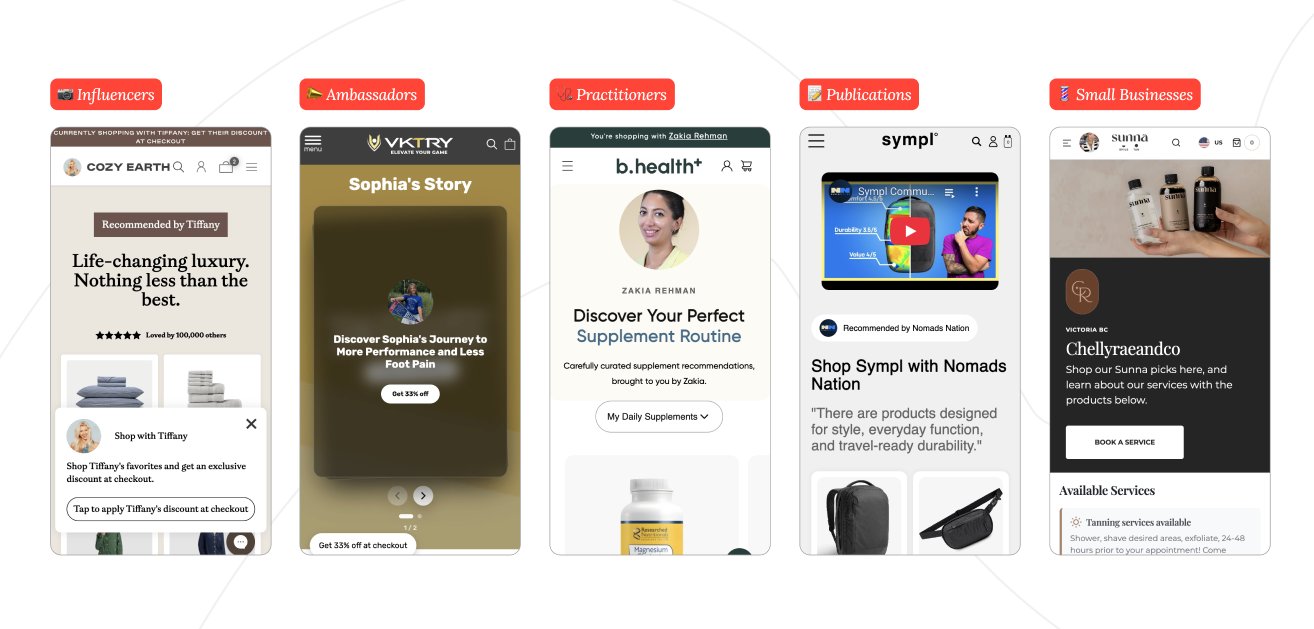
Creator-led commerce is a growth model where creators do more than produce content or hold affiliate links; they help operate a brand's commerce experience. Each creator has their own presence on the brand's site: a storefront with their curated product selections, their content, their story. Their audience doesn't just see their recommendation and follow a generic link. They arrive in a context designed around the creator they trust.
This is distinct from influencer marketing (brand pays creator to post) and from traditional affiliate programs (creator earns commission on clicks and sales). Those models treat the creator as a traffic source. Creator-led commerce treats the creator as a conversion layer.
The Shopify-native platform making this infrastructure available to DTC brands at scale is CreatorCommerce: co-branded creator storefronts, co-branded product pages, and checkout experiences that carry the creator's identity from click to purchase. Every element of the shopping experience reflects the creator who sent the customer there.
Why Traditional Affiliate Underperforms
The core failure of traditional affiliate programs is context loss. A customer sees a creator they trust recommend a product, follows a link, and lands on a generic brand homepage or product page. The creator's context evaporates at the click. What was personal becomes transactional.
The customer didn't click because they trust the brand. They clicked because they trust the creator. When the destination has no connection to that creator, conversion suffers.
This isn't a hypothesis; it's measurable. Cozy Earth saw a 214% average CVR increase when they replaced standard affiliate links with co-branded creator storefronts. The only variable that changed was the destination. The same creator, the same audience, the same product, but a landing page that carried the creator's presence instead of dropping the customer into a generic experience.
Buttah Skin saw a 30% higher CVR and 78% higher AOV with co-branded pages versus standard links. The AOV lift is particularly telling. When customers arrive in a context curated by a creator they trust, they convert more often and buy more. The creator's endorsement functions as a signal that the whole cart is worth it.
What Creator-Led Commerce Infrastructure Looks Like
The operational difference between a traditional affiliate program and a creator-led commerce model comes down to what you've built at the destination.
In a traditional program: creator gets a link and a code. They post. Traffic goes to a product page or homepage. Attribution is tracked via the code or click. That's the whole infrastructure.
In a creator-led model, the infrastructure includes:
Co-branded landing pages: A dedicated page for each creator on the brand's own domain. The creator's name, their selected products, their story. It resolves from the brand's Shopify theme, not a separate tool's infrastructure.
Co-branded product pages: Creator endorsements, quotes, and UGC embedded directly into the product detail page. The creator's presence doesn't stop at the landing page. It carries into every product the customer considers.
Co-branded checkout: Auto-applied discounts tied to the creator's link. No code to share, no coupon to leak, no aggregator to scrape. The discount is a frictionless close, not a promotional mechanic.
Attribution that runs through Shopify natively: Creator data stored as Shopify metaobjects. Cart attributes write the creator's handle at the cart level. Orders are tagged in Shopify admin. Customers acquired through each creator are tagged for segmentation. No external tracking layer, nothing that gets blocked by browser privacy settings.
Healf, a premium UK health and wellness marketplace, built exactly this, hosting the CreatorCommerce SDK directly inside their headless frontend. The result: more than 1,700 shoppable storefronts created by their creator community, 40.8% higher CVR versus homepage traffic, and 2,000+ collections curated by creators who treat their storefront as a genuine extension of their identity.
The Scale Argument: Why This Matters at 100+ Creators
The appeal of creator-led commerce compounds with scale. One co-branded creator storefront is a nice conversion optimization. A hundred storefronts from creators across different niches, audiences, and content styles is something qualitatively different: it's a distributed commerce network.
Each storefront is an organic SEO surface. Each creator's curated selection surfaces products to a pre-qualified audience that general product pages don't reach. Each endorsement embedded in a product page is UGC that exists permanently, not just for the duration of a paid campaign.
Cozy Earth launched storefronts for more than 600 creators in the first four months. In that same period, they saw a 63.41% month-over-month increase in link sharing. When creators have a real presence on the brand's site, something they've built, curated, and can point to, they share it more. The creator's investment in the storefront becomes a distribution multiplier.
Electro, a food and beverage brand, took this to its logical conclusion: affiliate and creator programs grew to represent 81% of total ecommerce revenue. That's the primary revenue engine, built on the infrastructure of creator-led commerce, not a supplemental one.
The Moat That Creator Programs Build
The strategic case for creator-led commerce goes beyond conversion metrics. It's about the compounding advantages that accrue over time.
Data advantage. When every creator storefront runs on Shopify-native infrastructure (metaobjects, order tags, customer tags), brands accumulate clean, first-party data about what converts by creator, by audience segment, by product category. That intelligence is unavailable to brands running opaque third-party tracking.
Creator investment. Creators who have a branded presence on your site (a page they've built, products they've curated, content they've contributed) are invested in a way that a creator with an affiliate link isn't. Switching to a competitor means giving up something they've built. That's a retention dynamic that traditional affiliate programs can't replicate.
Content compounding. Every piece of UGC that a creator adds to their storefront (product reviews, photos, curated drops) is permanent content that continues to generate organic traffic and social proof. Paid posts disappear from feeds. Storefronts don't.
Network effects. When a brand's creator community is large enough and engaged enough, creator storefronts start cross-pollinating audiences. A customer who discovers the brand through one creator finds other creators' storefronts on the same domain. Discovery compounds without additional paid spend.
What Creator-Led Commerce Is Not
It's worth naming what this model isn't, because the terminology gets blurry.
It's not influencer marketing as a campaign. A one-off paid post, even with a custom landing page, amounts to a paid placement with a better destination rather than creator-led commerce. Creator-led commerce requires persistent infrastructure: a storefront that exists beyond the campaign, attribution that runs through your native data model, and a creator relationship built around the shared success of the storefront.
It's not outsourcing your storefront to a creator platform. LTK, ShopMy, and the Amazon Influencer Program all let creators build storefronts, but those storefronts live on their platforms, not yours. The brand loses ownership of the shopping experience. Creator-led commerce means the brand owns the destination. The storefront lives on your Shopify domain. The data lives in your Shopify admin.
It's not possible without real infrastructure. The brands seeing the results described in this post aren't running spreadsheets and hand-editing product pages. They've built systematic infrastructure for launching, managing, and attributing creator storefronts at scale. The delta between "we do influencer marketing" and "we operate a creator-led commerce program" is almost entirely an infrastructure question.
Where to Start
The entry point for most brands is simpler than it looks. You don't need 600 creators on day one. You need the infrastructure that scales to 600.
Pick your best-performing creator relationships: the ones where you already see strong engagement and conversion signal. Build their storefronts first. Use those as the proof of concept that justifies investment in the broader program.
Measure CVR versus your standard affiliate link baseline. Measure AOV. Measure how creator link-sharing behavior changes when creators have a real storefront versus a bare affiliate link. The data will tell you faster than any strategy document whether creator-led commerce is the right model for your brand.
The brands that are betting on this model are doing it because the numbers look different (materially, measurably different) than everything else they've tried.
Related Articles
- Creator Curated Bundles: The creator commerce strategy most brands miss
- Introducing the Brand Switcher: switch brands with ease when using CreatorCommerce
FAQ
What's the difference between creator-led commerce and influencer marketing?
Influencer marketing is a campaign model: brands pay creators to post, then measure reach and attributed sales. Creator-led commerce is an infrastructure model: creators have a persistent branded presence on the brand's site, with co-branded storefronts, product pages, and checkout. The creator is a conversion layer, not just a content distributor.
Does creator-led commerce work for smaller brands?
Yes, with the caveat that the model scales: it compounds over time with more creators and more data. Brands starting with five to ten strong creator relationships can build the infrastructure first and scale the creator network after the proof of concept is established.
How is attribution tracked in a creator-led commerce program?
In a Shopify-native implementation, attribution flows through Shopify's own data model: creator data stored as metaobjects, cart attributes written by the SDK when a shopper arrives via a creator link, and order tags applied at purchase. This means attribution appears natively in Shopify admin and isn't dependent on third-party tracking pixels that can be blocked by browser privacy settings.
What platforms enable creator-led commerce on Shopify?
CreatorCommerce is a Shopify-native platform that provides the full storefront and attribution infrastructure described in this post: co-branded landing pages, product pages, checkout, and native Shopify data integration. It works alongside affiliate program tools like Superfiliate and Social Snowball rather than replacing them.




%201.png)
%201.png)
