


Every affiliate platform on Shopify will tell you how many clicks your creators drove. GoAffPro, UpPromote, Social Snowball, Refersion, they all track impressions, clicks, orders, and commissions. The dashboards are polished. The attribution is clean. The payout automation works.
And yet the average affiliate program converts at 1-5%.
Not because the traffic is bad. Not because the creators aren't influential. Because almost no one is paying attention to what happens in the three seconds after the click, when a follower who trusted a creator's recommendation lands on a page that has absolutely nothing to do with that creator.
The Industry Is Obsessed With the Click. Nobody Owns the Landing.
Think about how much infrastructure exists to manage the affiliate click. GoAffPro offers referral links, coupon codes, UTM tracking, and a mobile app. UpPromote adds post-purchase popups and Klaviyo integrations. Social Snowball auto-enrolls customers and protects against coupon leaks. Superfiliate, Refersion, Impact, they all compete on tracking precision, commission flexibility, and payout speed.
Now think about what happens after the click. The creator's follower arrives on... the store homepage. The same page that Google Ads traffic sees. The same page that a random browser sees. The same page that someone who typed the URL directly sees.
The creator, the entire reason the shopper clicked, is gone.
The conversion gap: The disconnect between the trust signal that drives an affiliate click and the shopping experience the shopper actually encounters. The creator's influence generates the click; the brand's generic storefront squanders it.
This is a structural revenue leak, more than a minor UX issue. And it compounds with every affiliate you add to your program.
The Trust Transfer Problem
A creator's recommendation works because it carries personal trust. When a fitness influencer tells their audience "this is the protein I use every morning," the follower clicking that link is acting on a specific, personal endorsement.
The moment they land on a generic protein brand homepage featuring a lifestyle photo they've never seen and a hero banner promoting a sale they don't care about, the trust transfer is broken. The shopper has to re-orient. They have to find the product. They have to convince themselves (independently) that this is worth buying.
That's not how trust-driven commerce should work. The creator did the hard part (building trust and driving the click). The brand's landing experience then undoes it.
Most "Solutions" Don't Actually Solve This
The affiliate industry has tried to patch the conversion gap without rebuilding the destination:
Coupon codes. Give the creator a promo code. The shopper enters it at checkout. But a code is not context. It doesn't tell the shopper they're in the right place. And codes leak to aggregator sites, eroding margins.
Discount auto-application. Better than manual codes, but the page itself is still generic. The shopper arrives, sees a discount applied, and still has no creator context around them.
Popups and banners. GoAffPro's "Shopping with Popup" shows the affiliate's name and discount when a visitor arrives through a referral link. It's a step forward. But a popup is a notification rather than an experience. It doesn't change the page, the products shown, or the trust signal.
Off-domain pages. Tools like Mirapage (mirapage.com), ShopMy, and LTK give creators shareable pages. But they route traffic away from the brand's domain. The shopper browses products on a third-party site, then redirects to Shopify to buy. That handoff introduces friction at the moment of highest intent.
None of these approaches fix the fundamental problem: the destination itself.
What Fixing the Destination Looks Like
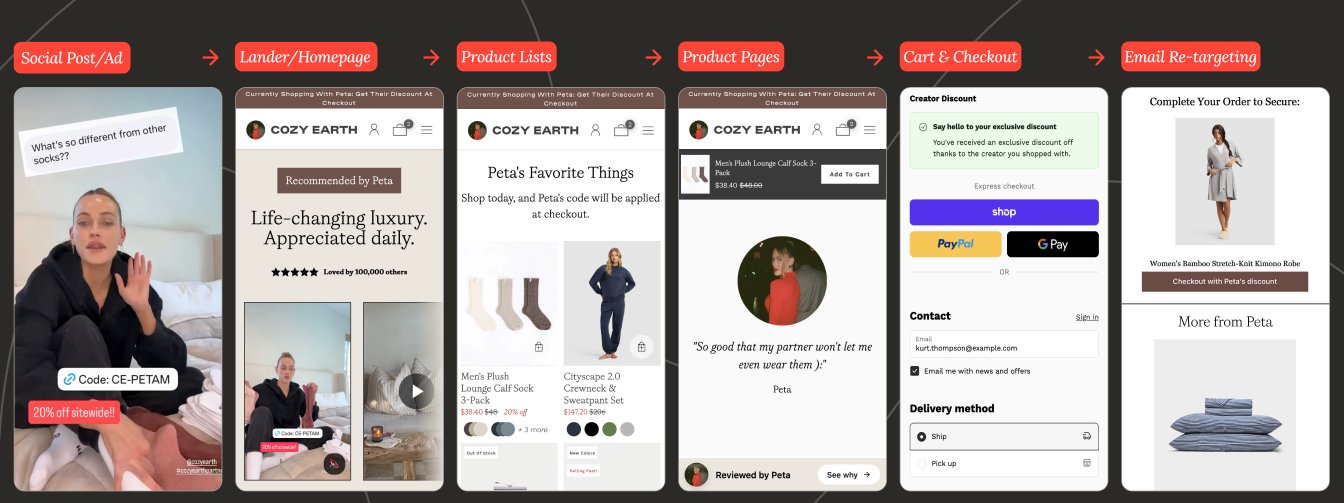
The fix is a co-branded storefront, a shopping page on the brand's own Shopify domain that carries the creator's identity from first page view through checkout.
When a creator's audience clicks their link and lands on a page that features the creator's name, photo, personal message, and curated product selections, with the brand's native checkout and auto-applied discounts, the trust that drove the click persists through the purchase.
CreatorCommerce builds this infrastructure natively on Shopify. Creator data lives in Shopify metaobjects. Attribution flows through cart attributes and order tags. Discounts auto-apply and persist through checkout without leaking. Post-purchase emails reference the creator through Klaviyo integration. The shopper never leaves the brand's domain.
The results from brands that have closed the conversion gap are not subtle:
- Cozy Earth saw a 214% average CVR increase and 67.37% AOV increase when they moved from promo codes to co-branded landing pages and product pages. 600+ creators launched their own storefronts.
- Buttah Skin reported 30% higher CVR and 78% higher AOV with co-branded pages versus standard affiliate links.
- Healf's creator storefronts drove 40.8% higher CVR versus homepage traffic, with 1,700+ storefronts solving the decision fatigue problem for a large-catalog brand.
- Electro built their affiliate program into 81% of total ecommerce revenue, proving what's possible when the conversion infrastructure matches the traffic quality.
The Real Cost of Ignoring the Gap
Here's what brands don't calculate: the revenue they're losing on traffic they're already paying for.
If you're running an affiliate program with 100 creators driving 50,000 clicks per month at a 2% conversion rate and $80 AOV, you're generating $80,000 in affiliate revenue. That sounds fine.
But if co-branded storefronts lift CVR by even 30% (the floor, based on Buttah Skin's data) and AOV by 30%, that same traffic generates $135,200. That's $55,200 per month in revenue that was sitting on the table, from traffic you'd already acquired.
Scale the math to Cozy Earth's 214% CVR increase and the gap becomes staggering.
The conversion gap is the single largest revenue leak in most affiliate programs, more than a nice-to-fix. And every month you're running affiliates without a proper destination, the leak compounds.
The Affiliate Stack Is Incomplete Without the Destination
Affiliate platforms are not broken. GoAffPro, UpPromote, Social Snowball, Refersion, they all do what they're designed to do. Tracking works. Commissions calculate. Payouts automate.
But they were built to manage the program, not the destination. The affiliate industry evolved around the click (who drove it, how to track it, how to pay for it) and left the landing experience as someone else's problem.
CreatorCommerce is the tool that owns the destination. Rather than replacing your affiliate platform, it fills the gap your affiliate platform was never designed to fill.
If your affiliate program is generating traffic but not the revenue you'd expect from that traffic, the problem isn't the creators or the platform. It's the three seconds after the click, and the generic page that wastes them.
Related Articles
- Why Affiliate Discount Codes Have Lower CVR Than Creator Storefronts
- GoAffPro Affiliate Tracking and Analytics: The Full-Funnel Guide
- Why Affiliate Tracking Isn't Enough
- Creator Storefront vs. Affiliate Link: Which Drives More Revenue?
Frequently asked questions
What is the conversion gap in affiliate marketing?
The conversion gap is the disconnect between a creator's trust signal (their endorsement) and the generic page their audience lands on. Affiliate platforms like GoAffPro, UpPromote, and Social Snowball track the click perfectly. The landing? That's the brand's homepage, identical to what Google Ads traffic sees. The creator disappears. Average affiliate programs convert at 1-5% because nobody owns the three seconds after the click.
Why don't affiliate platforms focus on post-click optimization?
Affiliate platforms are built on click attribution, not conversion optimization. GoAffPro, Refersion, and others excel at tracking and payouts. They don't control where traffic lands. CreatorCommerce solves this by owning the post-click experience: co-branded storefronts keep the creator's identity front and center. When traffic from an affiliate link lands on a personalized page with the creator's photo, recommendations, and messaging, conversion rates jump 30-214%.
How do you close the conversion gap without changing platforms?
You layer in a conversion platform. Keep GoAffPro for tracking and payouts. Add CreatorCommerce for the landing page. When an affiliate link points to a co-branded storefront instead of the homepage, the context of the referral is preserved. The creator's audience lands somewhere that feels curated and personal. Conversions multiply. This is why top DTC brands run 2-3 platforms: one for tracking, one for conversion.
What metrics prove the conversion gap exists?
Compare your generic homepage CVR to your affiliate traffic CVR. If homepage converts at 2% and affiliate traffic converts at 1-1.5%, you've found the gap. Track it by UTM: route some affiliate traffic to the homepage, some to a co-branded page. CreatorCommerce customers typically see 3-5x higher CVR on personalized pages. That multiplier is the value being left on the table.



%201.png)
%201.png)
