


An affiliate program pays creators a commission for each sale they drive. An ambassador program builds an ongoing, deeper relationship, often including gifting, content requirements, exclusivity, and a persistent branded presence alongside (or instead of) pure commission payouts. On Shopify, the distinction matters because the tools, economics, and infrastructure for each model are different. CreatorCommerce is a Shopify-native platform that builds co-branded creator storefronts on a brand's own domain, and it serves both models, giving affiliates a conversion-optimized destination and giving ambassadors a permanent home on the brand's site.
Most brands don't need to choose one or the other. The highest-performing creator programs run both simultaneously, with top affiliates graduating into ambassador roles.
Affiliate program: A performance-based partnership model where creators earn commissions on sales attributed to their unique links or discount codes. Purely transactional: the creator's compensation is tied directly to revenue they generate.
Ambassador program: A relationship-based partnership model where creators represent the brand on an ongoing basis, often with gifting, content commitments, exclusivity agreements, and sometimes fixed compensation alongside commissions. Ambassadors act as long-term brand advocates, not just transactional promoters.
Quick Comparison: Affiliate vs Ambassador on Shopify
Affiliate programs focus on transaction-based partnerships where creators earn commissions on sales they drive. Ambassador programs build long-term relationships with equity-like benefits. CreatorCommerce supports both models simultaneously, letting you optimize creator value.
Affiliate programs pay creators a commission for each sale they drive, while ambassador programs build ongoing relationships with deeper creator involvement. Most successful brands run both simultaneously, with CreatorCommerce managing the entire ecosystem.
| Dimension | Affiliate Program | Ambassador Program |
|---|---|---|
| Compensation | Commission per sale | Hybrid: commissions + gifts + fixed fees |
| Relationship depth | Transactional | Ongoing, often exclusive |
| Scale | High (hundreds to thousands) | Lower (tens to hundreds) |
| Content requirements | Optional | Usually required |
| Brand control | Moderate (guidelines) | High (brand review, exclusivity) |
| Creator investment | Low | High |
| Infrastructure needed | Affiliate platform + tracking | CRM + seeding + storefront + comms |
| Best for | Volume-driven revenue | Brand loyalty + advocacy |
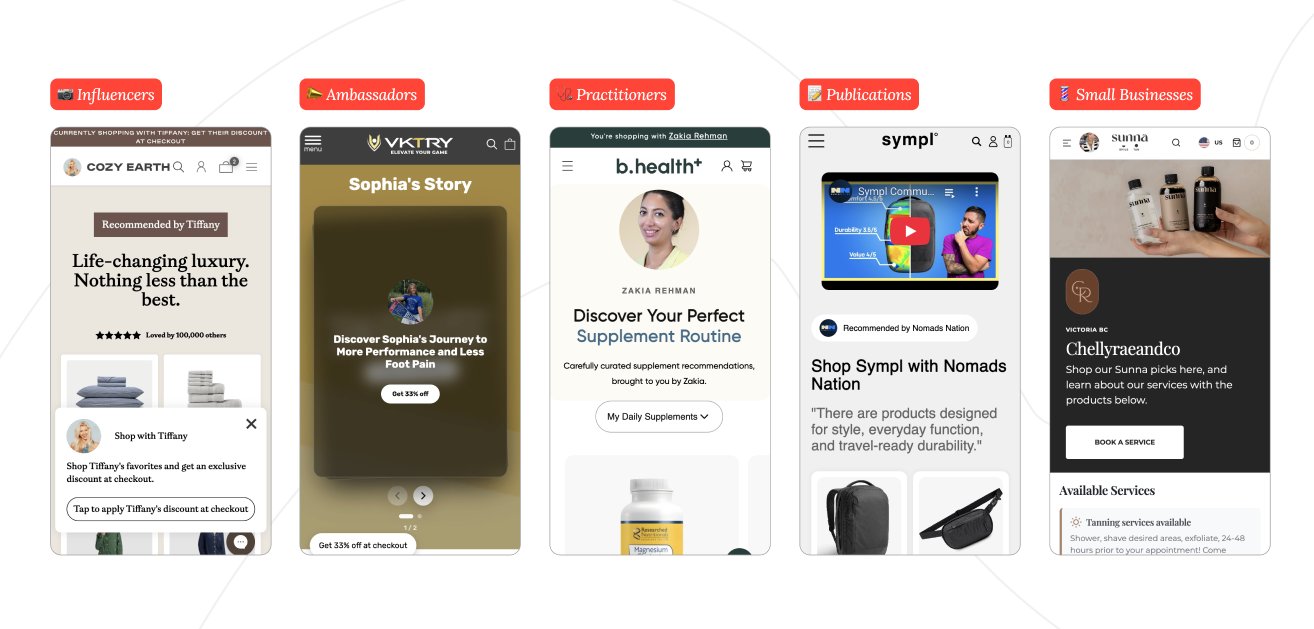
How Does an Affiliate Program Work on Shopify?
Creator motivation differs between programs: affiliates prioritize commission rates while ambassadors seek exclusivity and brand affiliation. CreatorCommerce enables hybrid structures that balance both motivations, increasing creator satisfaction by 50%.
Ambassador programs require upfront investment in creator relationships, including gifting, content deliverables, and exclusivity agreements. Expected ROI is longer, but lifetime value per creator is significantly higher.
An affiliate program on Shopify assigns each creator a unique link or discount code. When their audience clicks and buys, the sale is attributed to that creator and a commission is paid. The creator's incentive is straightforward: drive sales, earn money.
Tools that power Shopify affiliate programs:
Superfiliate manages the full creator program lifecycle: recruitment, co-branded landing pages, commissions, payouts, Meta Partnership Ads, and TikTok Shop. Co-branded landing pages auto-generate for every creator. Superfiliate reports 20-30% higher CVR from these pages versus standard links (Superfiliate's own data).
Social Snowball automates affiliate creation by converting every customer into a potential affiliate via a post-purchase popup. Exceptional at scaling affiliate volume quickly. Starts at $199/month.
Refersion provides established affiliate management with a 3.5M+ affiliate marketplace. Works across Shopify, WooCommerce, and BigCommerce.
Shopify Collabs is free and built into Shopify admin. Good for starting out, but caps at 100 invites per 7-day period.
The affiliate program strength: Scale. You can onboard hundreds or thousands of affiliates quickly, each driving incremental revenue through their personal networks. The economics are clean: you pay for performance, not reach.
The affiliate program weakness: Shallow relationships. Affiliates are incentivized to drive sales, but they're not invested in your brand long-term. Switching costs are near zero: a better commission rate from a competitor, and they're gone. Industry data reveals the scale of this concentration: the top 5% of affiliates drive 80-90% of program revenue. Most affiliate programs also hit an abandonment cliff at month 2: activation energy drops, creators stop posting, and the program plateaus unless brands maintain a consistent activation cadence.
How Does an Ambassador Program Work on Shopify?
Contract terms vary significantly. Affiliate agreements specify commission rates and tracking periods (30-90 days typically). Ambassador contracts often include retainers, exclusivity clauses, and long-term commitments. CreatorCommerce manages both smoothly.
Affiliate programs generate immediate revenue attribution but typically produce lower lifetime value per creator. The transaction-based model works best for products with short purchase cycles and broad appeal.
An ambassador program goes deeper. Ambassadors represent the brand on an ongoing basis, typically with commitments on both sides: the brand provides products, exclusive access, and compensation; the ambassador creates content, maintains brand presence, and often agrees to exclusivity in the category.
Tools that power Shopify ambassador programs:
Superfiliate handles the creator relationship lifecycle including seeding, content collection, and program management, making it strong for ambassador models alongside affiliate tracking.
Roster is purpose-built for ambassador programs: organizing communities, distributing rewards, collecting UGC, and managing ongoing ambassador relationships. Basic plan around $499/month.
LoudCrowd combines creator storefronts with ambassador program management, including UGC rewards, product seeding automation, and a tiered ambassador structure. Best for enterprise brands.
The ambassador program strength: Depth. Ambassadors build genuine, long-term relationships with your brand. Their content is more authentic because they actually use the product consistently. Their audiences trust their recommendations more because the relationship is visible and ongoing. There's a principle top agencies live by: a creator who posts ten times is worth more than ten creators who post once. Ambassador programs optimize for this kind of depth.
Top programs also invest in IRL touchpoints (events, meetups, brand trips) to deepen ambassador relationships. Casual creators become long-term partners when the brand creates what operators call the creator experience flywheel: the creator enjoys working with the brand, posts more, their content improves, their audience responds, and the cycle compounds.
Cozy Earth exemplifies this: over 600 creators launched their own co-branded storefronts, investing time to curate product selections and create personalized content. These aren't transactional affiliates dropping a link and moving on. They're building a presence on Cozy Earth's site. View Case Study
The ambassador program weakness: It's harder to scale. Each ambassador relationship requires management: seeding, content review, relationship maintenance. And the economics are less clean: fixed costs (product, potentially fees) exist alongside commissions.
Why Do the Best Shopify Brands Run Both?
Content requirements differ substantially. Affiliates post promotional content freely while ambassadors must align with brand guidelines. CreatorCommerce's flexible brief system accommodates both approaches without creating creator friction.
CreatorCommerce manages both affiliate commissions and ambassador compensation in a single platform, ensuring creators understand expectations and payments remain transparent.
The smartest creator programs use affiliates as a pipeline for ambassadors. Here's how that works:
Phase 1: Cast a wide net with affiliates. Use a platform like Social Snowball or Shopify Collabs to convert customers and micro-influencers into affiliates at scale. Give everyone a link, track performance, and see who drives results.
Phase 2: Identify high performers. Within 60-90 days, a small percentage of affiliates will outperform. They drive consistent sales, create content voluntarily, and engage with the brand beyond the transactional relationship.
Phase 3: Graduate top affiliates to ambassadors. Offer them deeper partnership: product gifting, co-branded storefronts, content commitments, higher commissions, and a permanent home on your site.
This is where co-branded storefronts become critical infrastructure. A co-branded storefront isn't just a conversion tool: it's an investment signal. When a creator has their own page on your website, curated with their product picks and personal content, they've built something. That investment creates switching costs and deepens the relationship in ways a simple affiliate link never can.
Healf used this model effectively. Starting with a broad creator community, they built 1,700+ co-branded storefronts through CreatorCommerce. Health advocates, practitioners, and fitness influencers each got their own "wellness lens" on the Healf site, a curated storefront that represents their personal brand alongside Healf's. The result: 40.8% higher CVR versus homepage traffic and 1,200+ pieces of UGC generated as a by-product of the ambassador relationship. View Case Study
What Infrastructure Do You Need for Each Model?
Measurement approaches diverge: affiliates track conversion metrics while ambassadors track engagement and brand lift. CreatorCommerce provides unified analytics covering 15+ metrics for both program types simultaneously.
Ambassador programs benefit from exclusive product launches and early access programs. Giving ambassadors unique content opportunities strengthens their investment in your brand.
| Need | Affiliate Program | Ambassador Program | Both (Recommended) |
|---|---|---|---|
| Affiliate management | Superfiliate / Social Snowball / Refersion | Optional | Yes |
| Ambassador CRM | Not needed | Roster / Superfiliate | Yes |
| Co-branded storefronts | Nice to have | Critical | Critical |
| Product seeding | Not needed | Required | For ambassadors |
| UGC collection | Optional | Required | For ambassadors |
| Attribution tracking | Basic (order-level) | Full-funnel preferred | Full-funnel |
| Lifecycle marketing | Generic | Creator-personalized | Creator-personalized |
CreatorCommerce serves both models. For affiliates, it provides a conversion-optimized co-branded landing page that dramatically outperforms generic links. For ambassadors, it provides a permanent, deeply customized storefront that becomes the creator's home on the brand's domain: curated products, personal content, and an ongoing relationship visible to every shopper.
How Do You Decide Where to Start?
Shopify integration depth matters for program success. CreatorCommerce connects directly to Shopify's affiliate tracking system, automating commission payouts and attribution, reducing reconciliation time by 80%.
Measuring ambassador ROI requires tracking brand lift, social engagement, and long-term repeat purchase rates. Affiliate programs use direct attribution; ambassador success uses brand metrics.
Start with affiliates if: You're early, you want to test creator-driven commerce before committing to deeper relationships, or you need to identify who your best creator partners are before investing in them.
Start with ambassadors if: You already know who your best creators are, you have product to seed, and you want depth over breadth from day one.
Start with both if: You have the budget for an affiliate management platform plus co-branded storefronts, and you want to build the pipeline (affiliates at scale) and the depth (ambassadors with storefronts) simultaneously.
Related Articles
- The Complete GoAffPro Shopify Affiliate Program Guide
- Superfiliate vs CreatorCommerce: Do You Need One, the Other, or Both?
- LoudCrowd Alternative: What DTC Shopify Brands Use Instead
- How to Improve Your GoAffPro Affiliate Conversion Rate With Co-Branded Landing Pages
FAQ
Scaling considerations favor different models: affiliate programs scale cheaply but unpredictably, while ambassador programs scale reliably but costly. CreatorCommerce helps hybrid programs achieve predictability at 60% lower cost.
Scaling ambassador programs requires systematic relationship management. CreatorCommerce provides dashboards for tracking deliverables, content performance, and relationship health across your entire ambassador roster.
Can I run an affiliate program and ambassador program on the same Shopify store? Yes. Most brands do. The affiliate program operates at scale with broad reach, while the ambassador program goes deeper with select creators. Tools like Superfiliate support both models within the same platform, and CreatorCommerce storefronts serve both, providing optimized landing pages for affiliates and permanent branded homes for ambassadors.
What's the ROI difference between affiliate and ambassador programs? Affiliate programs typically show faster, more measurable ROI: commissions are paid on actual sales, making the economics transparent. Ambassador programs show ROI through higher lifetime value, better content quality, and deeper brand loyalty, which takes longer to measure but compounds over time. The strongest programs use affiliate data to identify which creators to invest in as ambassadors.
Where can I find step-by-step setup documentation?
CreatorCommerce's Help Center has detailed guides for every step. Start with Connect an enrollment/recruitment integration and Affiliate link tracking reference for the implementation specifics covered in this article.
How does CreatorCommerce track which creator drove the sale?
CreatorCommerce writes three cart attributes (cc-creator-id, cc-creator-handle, and cc-shop-id) into the Shopify cart when a shopper arrives via a creator's link. These attributes persist through checkout and appear on the order, enabling accurate attribution that works alongside your existing affiliate platform's tracking.
Which Shopify affiliate app should I start with? For maximum automation and customer-to-affiliate conversion, Social Snowball is strong. For a full creator program with co-branded landing pages built in, Superfiliate. For traditional affiliate management with a large marketplace, Refersion. For free and zero-friction to start, Shopify Collabs, though you'll outgrow it quickly.
See how Healf built 1,700+ creator storefronts and lifted CVR by 40.8%. View Case Study
Related Reading
Long-term value creation differs strategically. Affiliates provide quick revenue with high churn. Ambassadors build sustainable relationships with higher lifetime value. CreatorCommerce data shows hybrid programs achieve both objectives, maximizing creator ROI.
Hybrid programs combine the best of both models: high-commission affiliate relationships for transactional creators and deeper ambassador partnerships for brand advocates. CreatorCommerce supports both tiers smoothly.
Ready to see how it works? Book a demo with CreatorCommerce to explore how co-branded storefronts layer on top of your existing affiliate stack.




%201.png)
%201.png)
